

Key Takeaways
- Nearly half of all cyber insurance claims are denied or closed without payment — often because of policy exclusions most small business owners never knew existed.
- Business Email Compromise (BEC) losses averaged approximately $129,185 per incident in 2024, yet the most common crime policy response is a flat denial under the “voluntary parting” exclusion.
- PCI-DSS fines from card brands are contractual liabilities, not government penalties — a distinction that voids most standard “regulatory coverage” clauses entirely.
- Standard cyber business interruption only covers networks you own, leaving vendor outages, cloud failures, and SaaS disruptions completely uninsured unless a specific endorsement is negotiated.
- The financial damage from a breach rarely ends when systems come back online — the reputational fallout discussed later is where most small businesses are blindsided.
Buying cyber insurance feels like a responsible move. For most small business owners, signing that policy brings genuine peace of mind — the sense that if something goes wrong digitally, the business is protected. What most never read are the cyber insurance exclusions quietly built into that same policy — and that assumption is costing businesses hundreds of thousands of dollars.
The uncomfortable truth is that standard cyber policies are full of carefully worded exclusions, sub-limits, and definitional traps that insurers use to deny claims that owners believed were covered. According to industry data, over 40% of submitted cyber claims are denied outright, and a significant share of the rest close without any payment. The gap isn’t just about premiums — it’s about understanding exactly what the policy actually says. TechEd Shield breaks down the language small business owners need to understand before a claim is ever filed.
The five risks below aren’t edge cases. They’re the most common points of failure — drawn from real court rulings, policy language disputes, and claim denial patterns that repeat across industries every year.
| Risk | How the Denial Happens | Real-World Cost Example | Endorsement That Closes the Gap |
|---|---|---|---|
|
Risk 1 Wire Fraud / BEC |
The “voluntary parting” exclusion bars coverage when an employee authorized a transfer — even if they were deceived into doing so. | BEC losses averaged $129,185 per incident in 2024; $2.77B in total reported losses (FBI IC3 2024). |
Fix Social Engineering Fraud (SEF) / Fraudulent Instruction endorsement — must remove voluntary parting exclusion and address callback verification conditions. |
|
Risk 2 PCI-DSS Card Brand Assessments |
PCI-DSS is a private framework; card brand penalties flow through Merchant Agreements (private contracts), not government orders — triggering the contractual liability exclusion. | P.F. Chang’s sought ~$1.9M in card brand assessments; court ruled against coverage. Card re-issuance typically $3–$5/card; forensic fees can exceed $100,000. |
Fix PCI-DSS Assessment endorsement covering card brand fines, card re-issuance costs, and forensic fees as contractual liabilities — backed by full policy limit. |
|
Risk 3 Vendor / Cloud Outage BI |
Standard BI only triggers when the insured’s own networks go down. SaaS, cloud, or managed IT outages leave the business with zero coverage regardless of revenue impact. | Medical billing firm: 10-day cloud platform outage; $175,000 in losses denied because local systems remained operational. |
Fix Dependent Business Interruption (CBI) endorsement with blanket vendor coverage, System Failure inclusion, and retroactive retention structure. |
|
Risk 4 Cyber-Caused Physical Damage (“Silent Cyber”) |
Property policies exclude cyber-caused losses; cyber policies exclude physical damage claims. Both carriers point to the other’s exclusion when a cyberattack causes physical harm. | Industry-standard exclusion clauses (CL 380, NMA 2914, LMA 5400) formalize this gap across marine, property, and energy lines. Hardware “bricking” is excluded by both policy types. |
Fix Cyber-Physical endorsement or Cyber CAT policy; explicit bricking endorsement; replace “arising out of” language with “for” in cyber policy’s physical damage exclusion. |
|
Risk 5 Reputational / Extended Revenue Loss |
Standard BI terminates when systems are restored. Client attrition, contract non-renewals, and pipeline contraction — the primary financial damage — begin after technical recovery and are entirely uninsured. | Boutique advisory firm: 5-day system outage paid $12,000 in BI. Subsequent 9-month revenue decline: ~$350,000 — fully uninsured. Standard extended indemnity cap: 90 days / $100K–$250K sub-limit. |
Fix Extended Period of Indemnity (180–365 days) + Contract Loss Extension + Brand Rehabilitation Coverage — backed by full policy limit, not standard sub-limits. |
Nearly Half of All Cyber Claims Pay Nothing — Here’s Why
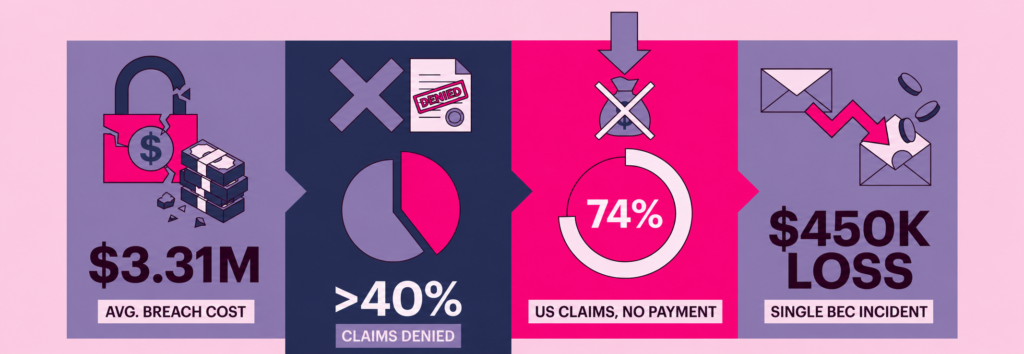
U.S. cyber insurance claims reached nearly 50,000 in 2024, a 40% jump year over year. But filing a claim and receiving payment are two very different things. Industry data shows that approximately 74% of cyber insurance claims filed in the United States in 2024 closed without any monetary payment — a figure that includes claims falling below the deductible or resolved through non-monetary assistance such as incident response, as well as outright denials. Of those, over 40% were formally denied, most commonly due to missing security controls or policy misrepresentations (NAIC 2025 Cybersecurity Insurance Report).
The most cited reason isn’t fraud or bad faith — it’s a mismatch between what businesses assumed their policy covered and what the policy language actually requires. Missing or incomplete Multi-Factor Authentication (MFA) deployment alone accounts for a disproportionate share of denials. Insurers increasingly treat security controls listed in the application as binding warranties: if the controls aren’t in place at the time of a breach, the entire claim can be voided — even if the missing control had nothing to do with how the attack succeeded.
Other common denial triggers include late breach notification (some policies require reporting within 72 hours), failure to apply known software patches before an incident, and misrepresentations on the insurance application — even unintentional ones. Together, these create a situation where a business owner pays premiums for years and then discovers, in the middle of a crisis, that coverage was never actually active in the way they expected.
The five risks below represent the deepest and most financially damaging gaps in standard policies — the ones most likely to result in a denied claim when a small business needs protection the most.
How well does your current cyber policy actually cover you?
Most small business owners discover the gaps only after a claim is denied. Use the quick checker below to see which of the five most common coverage exclusions may apply to your business — and which endorsements to ask your broker about before your next renewal.
🛡️ Cyber Insurance Coverage Gap Checker
5 questions · takes about 60 seconds · no email required
Does your business send wire transfers or ACH payments — even occasionally?
Business Email Compromise (BEC) tricks employees into authorizing wire transfers to fraudulent accounts. Standard policies can deny these claims under the “voluntary parting” exclusion, even when an employee was deceived.
Do you accept credit or debit card payments in your business?
Card brand fines after a breach flow through your Merchant Services Agreement — a private contract, not a government regulation. Most “regulatory coverage” clauses won’t cover these assessments.
Does your business rely on cloud software or third-party platforms to operate day-to-day?
Standard Business Interruption only covers networks you own. If a SaaS vendor, managed IT provider, or cloud platform goes down, your standard policy likely pays nothing — even if you’re completely unable to operate.
Does your business use any internet-connected equipment, smart systems, or automated machinery?
When a cyberattack causes physical damage, property policies cite their cyber exclusion and cyber policies cite their physical damage exclusion. Both deny the claim. This “silent cyber” gap affects any business running connected operational equipment.
Would a publicized data breach likely cause clients to reduce or cancel their business with you?
Standard cyber BI coverage stops the moment systems are restored — typically within days. The revenue loss from client attrition, stalled pipelines, and reduced renewals can extend 9–12 months and is entirely uninsured under standard policies.
Your Coverage Gap Assessment
This tool is for educational awareness only and does not constitute insurance or legal advice. Review your actual policy language with a licensed broker.
If any of the risks above apply to your business, the good news is that each one has a specific endorsement that closes the gap — but only if it’s negotiated before a claim is ever filed. Review your policy language now, not during a crisis, and bring the results of this checker to your next broker conversation.
Risk 1: You Wired the Money — So Insurance Won’t Cover It
The ‘Voluntary Parting’ Loophole Insurers Exploit
Business Email Compromise (BEC) is one of the most expensive cyber threats small businesses face — and real estate closings are a particularly frequent target. In 2024, BEC incidents drove $2.77 billion in total reported losses across 21,442 complaints, with an average loss of approximately $129,185 per incident (FBI IC3 2024 Annual Report). And yet, when businesses file claims after being tricked into wiring funds, their policies routinely deny them — legally.
The mechanism behind the denial is called the voluntary parting exclusion. Standard commercial crime policies contain this provision to bar coverage for any loss where the insured willingly surrendered property — even if they were deceived into doing so. In the eyes of the insurer, an employee who authorized and executed a wire transfer did so voluntarily. The fact that a scammer spent weeks impersonating an executive to make that transfer happen doesn’t change the legal outcome: your employee chose to send the money — the same voluntary-parting logic insurers now apply to Shopify merchants whose payout settings get silently redirected.
This exclusion sits in direct tension with what most business owners assume their “computer fraud” coverage does. Computer fraud clauses are written to require a direct causal link between the fraudulent use of a computer and the resulting loss. When a human employee acts as the link in the chain — reading a spoofed email and then manually executing a transfer — insurers argue that the loss was caused by human action, not a computer breach.
What Courts Have Actually Ruled on BEC Fraud
The case law on this issue is genuinely split, which is why it remains such a dangerous gap. Several significant rulings illustrate how differently courts interpret nearly identical policy language:
- Apache Corp. v. Great American Insurance Co. — Coverage denied. A vendor bank account change sent via fraudulent email was ruled “incidental” to the loss. The court held the email instructions didn’t directly cause the transfer; the employee did. (Note: this ruling turned on the “computer fraud” provision, not the voluntary parting exclusion — a separate but related gap.)
- Medidata Solutions Inc. v. Federal Insurance Co. — Coverage affirmed. Spoofing code that altered email headers was ruled to have compromised the computer system’s integrity directly, satisfying both the “entry of data” and “change to data elements” requirements in the computer fraud clause (2nd Cir. 2018).
- Principle Solutions Group v. Ironshore Indemnity — Coverage affirmed. A fraudulent email directing a transfer through an attorney was treated as a valid fraudulent instruction trigger.
- Midlothian Enterprises, Inc. v. Owners Insurance Company — Coverage denied. A $42,302 fraudulent transfer was barred entirely under the voluntary parting exclusion.
Modern insurers have studied these rulings closely. In response to cases like Medidata and Principle Solutions, carriers have tightened their policy definitions — specifically adding language that severs coverage if an employee authorization of any kind was part of the transaction chain. The result is that policies written today are often harder to claim against than those from even five years ago.
Real estate, title, and escrow firms feel this gap the hardest — see the specific $160K coverage gap in a typical title and escrow wire fraud claim.
The One Endorsement That Closes This Gap
The fix is specific: a Social Engineering Fraud (SEF) endorsement or Fraudulent Instruction endorsement that explicitly carves out and removes the voluntary parting exclusion for covered losses. This endorsement must be written to apply to instructions received via email, phone, or text — not just direct system intrusions.
There’s a second trap to watch for: callback provisions. Many SEF endorsements include a condition requiring the business to verify any change in payment instructions through a pre-approved secondary communication channel before making a transfer. If an employee failed to make or document that verification call, the insurer can deny the claim — even under the endorsement. The endorsement should either remove the callback condition or clearly define what constitutes adequate verification. Finally, if a business holds both a commercial crime policy and a standalone cyber policy, the SEF endorsement must be coordinated across both to prevent each carrier from pointing to the other when a claim is filed.
Risk 2: PCI-DSS Fines Aren’t Government Penalties
Why Your ‘Regulatory Coverage’ Won’t Pay Card Brand Assessments
Most small business owners who accept credit cards assume their cyber policy’s “Regulatory Fines and Penalties” section will cover them if a breach results in payment card penalties. This is one of the most expensive misunderstandings in small business insurance.
The PCI-DSS (Payment Card Industry Data Security Standard) is not a government regulation. It’s a private compliance framework created and enforced by the major card brands — Visa, Mastercard, American Express — through the PCI Security Standards Council. When a merchant suffers a breach that exposes cardholder data, the card brands don’t fine the merchant directly. Instead, they assess monetary penalties, card replacement fees, and forensic investigation costs against the merchant’s payment processor or acquiring bank. That bank then passes those costs directly to the merchant through the Merchant Services Agreement (MSA) — a private contract the merchant signed to accept card payments.
Because these costs flow through a private contract rather than a government order, standard cyber policies classify them as contractually assumed liabilities and deny the claim under standard contractual exclusions. The regulatory coverage module simply doesn’t apply.
To make it worse, insurers can also deny on a secondary basis: if the business was operating in non-compliance with PCI-DSS at the time of the breach — such as failing to run mandatory quarterly network scans — the policy’s conduct exclusions may kick in. And PCI-DSS itself only covers a fraction of what can go wrong — see 9 ecommerce security risks PCI DSS certification misses entirely for the threats sitting outside its scope.
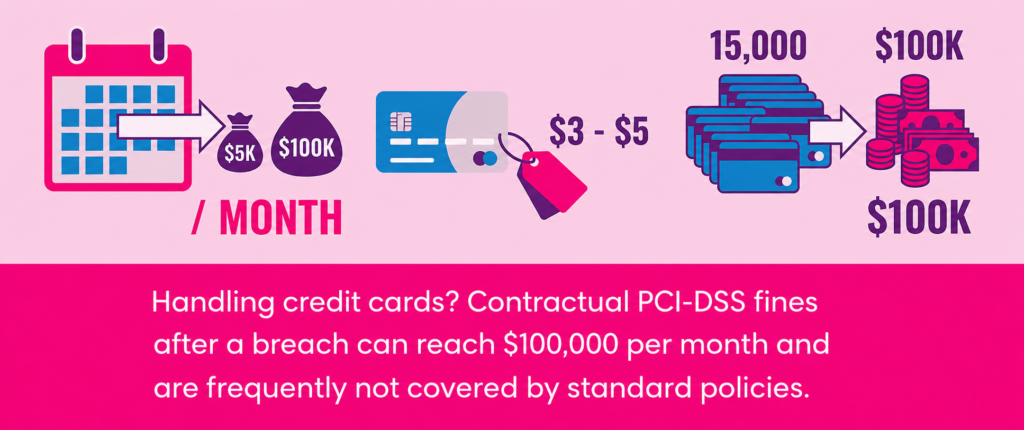
The assessments from card brands can include monthly non-compliance penalties, card re-issuance costs typically calculated at $3 to $5 per compromised card, and mandatory forensic investigation fees ranging from tens of thousands to over $100,000 for larger incidents.
The P.F. Chang’s Ruling That Cost $1.9 Million
The landmark case here is P.F. Chang’s China Bistro v. Federal Insurance Co. After suffering a payment card data breach, P.F. Chang’s sought reimbursement for approximately $1.9 million in card brand assessments billed through its payment processor. The court ruled in favor of the insurer, holding that the standard cyber policy’s third-party privacy coverage did not extend to contractual indemnification obligations assumed under a merchant agreement. The assessments were a private contractual liability — not a covered regulatory penalty.
The solution is a specific PCI-DSS Assessment Endorsement that explicitly covers contractually assumed liabilities under merchant agreements. For online retailers, our full breakdown of e-commerce cyber insurance in 2026 covers how payment page compliance intersects with coverage — and what to ask your broker before renewal. This endorsement must be broad enough to cover card brand fines, card re-issuance costs, and mandatory post-breach forensic fees — and it must be backed by the full policy limit rather than a low sub-limit. One additional negotiating point: ensure the policy’s conduct exclusions only trigger upon a final, non-appealable adjudication of willful negligence, so a preliminary PCI non-compliance finding can’t be used to deny the claim before any legal process concludes.
Risk 3: Your Vendor Goes Down, Your Claim Gets Denied
Standard BI Only Covers Networks You Own
Standard Business Interruption (BI) coverage in a cyber policy pays for lost net income and extra expenses when a business’s systems go down. The critical word is the business’s systems. Standard policy language restricts BI triggers to computer networks that are owned, leased, or directly operated by the insured organization.
Most small businesses today run on infrastructure they don’t own. Cloud-hosted accounting software, SaaS-based CRM platforms, third-party payment gateways, managed IT providers — these are the operational backbone for millions of small businesses. If any of these external providers go offline, the business stops functioning. Revenue halts. Employees sit idle. Customers can’t be served. And the standard cyber policy pays nothing, because the insured’s own systems never experienced an outage.
A regional medical billing firm running on a cloud-based practice management platform illustrates this precisely. When a ransomware attack took that cloud platform offline, the billing firm’s local workstations remained completely secure. But employees couldn’t access patient records or process insurance claims — halting all revenue generation for 10 days. The resulting $175,000 in combined lost revenue and extra expenses was denied by the cyber insurer, because the firm’s own “computer system” had never gone down.
Security Failure vs. System Failure: A Costly Distinction
Even when a policy includes some vendor outage coverage, insurers draw a sharp line between two types of disruptions:
- Security Failure — a system shutdown caused by a cyberattack, malware, or unauthorized access.
- System Failure — an unplanned, non-malicious outage caused by human error, a bad software patch, or misconfigured infrastructure.
Standard Contingent Business Interruption (CBI) forms often exclude System Failure entirely, or cap it at a severely reduced sub-limit. Increasingly, insurers want proof, not promises — including documented penetration test results — before this kind of coverage triggers at all.This means that if a critical SaaS vendor goes offline because of a botched update — not a hack — the claim can still be denied. In an environment where cloud provider outages are frequently caused by internal engineering errors rather than external attacks, this distinction leaves a massive practical gap.
What Dependent Business Interruption Coverage Actually Requires
Dependent Business Interruption (CBI) coverage is the endorsement that fixes this. It triggers when an Outsourced Service Provider suffers an outage that directly impacts the insured’s ability to conduct business. But even this coverage comes with structures that need to be negotiated carefully.
The waiting period functions as a time-based deductible — typically 8 to 24 hours — during which all losses are absorbed by the business with no reimbursement. Under a standard time-based retention model, coverage only begins after the waiting period expires, and losses during that initial window are never recovered. Under a retroactive retention model, once the outage exceeds the threshold, coverage triggers back to the first hour of the incident. The retroactive structure is significantly more favorable for the insured.
Key negotiating points for a CBI endorsement include:
- Coverage for both Security Failure and System Failure at outsourced providers.
- Reduction of the waiting period to 4-6 hours where possible.
- Transition from time-based to retroactive retention.
- A blanket vendor definition rather than a scheduled supplier list — because a policy that requires manually listing every SaaS tool will always have gaps as tools change.
Risk 4: Cyber Attacks Cause Physical Damage Neither Policy Covers
How ‘Silent Cyber’ Exclusions Left Two Policies Pointing at Each Other
As small businesses add internet-connected equipment, smart building systems, and automated machinery to their operations, a structural flaw in the insurance market becomes increasingly dangerous: the gap between cyber policies and property policies when a digital attack causes physical damage.
Traditional commercial property and general liability (CGL) policies were written in a world where physical damage came from physical causes — fires, floods, equipment failures. When cyber incidents started causing physical losses, insurers responded by inserting absolute cyber exclusions into property and CGL policies. The logic was that cyber losses belonged to cyber policies. Simultaneously, standard cyber policies contain broad exclusions for any claims arising from bodily injury or property damage, on the assumption that property and CGL policies would respond to those losses.
The result is what the industry calls the “silent cyber” problem: when a hacker causes a physical loss, the property carrier points to its cyber exclusion, and the cyber carrier points to its physical damage exclusion. Both deny the claim, and the business is left holding the full loss.
Standardized exclusion clauses formalize this gap. The Institute Cyber Attack Exclusion Clause CL 380 bars any loss caused by the malicious use of a computer or system across marine, property, and energy lines. The NMA 2914 Electronic Data Exclusion removes electronic data from the definition of tangible property in commercial property policies. The LMA 5400 Property Endorsement explicitly excludes cyber-induced physical losses unless affirmatively scheduled. On the liability side, standard ISO CGL policies often include endorsements that exclude bodily injury, property damage, and personal injury arising from data access or disclosure, reflecting the industry’s broader move to address silent cyber risks.
IoT, OT, and the Bricking Problem Small Businesses Miss
The physical stakes become real quickly for businesses running connected operational equipment. Consider a craft brewery using an automated, internet-connected system to manage fermentation temperatures, valve configurations, and pressure levels. If a threat actor gains access through a compromised mobile device and deploys code that overrides automated safety limits on pressurized brewing kettles, the resulting pressure failure could destroy manufacturing equipment, ruin inventory, and injure employees — all from a single network intrusion. Under the current exclusion structure, the property carrier denies on cyber grounds, and the cyber carrier denies on physical damage grounds.
A related risk that frequently goes unaddressed is bricking — a cyber incident that renders physical hardware completely non-functional by corrupting its software or firmware. The hardware may suffer no visible physical damage, but it cannot be restored without full replacement. Standard policies on both sides typically exclude bricking: property policies treat it as a software problem, while cyber policies treat it as physical property damage.
Addressing this gap requires a multi-step approach:
- Negotiate with the cyber carrier to replace the broad exclusionary phrase “arising out of, based upon, or attributable to” bodily injury and property damage with the narrower word “for.” This ensures the cyber policy still responds to legal claims resulting from the breach — such as lawsuits alleging privacy violations or emotional distress — even if it won’t rebuild the physical asset.
- Secure an affirmative Cyber-Physical endorsement or a specialized Cyber CAT policy that provides explicit coverage for physical property damage and bodily injury triggered by a network security event.
- Add an explicit bricking coverage endorsement that pays for hardware replacement when software, firmware, or system configurations are destroyed or corrupted by a cyber incident.
Risk 5: Insurance Stops When Systems Restart — Not When Customers Leave
Why the 90-Day Indemnity Cap Misses Most Reputational Losses
There’s a widespread belief among small business owners that the biggest financial hit from a cyberattack happens during the immediate outage — the days when systems are down and operations are frozen. The data tells a different story.
Standard cyber Business Interruption coverage pays for losses during the period of restoration — the time required to technically rebuild and restore systems. The moment the network comes back online, BI payments stop. What follows can be far more damaging: clients who quietly decide not to renew, referrals that never come in, sales pipelines that stall because prospects did their research and found a press release about the breach.
A boutique financial and tax advisory firm that suffers a breach exposing client Social Security numbers and bank routing details illustrates this precisely. Systems were fully restored in five business days. The BI claim paid $12,000 for that window. Over the following nine months, multiple high-value clients terminated contracts, partner recruitment slowed, and the firm’s quarterly sales pipeline shrank measurably. The resulting 30% drop in gross revenue — approximately $350,000 — was entirely uninsured. Nothing in the standard policy covered losses that began after the systems came back online.
Standard policies offer crisis management and public relations expense coverage, but these are designed for the immediate media cycle — not the year-long erosion of trust and revenue that follows a publicized breach. And even when policies include an Extended Period of Indemnity for reputational harm, carriers restrict it aggressively:
- A strict period of indemnity cap, typically limited to 90 days after system restoration.
- Severe sub-limits — often $100,000 to $250,000 — that are separate from and lower than the main policy limit.
- Narrow definitions of brand damage that require documented, direct customer attrition and exclude pipeline stagnation, slower sales cycles, or reduced contract renewal rates.
The Coverage Extensions Worth Negotiating
Addressing this risk means moving beyond crisis management line items and negotiating coverage that tracks business performance, not just system uptime. The key extensions to pursue are:
- Extended Period of Indemnity — Push the indemnity window from the standard 90 days to a minimum of 180 to 365 days. This is long enough to capture contract non-renewals that occur in the next annual business cycle, which is typically where the reputational losses actually show up.
- Contract Loss Extension — This endorsement explicitly covers the defined financial value of specific, identifiable client contracts that are terminated or non-renewed as a direct result of a publicized breach. It requires documentation of the contracts at risk and a defined methodology for calculating their value, but it converts the hardest-to-quantify reputational loss into a provable, covered claim.
- Brand Rehabilitation Coverage — Covers ongoing marketing, customer communication, and brand recovery expenses incurred after the technical period of restoration ends — not just the emergency PR retainer during the first week of a breach.
The sub-limit issue is just as important as the duration. A 365-day indemnity period means nothing if the sub-limit is $100,000 and the business loses $350,000. Negotiating this endorsement backed by the full policy limit — or at least a sub-limit that reflects the realistic annual revenue at risk — is the difference between coverage that actually works and coverage that looks good on paper.
Read Your Policy Now — Before a Claim Forces You To
Every one of these five risks follows the same pattern: a business owner buys a cyber policy, assumes the obvious scenarios are covered, and then discovers during the worst moment of their business life that the policy language tells a completely different story. The voluntary parting exclusion. The contractual liability carve-out for PCI assessments. The “owned networks only” restriction on business interruption. The dueling exclusions that leave physical damage from a cyberattack in no-man’s-land. The 90-day indemnity cap that stops paying before reputational losses even begin.
None of these denials are accidental. They reflect deliberate policy language that has been refined through years of court battles and claims disputes. Understanding them before a breach — not during — is what determines whether a cyber policy actually pays.
The five specific endorsements to request are summarized in the table above.
Reviewing policy language isn’t a one-time task either. Policies renew, markets shift, and the coverage that existed last year may carry different exclusions this year — especially as cyber insurers continue refining their forms in response to rising claim volumes. The best time to audit a cyber policy is before renewal, with specific questions about each of the exclusions above — if you’d rather talk those questions through with someone first, contact us. Pairing a well-structured policy with strong security controls is equally important — see how the true cost of managed security vs in-house IT compares for small businesses.
For small business owners who want a clearer picture of where a policy could leave them exposed, start with a free cyber insurance readiness check, a plain-English look at how your business measures up against the controls insurers commonly ask about, and which gaps could slow your application or put a claim at risk. It takes about three minutes, with no jargon and no IT background required.