


Key Takeaways
- The average data breach costs small businesses $3.31 million — enough to permanently close most operations.
- Hiring even one in-house cybersecurity professional costs 40-60% more than the base salary alone, once benefits, taxes, and training are factored in.
- True 24/7 security coverage requires a minimum of eight to twelve dedicated analysts — a personnel commitment that can exceed $1 million to $2 million annually before software costs.
- For a 50-employee business over three years, a fully outsourced MSSP totals roughly $187,000, compared to over $2.2 million for an equivalent in-house SOC.
- Understanding the hidden costs on both sides — compliance fines, insurance premiums, and breach response fees — is what separates a smart security budget from a financial liability. Keep reading for the full breakdown.
Most small business owners think about cybersecurity the same way they think about insurance — something they need but don’t want to spend too much on. The instinct is to hire one trusted IT person, buy a few tools, and call it done. It sounds reasonable. On paper, it even looks affordable.
The problem is that “on paper” and “in practice” are two very different things when running real security operations. The true cost of in-house IT security is packed with hidden costs that rarely make it into the initial budget conversation — and the gap between what businesses think they’re spending versus what they’re actually exposed to financially can be the difference between surviving a cyberattack and shutting down.
This guide breaks down the full picture of the true cost of managed security vs in-house IT: what in-house security actually costs, what managed security services (MSSPs) actually charge, and how the numbers stack up over a realistic three-year horizon for a 50-employee business. For businesses too small for either option, a $7-per-user-month stack that covers the basics is a practical middle ground worth understanding first.
A Single Breach Averages $3.31M — More Than Most Small Businesses Can Survive
According to the IBM Cost of a Data Breach Report, the average cost of a data breach for organisations with fewer than 500 employees reached $3.31 million — a key benchmark for small business risk. That number includes forensic investigation, legal fees, regulatory fines, customer notification, reputational damage, and lost revenue — and it’s not a worst-case figure. It’s the average.
The immediate forensic recovery costs alone average $120,000, but the financial tail is long. More than half of breach costs occur in the first year, with significant financial exposure continuing into year two and beyond (IBM Cost of a Data Breach Report). Businesses that survive the initial hit often find themselves quietly bleeding for years afterward.
Operational downtime is the biggest single cost driver during an attack, running at roughly $53,000 per hour (VikingCloud, 2025). A cyberattack that causes even one full business day of downtime can generate over $400,000 in direct productivity and revenue losses before a single legal or remediation fee is counted. For businesses operating on narrow margins, the math is brutal: 40% of small businesses report that an incident costing $100,000 or less would put them out of business (VikingCloud, 2025), and 19% directly face bankruptcy following a major attack (Verizon DBIR 2025).
Ransomware concentrates this risk heavily on smaller companies. While ransomware is present in 39% of enterprise breaches, it appears in 88% of small business breaches — a 2.3x higher exposure rate (Verizon DBIR 2025). The average ransomware recovery cost for a company with 100 to 250 employees is $638,536, not including any ransom paid (Sophos State of Ransomware 2025). The median ransom payment itself sits at $115,000. These aren’t abstract statistics. For a business without enterprise-grade defenses or a dedicated incident response capability, they represent a very real, very likely financial scenario.
The Hidden Price Tag of One In-House Hire
The in-house IT security conversation usually starts with a salary number — a mid-level analyst, a firewall, some antivirus software. Done. But that framing misses more than half the actual cost.
Beyond the Salary: Benefits, Taxes, and Recruitment Add 25-40% Before Day One
The fully loaded cost of an in-house cybersecurity hire runs 40-60% above base salary — factoring in payroll taxes, benefits, retirement contributions, office space, hardware, and recruitment fees that typically reach 15-25% of first-year salary.
At 2026 market rates, here’s what that looks like across common roles:
- Tier 1 SOC Analyst (Entry-Level): $50,000-$80,000 base → $75,000-$120,000 fully loaded
- Tier 2 SOC Analyst (Mid-Level): $65,000-$105,000 base → $97,500-$157,500 fully loaded
- Tier 3 Analyst / Incident Responder (Senior): $85,000-$130,000 base → $127,500-$195,000 fully loaded
- Cybersecurity Engineer: $118,500-$190,750 base → $177,750-$286,125 fully loaded
- CISO: $220,000-$420,000+ base → $330,000-$630,000+ fully loaded
The national average cybersecurity salary has reached $135,969, growing at 8-11% annually — well above inflation. For small businesses competing against enterprise recruiting budgets, this is a structurally disadvantaged position from the start.
Cybersecurity staff require continuous education as the threat landscape evolves — typically $5,000-$15,000 per analyst annually. Certifications compound the cost: CompTIA Security+ renewal adds an 11% salary premium; CISSP holders command 22% more. For a two-to-three analyst team, training alone runs $15,000-$45,000 before a single tool is purchased.
Why True 24/7 Coverage Requires More Staff Than You Think
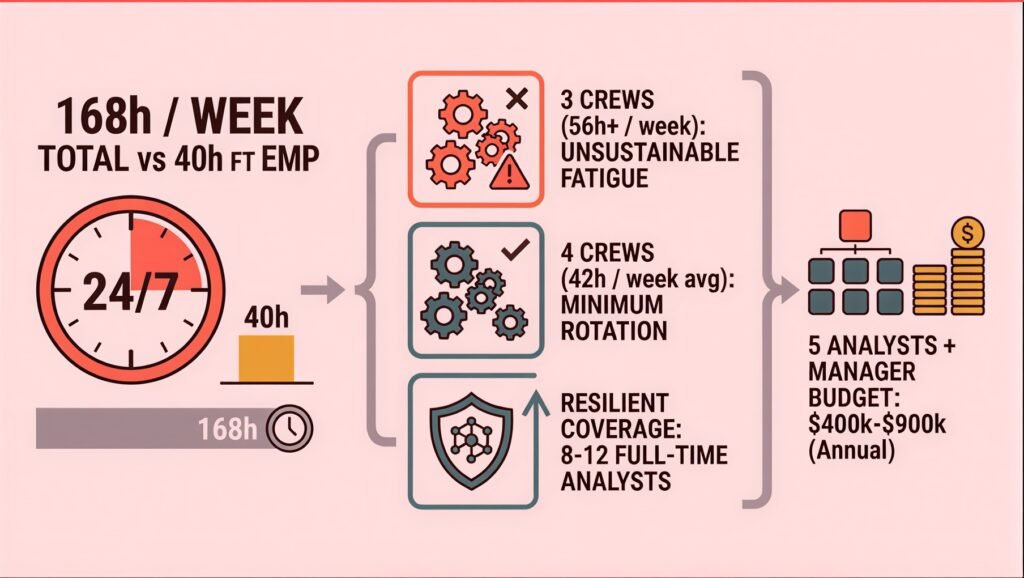
One of the most common misconceptions in small business security planning is the idea that one or two people can “cover” cybersecurity for the organisation. They can cover business hours. They cannot cover a business.
Running continuous coverage requires a minimum of four dedicated analysts on structured 12-hour rotations — the unavoidable math of 168 hours in a week against a 40-hour working standard. A three-crew model forces 56-61 hour weeks, producing fatigue, slow detection, and unsustainable turnover. Even a four-crew setup carries zero margin for leave, training, or attrition; industry benchmarks put a genuinely resilient internal SOC at eight to twelve analysts. At 2026 rates, that staffing alone runs $1M-$2M annually — before a single security tool is licensed.
Cyberattacks are not random — sophisticated threat actors deliberately strike during nights, weekends, and holidays to maximise the window before anyone notices. A Monday-to-Friday IT team leaves 128 of every 168 weekly hours unmonitored: enough time for attackers to move laterally, exfiltrate data, and disable backup defences before a single alert is raised. IBM’s 2024 Cost of a Data Breach Report puts the average breach lifecycle at 258 days — 194 to identify, 64 to contain. For a detailed breakdown of how in-house SOC costs compare to managed security at enterprise scale, this analysis from Visiontech reinforces the same core finding. With only 40-hour-per-week coverage, a business may not detect a breach at all until the damage is irreversible.
Security Tool Licensing: A Complex, Escalating Cost for Any SMB
Security people are only part of the equation. The tools they use to monitor, detect, and respond to threats carry their own significant costs — and for small businesses going the in-house route, those costs are paid in full rather than shared across a client base.
EDR and SIEM Alone Can Run Into Tens of Thousands Annually for a 50-User Business
A functional internal security stack requires separate licensing for Endpoint Detection and Response (EDR), Security Information and Event Management (SIEM), vulnerability management scanners, firewalls, and backup infrastructure. Here’s what standalone licensing looks like for a 50-user organisation in 2026:
- Microsoft Defender for Business: $3.00/user/month → ~$1,800/year
- SentinelOne Singularity Core: $5.00-$7.00/endpoint/month → $3,000-$4,200/year
- CrowdStrike Falcon Enterprise: $184.99/device/year → ~$9,250/year
- Sophos Intercept X Advanced: Starting at approximately $28/user/year → ~$1,400/year for 50 users
- Microsoft Sentinel (SIEM): $5.20/GB ingested → ~$18,720/year at 10 GB/day
- Splunk Enterprise Security: Pricing scales significantly with data volume; for small businesses ingesting 1-10 GB/day, costs typically range from $1,800 to $18,000/year at base ingestion rates, with the Enterprise Security add-on increasing that by 30-60%
- Vulnerability & Backup Tools: $50-$200/month → $600-$2,400/year
Even choosing the more affordable end of the spectrum, a 50-user organisation running standalone EDR and SIEM is looking at $20,000-$30,000 per year in pure licensing costs before touching the enterprise-tier platforms.
Setup, Configuration, and Integration Compound the Software Spend
When a small business chooses to manage its own security stack, it also has to act as its own systems integrator. That means paying for professional services to handle initial platform deployment, firewall rule tuning, parser configuration, and custom API connections between endpoint agents and cloud environments.
These integration and setup costs typically run 30% to 50% of the annual software licensing total. For a 50-employee firm, a self-managed security stack can escalate from a baseline of $15,000 to over $100,000 annually in combined software and integration costs — and that’s before accounting for the labour hours required to actually operate it day-to-day.
What MSSPs Actually Cost — and What to Watch For
Managed Security Service Providers operate on a shared-cost model, spreading the infrastructure and staffing expenses of a 24/7 SOC across a broad client base. This is why their pricing looks dramatically lower than the equivalent in-house build — they’re not discounting services, they’re sharing fixed costs.
Predictable Pricing: $50-$200+ Per User/Month via Shared Infrastructure
MSSP pricing in 2026 generally follows several models:
- Per-User Pricing: $50-$200+/user/month for standard business; $200-$400+/user/month for regulated industries
- Per-Device Pricing: Workstations at $50-$100/month; servers at $200-$500/month; network devices at $25-$75/month
- Tiered Bundles: Bronze ($80-$120/user), Silver ($140-$200/user), Gold ($220-$350/user)
- Flat Monthly Retainer: $1,500-$15,000/month scaled by company size and complexity
- Co-Managed Security: $40-$120/user/month, retaining an internal IT generalist for daily operations
For a 50-user business using a mid-tier per-user plan at $100/month, the annual subscription cost runs $60,000 — with all licensing, monitoring infrastructure, and SOC staffing included. Compare that to the $100,000+ a business would spend on software alone in the in-house model.
4 Contract Clauses That Can Blow Your Budget
The subscription price is the starting point, not the full story. Before signing any MSSP agreement, these four contract areas deserve close scrutiny:
- Onboarding and Configuration Fees: Initial setup — asset discovery, endpoint deployment, firewall configuration, API integration — typically runs $2,000 to $10,000+ and is rarely waived without a multi-year commitment.
- Vague Scope of Work: Contracts that list services as “security management” or “network monitoring” without defined limits can result in routine tasks (like configuring a new VPN or onboarding cloud resources) being billed as out-of-scope work at $150-$200/hour.
- Incident Response Overage Billing: Standard agreements include alert monitoring and triage but cap the hours for active containment and forensic investigation. Beyond that cap, overage rates run $250-$500/hour — and a serious incident can rack up hours fast.
- Early Termination Penalties: Many MSSP contracts run on multi-year terms, commonly 36 months. Exiting early can trigger significant financial penalties — industry contract benchmarks suggest figures in the range of 25% to 50% of the remaining contract value are not uncommon. Auto-renewal clauses with 60-90 day notification windows can also trap businesses in another multi-year cycle if deadlines are missed.
One additional risk worth flagging: if a contract doesn’t explicitly state that the client owns the custom security rules and automation logic built in their environment, the MSSP can remove those configurations entirely upon contract termination. Always ensure the statement of work includes clear intellectual property ownership language. If you’d rather have a second pair of eyes on a contract before you sign, get in touch and we’ll talk it through with you.
Compliance Fines Widen the Gap Further
The cost scenarios above don’t include regulatory fines — which can add hundreds of thousands of dollars to the true cost of operating without adequate security controls.
HIPAA Penalties Range From Tens of Thousands to Over $2M Per Violation
The HHS Office for Civil Rights actively enforces HIPAA against practices of all sizes. In 2024, solo practitioners and small clinics received fines ranging from $30,000 to $250,000 for violations including missing risk assessments, inadequate security controls, and failure to provide patient access to records. The single-tier civil monetary penalty cap reaches $2,134,831 per violation category annually. These aren’t penalties reserved for large hospital systems — they are regularly assessed against small medical practices, dental offices, and health-adjacent businesses that experience a breach and fail to demonstrate adequate safeguards.
See the 9 cyber risks HIPAA compliance alone won’t catch for the specific gaps that trigger these fines in the first place.
GDPR and CMMC Add Costly Assessment and Ongoing Compliance Burdens
For businesses handling data from European Union residents, GDPR enforces a tiered penalty structure. Tier 1 violations — such as failing to report a breach within 72 hours — carry maximum penalties of €10 million or 2% of global annual turnover, whichever is higher. Tier 2 violations involving breaches of fundamental rights cap at €20 million or 4% of global turnover.
Defense contractors in the federal supply chain face the Cybersecurity Maturity Model Certification (CMMC 2.0). Achieving CMMC Level 2 compliance — which requires meeting 110 NIST SP 800-171 security requirements — costs small businesses $100,000 to $200,000 or more for a formal third-party C3PAO assessment and associated preparation, per DoD estimates, plus $50,000 to $100,000 in ongoing compliance documentation and operational costs. A mature MSSP with built-in compliance reporting significantly reduces both the assessment burden and the exposure to these fines — not by cutting corners, but by maintaining continuous audit-ready documentation.
For a broader look at what a full compliance audit costs across frameworks, see our 2026 small business security audit cost breakdown.
Detection Speed Is Where MSSPs Save Nearly $2M Per Breach
Beyond the headline cost comparisons, the single most financially significant difference between in-house and managed security is how fast a threat gets found and stopped.
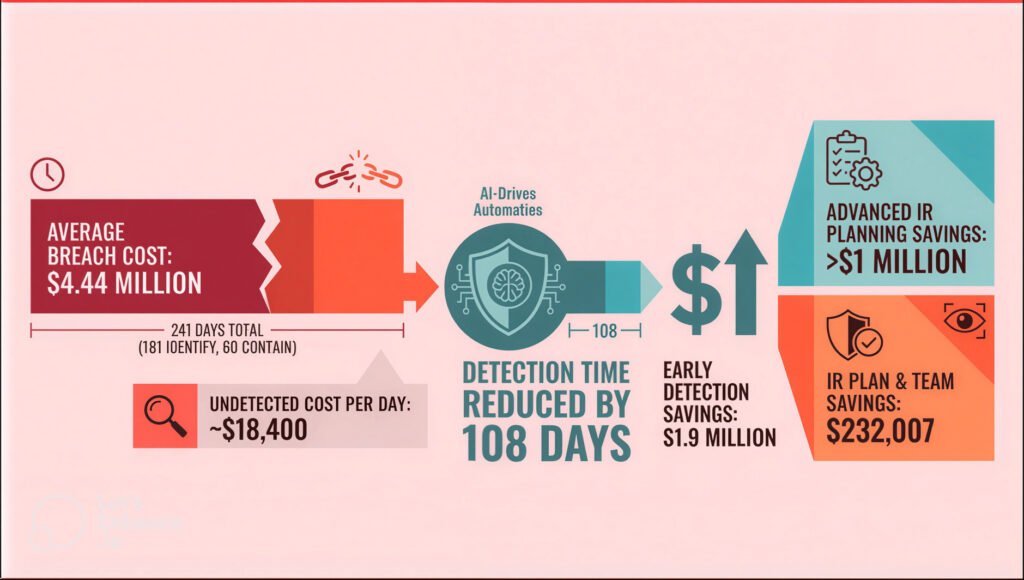
The Dwell Time Gap: Weeks of Undetected Access vs. Under 24 Hours
According to IBM’s 2024 Cost of a Data Breach Report, the average breach lifecycle runs 258 days — 194 days to identify and 64 days to contain. For breaches involving stolen credentials, the timeline stretches even further. At a global average breach cost of $4.88 million, every single day of undetected attacker access costs approximately $18,900.
An in-house team without 24/7 coverage has a mean time to detect (MTTD) aligned with the industry average of 194+ days and a mean time to contain (MTTC) of 64 days. IBM’s 2024 research found that organisations using security AI and automation extensively — the model underlying the most advanced MSSPs — detected and contained incidents an average of 98 days faster, delivering average savings of $2.2 million per breach compared to organisations without those capabilities. MSSP-managed environments typically achieve MTTD of under 24 hours and MTTC of under 4 hours.
That’s not a marginal improvement. It’s the difference between a contained incident and a catastrophic one.
24/7 MSSP Coverage Also Cuts Cyber Insurance Premiums by 10-30%
Having a documented incident response plan and an active monitoring team reduces the direct cost of a breach by a meaningful margin, according to IBM research. The financial benefit extends further: cyber insurance carriers actively reward 24/7 MSSP partnerships. Organisations with documented MSSP coverage, privileged access management (PAM), and multi-factor authentication (MFA) in place regularly receive 10% to 30% premium reductions on corporate renewals — including on e-commerce cyber insurance coverage, where underwriters are increasingly tying claim eligibility to documented security controls.
For a business paying $15,000-$30,000 annually in cyber insurance premiums, a 20% reduction saves $3,000-$6,000 per year — a meaningful offset that compounds over the life of an MSSP contract. This isn’t a hypothetical benefit. It’s a direct underwriting preference that reflects how much insurers value active, continuous monitoring over reactive security postures. It’s also worth reading alongside the cyber insurance policy exclusions that most often deny these claims in the first place — premium discounts don’t help if the claim gets denied outright.
For Small Businesses, Outsourcing Security Delivers 60-80% Lower Total Cost — With Better Protection
The numbers tell a consistent story. For businesses under 25 employees, outsourcing to an MSSP is often the only financially viable path — delivering 60-80% total cost of ownership advantage over building an internal team, with broader skill coverage and continuous monitoring no single hire can replicate.
For the 25-100 employee range, the co-managed hybrid is the strongest balance: an internal IT generalist handling daily operations, paired with an MSSP providing 24/7 SOC, compliance engineering, and advanced threat response. If you’re still deciding between a consolidated security platform and a stack of separate specialist tools before you even get to the staffing question, our cost guide comparing all-in-one platforms vs. separate security tools breaks down which one wins on total cost for your size.
In-housing everything only makes economic sense at 500+ employees, where security represents a direct competitive advantage and fixed team costs can be justified against revenue scale. For everyone else, the math reliably favours managed services — not because in-house security is inherently bad, but because doing it properly at small business scale simply costs more than most can sustain.
Use the calculator below to estimate your true security costs over three years. Adjust the sliders to match your business size and security setup, and see instantly how in-house IT compares to an outsourced Managed Security Service Provider (MSSP).
3-Year Security Cost Estimator
Adjust the inputs below to see how costs compare for your business.
* In-house estimate includes staff salaries, software licensing (~$25,000/yr for 50 users), and training costs (~$10,000/analyst/yr). MSSP estimate uses your per-user rate × employees × 36 months + $6,000 onboarding. Figures are illustrative; real costs vary by vendor, industry, and compliance requirements.
The three-year numbers make this concrete: a fully outsourced MSSP costs $187,000; an equivalent in-house SOC costs $2,221,090 — nearly twelve times more, with higher breach risk and slower detection. The co-managed hybrid at $546,756 delivers 24/7 coverage at a quarter of that cost.
Factor in a single average breach – $3.31 million – and the decision becomes impossible to argue against. Managed security isn’t a luxury. For most small businesses, it’s the only structure where surviving an attack remains a realistic outcome. For the specific triggers — beyond cost alone — that signal it’s time to bring in outside help, see When to Hire a Cybersecurity Consultant vs Going It Alone.. It’s also worth knowing that cyber insurers increasingly reward — or require — exactly this kind of coverage when they set your premium.
For owners navigating these decisions without an IT team, TechEd Shield‘s free cybersecurity health check for small businesses is the clearest first step — a plain-English snapshot of your most common risks in minutes, no IT background required.
NYC business owners weighing this decision can also compare vetted local providers in our 7 best cybersecurity firms in NYC for small businesses.
Not Sure Where Your Business Stands? Start Here
Before committing to an MSSP, hiring staff, or purchasing tools, the smartest first step is understanding your current exposure.
TechEd Shield’s Free Cyber Health Check gives small business owners a plain-English snapshot of their most common cyber risks — account protection gaps, password vulnerabilities, email fraud exposure, backup weaknesses, and incident response readiness — in minutes.
Get your Free Cyber Health Check →
A note on pricing: Prices correct at time of writing. Always check current pricing before purchasing.