

Key Takeaways
- Most small businesses spend between $20,000 and $80,000 on SOC 2 compliance in year one — and the software license typically represents a minority of that total cost, though the exact share varies by situation.
- SOC 2 Type II requires a minimum 3-month observation period that no software tool can shorten — but the right platform can dramatically reduce the weeks of prep and fieldwork around it.
- The seven tools reviewed here — Vanta, Drata, Sprinto, Secureframe, Thoropass, Scrut Automation, and Scytale — each serve a different type of small business depending on budget, timeline, and technical capacity.
- Year-two costs are where many small businesses get blindsided: renewal price increases and headcount-based overages are common across the major platforms.
- Choosing the wrong tool early can lock a business into a vendor that is difficult and expensive to leave — understanding the full picture before signing matters more than picking the biggest brand name.
SOC 2 compliance used to feel like something only enterprise companies worried about. That is no longer true. In 2026, enterprise buyers are routinely requiring SOC 2 reports from even the smallest SaaS vendors before signing contracts. If a small business sells software or handles customer data, SOC 2 has become a prerequisite — not a nice-to-have. The good news is that a new category of compliance automation tools has made this achievable without a dedicated IT team. That’s exactly what this roundup covers: 7 SOC 2 compliance tools small businesses are actually using in 2026, and which one fits a real budget and timeline versus which ones are built for companies ten times the size.
Most Small Businesses Spend $20,000-$80,000 on SOC 2 in Year One
The sticker shock is real. When small business owners first start researching SOC 2 compliance, the number that shows up most often is the software subscription price — somewhere between $7,500 and $15,000 per year for a single framework. That number is accurate, but it only tells a fraction of the story.
The true all-in cost of a platform-assisted SOC 2 Type II program for a 50-person SaaS company typically lands between $35,000 and $155,000 in the first year, with the median SMB spending around $75,000. That range might seem wide, but it reflects the many layers of cost that most guides do not mention upfront.
Understanding those layers — before choosing a tool — is what separates businesses that budget correctly from those that get surprised mid-audit. For the full cost range across all compliance frameworks — not just SOC 2 — see our 2026 small business security audit cost breakdown.
What You Are Actually Paying For
Base Software Is Only Part of the True Cost
Base compliance software is just the starting point. Here is what a realistic year-one budget actually includes:
- Platform licensing: $7,500-$15,000 for a single framework — but advanced features like automated User Access Reviews or Vendor Risk Management often require upgrading to higher tiers or paying for add-ons, which can significantly increase the total software spend.
- Onboarding and implementation fees: Most vendors charge a separate setup fee ranging from $2,000 to $10,000 — and up to $25,000 for more complex environments. These are frequently non-negotiable.
- External auditor fees: The compliance software does not perform the audit or issue the final report. For the full scoping and rollout process these tools fit into, see our SOC 2 compliance for small businesses with no IT team guide. A specialized CPA firm charges between $15,000 and $35,000 for a SOC 2 Type II audit, with national mid-tier firms exceeding $50,000.
- Annual penetration testing: Auditors and enterprise buyers frequently expect an independent third-party penetration test, which typically costs $4,500-$15,000.
- Internal labor: Even with strong automation, first-time implementations demand significant internal hours from engineering and operational leads — an implicit cost that can range from $10,000 to well above $25,000 in staff time depending on complexity.
The software subscription is the entry ticket. Everything else is the actual event. That “annual penetration testing” line item above isn’t optional padding — see our breakdown of when cyber insurers require a penetration test, not just a scan for why auditors and insurers are now asking for the same proof.
What Year-Two Costs Look Like Once Systems Stabilize
Year two brings its own financial surprises. Implementation fees disappear, but several structural cost shifts take their place.
The most common trap is the platform renewal price increase. Vendors often offer discounts in year one to win the contract. Once a business infrastructure, endpoints, policy acknowledgments, and audit history are embedded in the platform, switching becomes more expensive than renewing — in engineering hours alone. Vendors know this, and year-two quotes can arrive with meaningful base licensing increases that catch small businesses off guard.
Headcount growth adds another layer. Most platforms price subscriptions based on employee count or monitored endpoint bands. Scaling from 50 to 100 employees can push a business into a higher tier, triggering additional fees that were not in the original budget. Annual re-audits typically run at a similar cost to the initial audit, though often somewhat lower, and penetration testing remains a recurring $5,000-$15,000 annual expense. Altogether, the baseline year-two maintenance cost ranges from $15,000 to $40,000 in recurring hard costs — before any headcount-driven tier increases.
What Compliance Software Can (and Cannot) Do for Your Timeline
SOC 2 Type I vs. Type II: The Difference That Changes Your Plan
The AICPA defines two distinct types of SOC 2 reports, and confusing them is one of the most common planning mistakes small businesses make.
SOC 2 Type I evaluates whether security controls are designed correctly as of a specific date — a point-in-time snapshot. If configurations, integrations, and policies are properly mapped, an auditor can verify their existence relatively quickly. A Type I report can typically be issued within a few weeks after preparation is complete, though exact timing depends on auditor availability and the complexity of the environment.
SOC 2 Type II goes further. It evaluates both the design and the operating effectiveness of those controls over a continuous observation period — typically between 3 and 12 months. The auditor does not just check whether a control exists today; they test samples across the entire historical window to confirm it operated consistently without gaps or failures.
Many small businesses pursue Type I first to demonstrate control design to early enterprise buyers, then begin the Type II observation period in parallel. This is a legitimate strategy — but it requires understanding that Type II takes time by design, regardless of which software tool is being used.
Where Automation Actually Saves Time
No compliance software can shorten the mandatory observation window for a Type II report. If a control requires a monthly access review, an auditor reviewing a 6-month period needs to see evidence from six distinct calendar months. That is a fundamental auditing principle, not a software limitation.
What automation does compress is everything around the observation window:
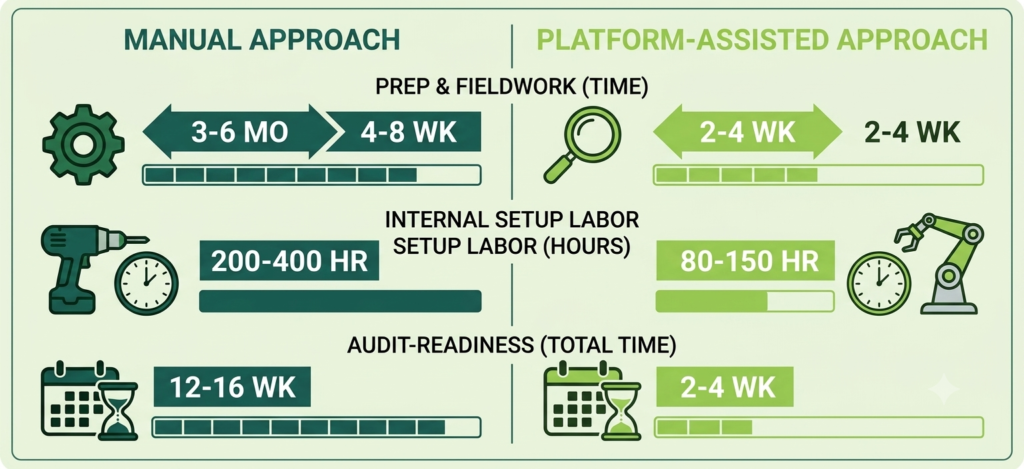
- Preparation phase: Manually mapping controls, drafting policies, and auditing cloud configurations can take several months without tooling. Platforms with read-only API connectors auto-discover environments and pre-populate framework-mapped policies, significantly reducing this phase for cloud-native teams.
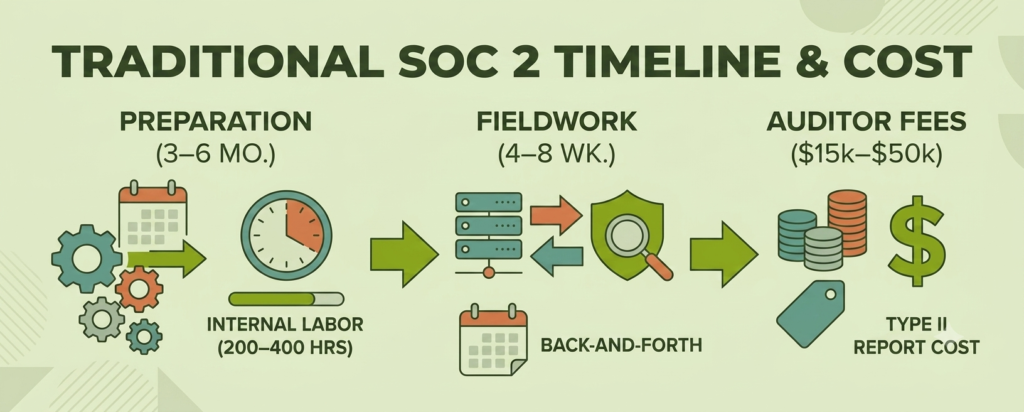
- Audit fieldwork: In a manual process, engineers can spend weeks in email chains compiling log exports and screenshots. With a compliance platform, auditors log directly into a dedicated portal and query evidence in real time — reducing active fieldwork substantially.
- Internal labor hours: Compliance automation platforms can meaningfully reduce internal preparation hours, though teams should still budget for 100 or more hours of internal staff time even with strong tooling in place.
A small SaaS startup that would realistically take many months to reach audit readiness manually can get there far faster with the right platform — without touching the Type II observation period at all.
The 7 Tools Small Businesses Are Using in 2026
1. Vanta — Best for Venture-Backed Startups Targeting Enterprise
Vanta is the default market leader in compliance automation for a reason. Over 16,000 organizations use the platform, and it has become the expected name in enterprise security reviews. Its core engineering value comes from continuous control monitoring: a large library of native API integrations that pull evidence from cloud providers, identity systems, developer infrastructure, and HR platforms without manual input.
In early 2026, Vanta deployed its AI Agent 2.0, which drafts custom security policies linked directly to live system configurations and auto-populates security questionnaire answers based on historical audit documentation.
The practical limitation is cost structure. Vanta starts at $10,000-$15,000 per year for a single framework — already steep for a bootstrapped team. Features like Trust Centers, Vendor Risk Management, and automated questionnaire responses are sold as separate add-on modules, each scaling with headcount. Year-two renewals have been reported to arrive with notable price increases once a business audit history is locked in. Vanta makes the most sense for Series A or Series B companies with internal compliance bandwidth targeting large enterprise buyers.
Auditor model: In-app marketplace plus full Bring-Your-Own-Auditor (BYOA) support. Auditors log directly into the platform to review evidence — no zip file exports needed.
2. Drata — Best for Multi-Framework Compliance at Scale
Drata is built for organizations that have outgrown a single framework and need to manage SOC 2, ISO 27001, HIPAA, GDPR, and others simultaneously. Its developer-focused control framework allows engineering teams to build custom, logic-based automated tests — making it genuinely useful for teams with non-standard infrastructure.
A significant 2025 development strengthened Drata’s commercial story: its $250 million acquisition of SafeBase added an enterprise-grade Trust Center that streams live compliance evidence to prospective buyers, replacing static PDF reports with real-time security posture data.
The friction is real, though. Drata is not built for fast, low-touch setup. Configuring its advanced monitoring systems and custom connections requires a dedicated internal compliance owner. An additional implementation fee of $10,000-$25,000 is charged on top of base licensing ($7,500-$15,000 per year), and premium support is strictly tiered by subscription level.
Auditor model: The Drata Audit Alliance includes a network of pre-vetted CPA firms globally, with a dedicated auditor portal for remote-first, flat-fee audits.
3. Sprinto — Fastest Path to Audit-Readiness
Sprinto is among the fastest options on this list for getting to audit-ready status. The platform is built specifically for bootstrapped startups and early-stage seed-to-Series-A teams that lack dedicated security staff. Its structured, guided workflows automate most of the manual prep work, and its published timelines of 2-4 weeks to audit readiness are backed by real implementation data.
Two capabilities stand out. First, Sprinto includes a built-in endpoint compliance agent that performs native checks across employee laptops — monitoring disk encryption, password complexity, screen locks, and firewalls. This can eliminate the need for separate device management software purchases. Second, its alerting and escalation engine routes Slack or Jira notifications directly to the responsible developer when a control begins sliding toward failure, providing remediation instructions before an audit exception is triggered.
The tradeoff is rigidity. Sprinto’s speed comes from highly pre-defined compliance workflows, and organizations with non-standard or on-premises infrastructure will hit friction quickly. Pricing for early-stage teams typically starts in the range of $6,000-$10,000 per year, though first-year promotional pricing is common and renewal costs can increase meaningfully once those discounts roll off.
Auditor model: Pre-vetted auditor network trained specifically on Sprinto’s evidence format, with a dedicated in-platform collaboration dashboard. BYOA is supported but not the preferred path.
4. Secureframe — Best for Teams That Want Hands-On Expert Support
Secureframe sits at an interesting intersection: compliance automation with a strong human support layer built in. Its standout engineering feature is Comply AI, a remediation engine that detects a failing infrastructure control in AWS, Google Cloud, or Azure and automatically generates the precise Infrastructure-as-Code or Terraform script needed to fix it. Engineering teams can copy, paste, and deploy the fix directly — no manual translation required.
What truly differentiates Secureframe for smaller teams is its in-house compliance advisory team: certified compliance experts and former auditors who perform a pre-review of all controls, policies, and evidence packages before formal audit fieldwork begins. This functions as a quality assurance gate that significantly improves first-time audit success rates.
The cost structure becomes complex as an organization grows. Base licensing starts around $7,500 per year, with each additional framework adding to that total. Users have also reported synchronization latency in the testing interface — a remediated control can take time to update from failed to passed in the dashboard, which creates confusion during active audit periods.
Auditor model: BYOA — but Secureframe’s internal compliance team manages the pre-audit review phase, reducing the risk of auditor surprises.
5. Thoropass — Best for Predictable, All-In-One Pricing
Thoropass is purpose-built for early-to-mid-stage companies (25-300 employees) that want to buy compliance software and licensed audit execution under a single contract. The core commercial appeal is cost predictability: one vendor, one price, no separate auditor search or coordination overhead.
The platform’s First Pass AI technology — launched in late 2024 — runs automated quality assurance checks on evidence and logs before they reach the auditor, with the goal of cutting manual QA time and reducing secondary auditor requests. The result is a compressed audit fieldwork timeline compared to traditional manual processes.
The most significant limitation is auditor lock-in. Because the platform and audit practice are architecturally tied together — the attestation is issued by a connected CPA firm under common ownership with Thoropass — organizations cannot bring their own auditor without leaving the platform entirely. The integration library is also smaller than some competitors, which increases manual evidence collection for non-standard tech stacks. Some enterprise security review teams have raised questions about auditor independence due to the common ownership structure.
Auditor model: Connected Audit model — software and attestation are bundled under one contract. No BYOA option.
6. Scrut Automation — Best for Cross-Border and APAC Compliance
Scrut Automation is built for organizations managing compliance across multiple regional regulatory standards simultaneously — particularly companies with operations in India, the APAC region, or Europe. Its unified control framework automatically maps a single technical evidence source across a wide range of regional standards, including RBI system audit reports, SEBI cybersecurity frameworks, GDPR, and ISO 27001. This eliminates redundant testing for cross-border financial and SaaS operations.
Continuous cloud security posture monitoring scans configurations against a broad set of industry benchmarks, and the Scrut Teammates AI co-pilot injects prioritized remediation tasks directly into the engineering team’s developer pipeline in real time.
The pricing reflects the platform’s sophistication: licensing starts at $15,000 per year for up to 20 employees on the AWS Marketplace — significantly higher than Sprinto or Secureframe entry points. Scrut also lacks a native multi-tenant workspace for vCISO or MSP partners, meaning consulting firms managing compliance programs for multiple clients cannot do so from a single console. For a US-only, early-stage startup with no international footprint, Scrut is likely over-engineered and over-priced.
Auditor model: BYOA, supported by a centralized Auditor Collaboration Dashboard where external auditors — including CERT-In accredited regional auditors — can review evidence directly without physical site visits.
7. Scytale — Best for First-Timers With No Compliance Background
Scytale is designed for teams that have no prior compliance experience and want a human expert guiding them through every step. Following its acquisition of AudITech, Scytale has integrated automated Sarbanes-Oxley (SOX) IT General Controls (ITGC) monitoring directly into the platform — making it one of the few tools that supports teams from seed-stage SOC 2 all the way through pre-IPO SOX readiness.
Its GRC AI agent Scy automates security questionnaire completion and continuously validates evidence quality. The platform’s defining characteristic is its managed compliance advisor model: Scytale’s embedded advisors actively manage the interface between the client and the external CPA firm, translating complex auditor evidence requests and shielding the internal engineering team from direct auditor communication during active audit cycles.
The integration library is modest, with sources citing figures ranging from approximately 100 to 150 integrations depending on the account tier, and the continuous monitoring engine operates on a daily scanning interval — meaning there is a latency window between automated scans. Adding comprehensive virtual compliance expert services can cost up to $36,000 per year on top of base licensing. For a first-timer, that advisor layer is often worth it — but it is a cost that needs to be budgeted intentionally.
Auditor model: Hybrid managed model — BYOA is supported, but Scytale advisors actively manage the client-auditor relationship throughout the audit cycle.
| Tool | Best For | Year-1 Platform License | Auditor Model |
|---|---|---|---|
| Vanta | Venture-backed startups targeting enterprise | $10,000-$15,000/yr | In-app marketplace + full BYOA |
| Drata | Multi-framework compliance at scale | $7,500-$15,000/yr + $10,000-$25,000 implementation | Drata Audit Alliance (pre-vetted CPA network) + BYOA |
| Sprinto | Fastest path to audit-readiness | $6,000-$10,000/yr | Pre-vetted auditor network; BYOA supported, not preferred |
| Secureframe | Hands-on expert support | From ~$7,500/yr (per framework) | BYOA + in-house pre-audit review team |
| Thoropass | Predictable, all-in-one pricing | Bundled with audit under one contract (no separate license figure given) | Connected Audit model; no BYOA option |
| Scrut Automation | Cross-border and APAC compliance | From $15,000/yr (up to 20 employees) | BYOA + Auditor Collaboration Dashboard |
| Scytale | First-timers with no compliance background | Base license + advisory add-ons up to $36,000/yr | Hybrid managed model; BYOA supported |
How These Tools Win Enterprise Deals Faster
Automated Trust Centers Replace Manual Security Reviews
A Trust Center is a branded, customer-facing digital interface that displays a company’s active security posture, live compliance certifications, data privacy policies, and system uptime — available on demand to any prospective buyer. In 2026, Trust Centers have become a standard expectation among enterprise procurement teams.
The commercial impact is concrete. Rather than routing sensitive documents through manual email chains — or waiting weeks for legal teams to execute NDAs — a Trust Center automates the entire due diligence workflow. Prospects can request access to the full SOC 2 Type II report or penetration test summary, and the platform handles NDA execution automatically, often integrating with Salesforce or CRM systems to auto-approve known contacts.
The more powerful shift is from static PDFs to live data. Traditional security reviews rely on documents that may be months out of date. Modern Trust Centers stream real-time control statuses directly from cloud integrations — allowing prospects to verify on-demand that MFA is 100% enforced or that database backups are actively passing integrity checks. That kind of live visibility removes the back-and-forth that traditionally stalls enterprise deals by weeks.
AI Questionnaire Tools Turn Weeks of Work Into Hours
Enterprise buyers who decline to accept a standard SOC 2 report often insist on custom, multi-column Excel questionnaires. Answering these manually — across hundreds of rows with precise technical language — has historically consumed weeks of engineering and legal time per deal.
Modern compliance platforms have addressed this directly. AI questionnaire engines built into tools like Vanta AI Agent 2.0, Drata’s AI Questionnaire, Secureframe’s Trust AI, and Scytale’s Scy use semantic matching against a company’s existing GRC datastore — pulling from live control evidence, historical audit documentation, and policy libraries to draft complete, accurate answers automatically.
The result is a shift from writing to editing. Rather than composing answers from scratch, security leads review and approve pre-populated responses. What used to take a dedicated team member two to three weeks can now be turned around in a matter of hours — directly accelerating sales cycles for deals that were previously stalled in the security review phase.
Side-by-Side: Cost, Setup Time, and Auditor Model
Here is a consolidated view of how the four most commonly compared strategies break down across the dimensions that matter most to small businesses:
Dimension Vanta Drata Sprinto Manual (No Tool) Platform License (Yr 1) $10,000-$15,000 $7,500-$15,000 $6,000-$10,000 $0 External Auditor Fee $15,000-$50,000 $15,000-$35,000 $15,000-$25,000 $15,000-$50,000 Internal Labor (Setup) 80-150 hrs 100-220 hrs 80-150 hrs 200-400 hrs Time to Audit-Readiness 6-8 weeks 8-12 weeks 2-4 weeks 12-16 weeks Year-2 Renewal Risk Reported price increases at renewal Opaque / Overage risk Price spike on discount rolloff N/A Auditor Model BYOA + Marketplace Audit Alliance + BYOA Preferred Network + BYOA BYOA only
The manual path looks attractive on paper because the software cost is zero. But with 200-400 internal hours required — and a 12-16 week runway just to get audit-ready — the true cost of going manual often exceeds platform-assisted alternatives once internal staff time is factored in.
The Right Tool Depends on Your Budget and Timeline — Not the Biggest Brand Name
Not sure which of these seven tools actually fits your business?
The right platform depends on where you are, not which brand has the biggest name. Answer two quick questions below — what you need most right now, and what you’re comfortable spending on the platform in year one — and we’ll point you to the tool that matches your situation, plus the trade-off worth knowing before you sign anything.
Find your SOC 2 tool in 15 seconds
However the quiz landed for you, remember the platform license is the entry ticket, not the invoice. Auditor fees, penetration testing, implementation costs, and internal labor hours make up the rest of the year-one total — regardless of which tool you pick. Budget for the whole structure, not just the software line item.
There is no universal answer here. The right compliance tool is the one that matches a business’s actual situation — not the one with the most name recognition or the flashiest feature list.
A useful way to think through the decision:
- Tight budget, early stage, cloud-native stack: Sprinto offers the fastest path at a lower entry price, with built-in endpoint compliance checks. Just budget for the pricing jump when promotional discounts roll off.
- Need hand-holding through the first audit: Scytale’s managed advisor model is worth the premium for teams that have never been through a compliance audit. Secureframe’s expert review team offers a similar support advantage with more auditor flexibility.
- Managing multiple frameworks or international standards: Drata or Scrut Automation — Scrut especially for APAC or cross-border regulatory requirements.
- Targeting large enterprise buyers and need sales acceleration tools: Vanta’s integration depth and brand recognition carry real weight in enterprise procurement cycles, especially for Series A and B companies.
- Want software and audit bundled in one contract: Thoropass is the cleanest option for cost predictability — just understand that auditor flexibility is off the table.
Whatever the choice, the biggest mistake is treating the software subscription as the full cost of compliance. The tool is the foundation. The auditor, the internal labor, the penetration test, the add-ons, and the year-two renewal — those are the rest of the structure. Getting a clear picture of all those costs before selecting a platform is the decision that protects both the budget and the timeline. If SOC 2 is the first framework your business has ever had to meet, that’s also usually the moment DIY security stops being enough — see When to Hire a Cybersecurity Consultant vs Going It Alone for the other three triggers that carry the same weight.
SOC 2 compliance is genuinely achievable for small businesses in 2026 — even without a dedicated IT team — but only when the full picture is understood before the contract is signed. Our free cybersecurity health check helps small business owners cut through technical complexity and make confident, informed decisions about protecting and certifying their business.
A note on pricing: Prices correct at time of writing. Always check current pricing before purchasing.