

Key Takeaways
- Small business security audits range from $1,500 to $75,000+ in 2026, depending on company size, industry, and the compliance framework required.
- The auditor’s invoice is rarely the biggest expense – post-audit remediation, security tools, and staff time often add up to a significant portion of the total first-year cost, frequently exceeding the initial audit fee itself.
- A proactive audit costing $5,000-$15,000 can protect a business from breach-related losses that average $120,000 to $1.24 million for small businesses.
- There’s an important difference between a gap assessment and a formal audit – and mixing them up is one of the most common and costly budgeting mistakes owners make.
- TechEd Shield helps small business owners understand and navigate cybersecurity decisions without needing a technical background.
If you’ve ever searched “how much does a security audit cost” and walked away more confused than before, you’re not alone. The truth is, small business security audit cost genuinely depends on your business size, what data you handle, and which industry rules apply to you. This breakdown cuts through the noise with real numbers for 2026, so you can budget with confidence rather than guesswork.
Most Small Businesses Are Budgeting Wrong
The most common mistake small business owners make is treating a security audit like a one-time purchase with a fixed price tag. The auditor’s fee is just the starting point. Preparation costs, tool upgrades, staff time, and post-audit fixes often represent the majority of the true first-year cost of getting – and staying – compliant.
The other big mistake? Assuming that a small business isn’t a target. In 2026, between 43% and 49% of all small businesses were targeted by cyberattacks. The widely cited claim that 60% of breached small businesses close within six months has since been debunked, but the financial damage from a breach remains severe and, for many smaller operations, potentially fatal. A security audit is a financial risk management decision, not an IT luxury. For a look at exactly what auditors check — access control, network security, and the other five areas — see our breakdown of the 7 critical areas a small business security audit covers.
Three Tiers, Three Very Different Price Tags
Audit pricing in 2026 breaks into three tiers based on company size and complexity. Here’s what each one looks like in practice.
Tier 1: Micro-Businesses (Under 25 Users) – $1,500 to $6,000
Micro-businesses running on tools like Microsoft 365 or Google Workspace, with little to no on-premises hardware, fall into the lowest-cost tier. A baseline audit focuses on core security hygiene: password policies, multi-factor authentication (MFA) on admin accounts, endpoint antivirus, and backup practices.
Expect automated external vulnerability scans, a questionnaire-based control review, and a prioritized remediation report. For UK businesses pursuing the Cyber Essentials certification, registration alone costs £300-£500, with total first-year consulting bringing the bill to roughly £1,500-£3,500. The main cost inflators at this tier are undocumented systems and unmanaged personal devices used for work.
Tier 2: Growing SMBs (25-100 Users) – $8,000 to $25,000
This tier involves more moving parts: hybrid workforces, legacy servers, multiple cloud platforms, and centralized identity management. Auditors at this level go deeper – conducting credentialed internal vulnerability scans, reviewing Active Directory and cloud identity configurations for excessive permissions or orphaned accounts, and performing focused external penetration testing (typically 3-7 days).
Firewall rules, network segmentation, VPN configurations, and backup restore integrity are all examined. Highly integrated or multi-site environments can push costs higher, potentially toward $35,000, reflecting the increased complexity involved. The number of distinct cloud integrations and active endpoints directly drives the auditor’s time commitment.
Tier 3: Regulated or Compliance-Required – $15,000 to $75,000+
Businesses handling sensitive health, financial, or government data – or those serving as vendors to large enterprises – face the most rigorous audits. These are formal, framework-aligned engagements that produce signed third-party certification reports.
Base costs run $15,000-$75,000, but when you factor in compliance automation software, third-party attestations, and remediation, first-year program costs can easily hit $45,000-$200,000+. The auditing firm you choose matters enormously: a boutique firm might charge $15,000-$35,000 for a SOC 2 Type II audit, while a Big Four accounting firm auditing the same scope charges $80,000-$150,000+.
| Tier | Business Size | Audit Cost Range | What’s Typically Included | Main Cost Inflators |
|---|---|---|---|---|
| Tier 1: Micro | Under 25 users | $1,500 – $6,000 | Automated external vulnerability scans, questionnaire-based control review, prioritized remediation report | Undocumented systems, unmanaged personal devices |
| Tier 2: Growing SMB | 25–100 users | $8,000 – $25,000 (up to ~$35,000) | Credentialed internal vulnerability scans, Active Directory/cloud identity review, 3–7 day focused penetration test | Number of distinct cloud integrations and active endpoints |
| Tier 3: Regulated | 100+ users or sensitive data | $15,000 – $75,000+ (first-year program: $45,000–$200,000+) | Formal, framework-aligned engagement with signed third-party certification report | Choice of auditing firm (boutique vs. Big Four) |
Gap Assessment vs. Formal Audit: Not the Same Thing
These two terms get used interchangeably, but they’re fundamentally different exercises – and confusing them can lead to expensive surprises.
Gap Assessment – $3,000 to $15,000
A gap assessment (sometimes called a readiness check) is a forward-looking diagnostic. It identifies what’s missing or weak before a formal audit ever happens. Think of it as finding out where the cracks are so you can fix them privately, rather than having a third-party auditor document them in an official report. It typically takes 1-4 weeks and delivers a remediation roadmap, risk register, and policy templates.
Formal Third-Party Audit – $10,000 to $100,000+
A formal audit is a backward-looking validation. The auditor verifies that required controls exist, were designed correctly, and actually worked over a defined period. The output is an official certification or signed compliance report – the document that satisfies enterprise buyers, regulators, and cyber insurers. Timelines for formal audits range from several weeks for simpler frameworks to 24 weeks or more for complex ones like SOC 2 Type II, which requires a 3-12 month observation window.
Before you keep reading: what would this actually cost you?
Every number so far has been a range — because your real cost depends on your business size, which framework you’re required to meet, and what you already have in place. Plug in your details below and watch the first-year total build, line by line, the way your invoices actually will.
If that total surprised you, you’re not alone — it’s the gap between “audit fee” and “first-year cost” that catches most owners off guard. The good news: every line item above is addressable before an auditor ever shows up, which is exactly what a gap assessment is for.
What Each Compliance Framework Actually Costs
SOC 2 Type II, ISO 27001, and CMMC Level 2
These three frameworks are the most commonly required for businesses working with enterprise clients or government contracts. Passing one of these audits is a baseline, not a guarantee — see 9 cyber risks law firms miss even when fully compliant for the gaps a standard audit doesn’t catch.
- SOC 2 Type II: Gap analysis runs $5,000-$25,000; the formal audit adds $15,000-$70,000; annual re-audit maintenance typically ranges from $5,000-$40,000, depending on the scope of ongoing compliance efforts. For a full first-year cost breakdown specific to SOC 2 alone, see our SOC 2 compliance for small businesses with no IT team guide. If you’re comparing platforms to manage this process, see our breakdown of 7 SOC 2 compliance tools small businesses actually use.
- ISO 27001: Formal audit fees of €10,000-€25,000, with annual surveillance audits costing €4,000-€8,000. Initial preparation typically requires an estimated 0.5-1.0 full-time staff equivalent, or equivalent consultant engagement.
- CMMC Level 2: The most expensive on this list. Gap analysis runs $3,500-$20,000, with formal C3PAO assessment fees of $75,000-$150,000+ and annual program maintenance of $30,000-$100,000. The framework requires verification of all 110 NIST SP 800-171 controls.
HIPAA Security, NIS2, and DORA
- HIPAA Security: Formal audits for small healthcare providers range from $5,000-$40,000+, with annual maintenance – covering mandatory risk reviews, penetration testing, and vulnerability scans every six months – costing $2,000-$30,000 for small to mid-sized providers. See our HIPAA cybersecurity for small clinics: no-IT-staff buyer’s guide for the specific five-tool stack that satisfies this. Audit spend is only part of the healthcare cost picture — see our breakdown of cyber insurance premiums for small clinics for how these controls affect what a clinic pays for coverage.
- NIS2 and DORA (Europe): DORA, fully enforced since January 2025, requires financial entities to maintain audited operational resilience frameworks and a structured Register of Information for all third-party ICT arrangements. NIS2 applies to medium and large organizations across 18 critical sectors, with strict 24-hour incident reporting requirements.
The Hidden Costs That Catch Owners Off Guard
Post-Audit Remediation
An audit tells you what’s broken. Fixing it is a separate bill. Common findings – outdated infrastructure, unmanaged devices, flat networks – each carry their own remediation price tag that can rival or exceed the audit fee itself.
Endpoint Security: Per-Device Costs Add Up Annually
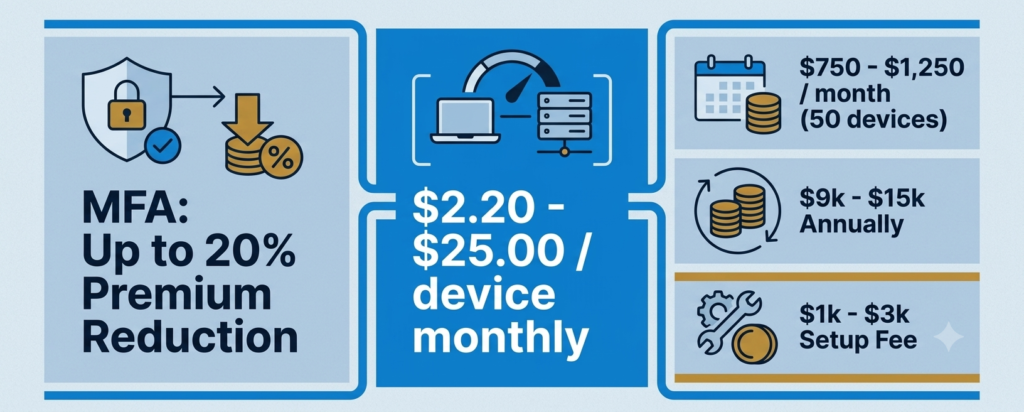
Basic antivirus no longer satisfies audit or insurance requirements in 2026. Behavioral threat detection – specifically Endpoint Detection and Response (EDR) – is now the standard. For specific tools at each price point, see our roundup of the best cybersecurity tools for small businesses with no IT team. Direct EDR licensing from platforms like SentinelOne, CrowdStrike, or Microsoft Defender for Business costs $3.00-$15.00 per device per month. Pair that with a Managed Detection and Response (MDR) service providing 24/7 Security Operations Center (SOC) monitoring, and costs climb further. Whether it’s cheaper to buy that coverage as part of a bundled platform or piece it together from separate tools is its own decision — we break down the total cost of each approach here.
For a 50-device business, EDR and MDR services combined typically cost approximately $10,800-$24,000 annually. If you’re weighing whether to build this capability in-house or outsource it, our full managed security vs. in-house IT cost comparison breaks down the three-year numbers.
Access Control and Device Management
Common audit findings include unmanaged personal devices, flat networks with no segmentation, and orphaned accounts from former employees. Addressing these gaps requires investment in Mobile Device Management (MDM) tools and centralized identity solutions – costs that vary based on user count and the platforms already in place.
What’s Draining the Budget Beyond the Auditor’s Invoice
Compliance Software and GRC Platforms
Many businesses use Governance, Risk, and Compliance (GRC) automation tools like Vanta, Drata, Secureframe, or Thoropass to simplify evidence collection. Standard licensing runs $7,500-$25,000 per year, and as compliance programs grow, additional modules and tier upgrades can add thousands more annually.
Internal Staff Time and Opportunity Costs
This is the cost most owners never see coming. For small teams, compliance work consumes 100-400 hours of internal labor per year – often pulling a lead engineer or senior staff member away from core business work for months at a time. Larger SMBs dealing with complex mid-size compliance programs can spend 700-1,000 hours or more annually on documentation, evidence gathering, and auditor coordination. At standard engineering rates, that translates to $25,000-$90,000 in lost productivity.
Audit Cost vs. Breach Cost: The Real Comparison
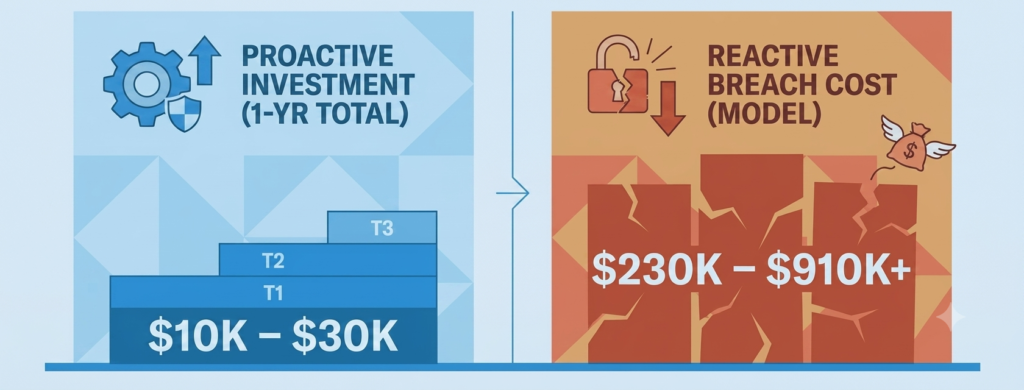
A proactive security audit and tooling program costs a mid-size SMB roughly $10,000-$30,000 in year one. An unmitigated breach of the same business can cost anywhere from $230,000 to over $900,000 – accounting for incident response forensics ($10,000-$50,000), system downtime, regulatory fines, customer notification requirements, and customer churn averaging 40-55% post-incident.
Globally, the average cost of a data breach is around $4.44 million in 2026, a slight decrease from $4.88 million in 2024-2025. For small businesses specifically, incident recovery costs range from $120,000 to $1.24 million. Proactive auditing significantly reduces the total financial risk profile compared to doing nothing, with prevention costs being 50-60 times less than recovery.
Proactive Security Investment and Insurance Costs
Cyber insurers in 2026 are not just asking whether controls exist – they’re asking for documented proof. If you’re setting these controls up during a cloud move, see our 12-step cloud security checklist for small business migration. The relationship between security controls and insurance premiums has shifted: controls are now baseline requirements, and their absence carries real financial consequences.
- Multi-Factor Authentication (MFA) on all email and admin portals is required for coverage eligibility. Its absence can result in materially higher premiums (15-40% loadings) or outright coverage denial.
- Endpoint Detection and Response (EDR) is a baseline requirement for most policies. Without it, businesses face materially higher premiums or coverage exclusion. Higher coverage limits often make penetration testing a formal requirement too — see does cyber insurance require a pen test or vulnerability scan for where that threshold sits.
- Immutable, tested backups (air-gapped with verified quarterly restores) are a baseline requirement. Their absence can result in ransomware coverage exclusions or higher premiums.
- A documented incident response plan with annual tabletop exercise validation is a baseline requirement, and demonstrating it can unlock better rates or coverage terms.
Overall, organizations with active, audited controls have seen premiums stabilize or see modest decreases compared to those without, who may face higher premiums or denial of coverage entirely. For many small businesses, that difference alone offsets a meaningful portion of the annual audit cost.
Not sure whether your business needs a consultant to prepare for that audit, or whether the basics are enough for now? When to Hire a Cybersecurity Consultant vs Going It Alone walks through the four triggers that make that call.
For small business owners who want to understand what security steps actually matter – without wading through technical jargon – TechEd Shield provides plain-language guidance and practical tools built specifically for businesses without an IT team. Moving core infrastructure to the cloud is one of the biggest cost levers here — see 7 reasons SMBs are switching from on-premise to cloud security for the tradeoffs.
A note on pricing: Prices correct at time of writing. Always check current pricing before purchasing.