

Key Takeaways
- Most small businesses can dramatically reduce their risk by mastering a handful of high-impact basics – MFA, backups, patching, and smart password habits – without hiring anyone.
- Four specific triggers signal when doing it yourself stops being cost-effective and starts being dangerous: regulatory compliance obligations, enterprise B2B contracts, custom software development, and hardened cyber insurance requirements.
- The average cost of a data breach for a small business runs between $120,000 and $1.24 million – making proactive prevention 50 to 60 times cheaper than recovering from an attack.
- A virtual CISO (vCISO) offers ongoing strategic security leadership at a fraction of the cost of a full-time hire, while a one-off consultant fits defined, short-term projects.
- The decision matrix later in this post helps SMB owners quickly determine whether they are still in safe DIY territory – or past the point where they need outside help.
For small business owners managing everything themselves, cybersecurity can feel like one more impossible thing on an already overwhelming list. The good news: most businesses are not starting from zero, and getting meaningfully protected does not require a dedicated IT department. The real question is when to hire a cybersecurity consultant vs going it alone — knowing exactly where that line is, and what happens when it gets crossed.
80% of Small Businesses Were Hit in 2025 – and 83% Were Unprepared
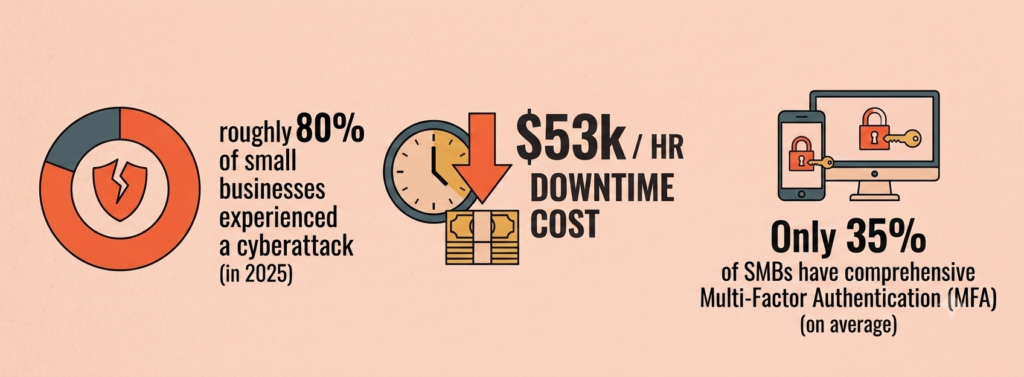
The numbers are hard to ignore. In 2025, roughly 80% of small businesses experienced a cyberattack, with average losses reaching $254,000 per breach in 2026. Nearly one in five attacked SMBs face bankruptcy as a direct result, and ransomware was present in 88% of SMB breaches.
What makes this especially painful is that most of these attacks were not sophisticated. They targeted predictable gaps – weak passwords, unpatched software, no employee training. That is actually encouraging, because it means the majority of SMB risk is preventable with the right habits in place. The question is not whether to take security seriously. Figuring out which parts can be handled independently – and which parts genuinely need a professional – is where the real work begins. TechEd Shield exists specifically to help non-technical business owners answer that question clearly and practically.
What You Can Secure Without Expert Help
The Center for Internet Security (CIS) defines a baseline set of safeguards – called Implementation Group 1– that covers the most common, non-targeted attacks. These controls do not require a consultant. They use tools already built into the platforms most businesses are already paying for.
Identity: MFA and Password Management
Compromised credentials are a leading entry point in security breaches. Enabling multi-factor authentication (MFA) across all business accounts – email, cloud tools, remote access, admin panels – can block up to 99.9% of automated login attacks. Standard authenticator apps like Microsoft Authenticator or Google Authenticator are free, effective, and take less than an hour to roll out across a small team.
Pair MFA with a strong password policy: 12 to 15 character passphrases, no reuse across accounts, and a dedicated password manager such as Bitwarden or 1Password to keep things organized. This combination closes most credential-based risk without any outside help.
Network: Router and Firewall Basics
Securing a small office network does not require enterprise equipment. Three steps make an immediate difference: change default manufacturer passwords on every router and network device, enable built-in firewalls on all computers and servers, and disable unused network ports. These settings live in the router admin panel and operating system settings – no specialist required.
Data and Backups: Your Last Line of Defense
Unpatched software is a well-documented liability – exploited vulnerabilities consistently rank among the top root causes of ransomware and other attacks. Enabling automatic updates on every device – Windows, macOS, and all major apps – closes this gap quickly. Then set up automated daily backups to an isolated cloud repository or offline storage. Since ransomware appeared in 88% of SMB breaches, a tested offline backup is not optional. Running a manual restore test at least once a year confirms the backup actually works when it counts.
4 Triggers That Make DIY a Liability
Basic hygiene handles the majority of everyday risk. But certain business developments fundamentally change the equation. When these four triggers appear, attempting to self-manage security stops being resourceful and starts being genuinely dangerous.
Regulatory Compliance (HIPAA, PCI DSS, SOC 2)
The moment a business becomes legally bound to a compliance framework, DIY stops working. HIPAA, PCI DSS, SOC 2, and ISO 27001 each require formal gap analyses, documented policy writing, and control mapping that goes well beyond standard hygiene. (If SOC 2 is the framework in question, 7 SOC 2 compliance tools small businesses actually use breaks down the software side of that build-out.). As of 2026, HIPAA penalties range from $145 to $73,011 per violation depending on culpability tier, with statutory annual caps reaching $2,190,294 for the most serious violations. Healthcare breaches average $7.42 million per incident. A failed DIY compliance attempt carries significant direct costs on top of whatever breach expenses follow. This is the clearest signal that a qualified consultant is not optional.
New York businesses face this trigger earlier than most — NYDFS Part 500 and the SHIELD Act impose their own compliance deadlines, and our roundup of the 7 best cybersecurity firms in NYC for small businesses breaks down which providers handle those requirements.
Signing Enterprise B2B Contracts
Enterprise buyers do not take a vendor’s word on security. They issue standardized security questionnaires – including the SIG Core, the SIG Lite, and the Cloud Security Alliance’s CAIQ – each covering dozens to hundreds of questions across multiple risk domains. Business owners who try to complete these without guidance routinely stall sales cycles, delay approvals, and lose deals. A vCISO or security consultant who maintains standard response frameworks can unlock blocked enterprise revenue far faster than any internal effort.
Building Custom Software or APIs
Businesses that shift from using off-the-shelf software to developing custom applications or APIs take on a fundamentally different risk profile. Native firewalls and standard antivirus cannot protect custom code. This environment requires a DevSecOps approach – integrating security into every stage of development – and professional web application penetration testing, which typically costs between $5,000 and $15,000. Embedding security into development from the start consistently reduces breach costs compared to addressing it after the fact.
Hardened Cyber Insurance Requirements
Cyber insurance underwriting has become significantly more rigorous. Carriers now demand verifiable proof of technical controls – not just checked boxes. Specifically, insurers are looking for:
- Phishing-resistant MFA on all accounts, with a clear preference for hardware tokens or WebAuthn over SMS codes.
- Managed EDR (Endpoint Detection and Response) with 24/7 active monitoring – traditional antivirus is no longer accepted by most carriers.
- Immutable or air-gapped backups validated by documented restore logs from the past 12 months.
- A written Incident Response plan verified by annual tabletop exercises and after-action reports.
For organizations with more than 50 endpoints or those in regulated industries, carriers frequently require Managed Detection and Response (MDR) with documented response SLAs. Failing to provide proof of these controls leads to premium hikes, coverage exclusions, or outright policy denial – often discovered only when a claim is filed.
The Real Cost of Waiting Too Long
Breach Costs vs. Prevention Costs
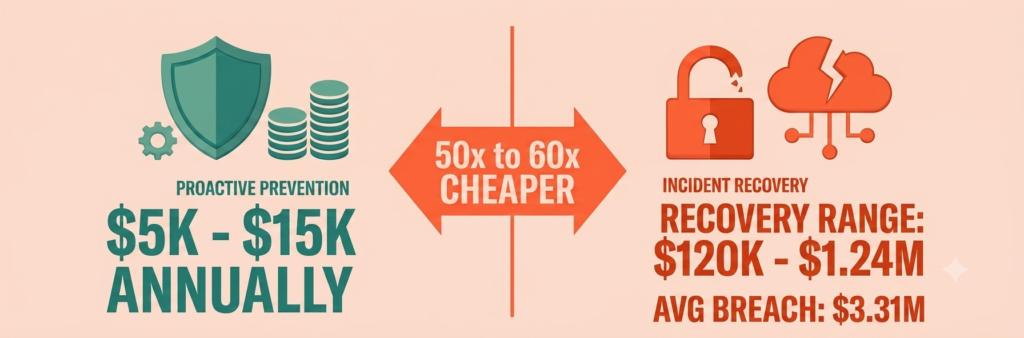
For businesses with fewer than 500 employees, the average data breach costs $3.31 million, with realistic recovery ranges falling between $120,000 and $1.24 million. Operational downtime alone costs an average of $53,000 per hour – meaning a single day of disruption can wipe out months of cash flow. Critically, 40% of small businesses say a security event costing $100,000 or less would drive them out of business entirely. Proactive prevention – including professional consulting – typically costs between $5,000 and $15,000 annually. That is 50 to 60 times cheaper than recovering from an active breach.
The Hidden Price of Founder-Managed Security
When a business owner spends 10 to 15 hours per month managing security configurations, drafting compliance documents, or responding to insurance audits, there is a real cost that never appears on an invoice. At a conservative executive valuation of $1,000 per hour, that exceeds $10,000 per month in opportunity cost – time not spent on revenue, product, or growth. Outsourcing that function to a qualified vCISO reclaims that time and removes execution risk simultaneously.
vCISO vs. One-Off Consultant: Which Fits Your Stage?
A virtual CISO (vCISO) provides continuous, strategic security leadership on a fractional basis. They manage the overall security posture, handle compliance audits, respond to enterprise procurement questionnaires, and align controls with business goals over time. Monthly retainers typically run $3,000 to $20,000, with small businesses in the 20 to 100 employee range generally landing between $5,000 and $8,000 per month. Compare that to a full-time CISO, whose total compensation runs $250,000 to $565,000 annually – a gap that mirrors the broader managed security vs. in-house IT cost comparison small businesses face across their whole security stack, not just leadership, and the same hidden-cost pattern shows up in on-premise infrastructure spending too. For businesses with active compliance obligations or growing enterprise sales pipelines, a vCISO delivers the strongest return.
A one-off consultant fits defined, time-limited projects – a penetration test ($5,000 to $15,000), a compliance readiness assessment ($15,000 to $50,000), or hourly advisory work ($200 to $400 per hour).. Once the engagement ends, so does the oversight. Internal staff inherit the implementation burden with no ongoing monitoring. This model works well when a specific technical milestone needs to be hit – not for long-term program management.
How to Vet a Consultant (and Spot Security Theater)
5 Questions to Ask Before Signing
- “Which controls would you prioritize first given our budget?” A grounded consultant focuses on high-impact basics before pushing complex overhauls.
- “How will you report on what changed and what risk remains?” Look for clear, business-language reporting – not jargon-heavy presentations.
- “Are there software purchases required through your firm as a condition of engagement?” This uncovers hidden reseller markups and tool-first incentives.
- “What happens to billing if we exceed hours during an active breach?” Establishes emergency rate transparency before a crisis hits.
- “What is your experience with companies our size and industry?” Enterprise experience does not automatically translate to small business practicality.
3 Red Flags to Walk Away From
- Tool-first requirements: Any consultant who insists on deploying expensive platforms before conducting a risk assessment is likely optimizing for commissions, not security outcomes.
- Template warehousing: Pre-written policy packages sold as instant compliance are shelf documents. Without operationalization, verification, and staff training, they fail both audits and real attacks.
- Fear-based enterprise pitches: Consultants who lead with alarming statistics to justify oversized solutions are masking a poor understanding of small business constraints. Effective advisors prioritize affordable, incremental risk reduction.
DIY or Hire: A Decision Matrix for SMB Owners
| Domain | Stay DIY If… | Hire a Consultant If… |
|---|---|---|
| Compliance | No HIPAA, PCI, or SOC 2 requirements in play | Regulated data or enterprise clients require audited compliance |
| Identity and Access | Standard MFA is enabled on Microsoft 365 or Google Workspace | Insurer requires phishing-resistant hardware keys or Conditional Access exports |
| Software Development | Business uses only off-the-shelf SaaS tools | Custom apps, web platforms, or APIs are in development |
| Sales and Procurement | Sales are B2C or transactional with no vendor questionnaires | Enterprise deals are stalling on SIG or CAIQ security reviews |
| Endpoint Protection | Native antivirus covers a small local workstation fleet | Insurance mandates managed EDR with 24/7 SOC monitoring |
| Incident Response | General backups exist and the team has a basic response idea | No written, tested IR plan or validated backup restore logs on record |
Reading through four triggers and a cost breakdown is one thing. Knowing where your business actually stands is another. Use the checklist below — it takes about a minute — to see whether you’re still in solid DIY territory or approaching the point where outside help pays for itself.
However the stamp landed, the takeaway is the same one that runs through this whole piece: the line isn’t about company size or revenue. It’s about whether a regulator, an enterprise buyer, a codebase, or an insurance carrier is now asking something of your security posture that a checklist and good intentions can’t answer. If you checked any of the four triggers, that’s your answer — the rest is just deciding between a vCISO and a one-off consultant.
Basic Hygiene Buys Time – Complexity Demands a Pro
The dividing line is operational complexity and external demand – not company size or revenue. For businesses operating below the four trigger thresholds, investing in solid fundamentals – MFA, patching, backups, and basic training – provides real, measurable protection without external capital. Do the basics well and consistently, and most businesses will be safer than the majority of their peers.
The moment regulatory obligations, enterprise contracts, custom software, or insurance scrutiny enter the picture, the stakes change rapidly. Downtime averaging $53,000 per hour, breach recovery costs exceeding $1 million, and the real possibility of permanent closure make professional security leadership a business continuity decision – not a luxury. Knowing which side of that line the business sits on is the most valuable security judgment a small business owner can make.
For practical, no-jargon guidance on building that security foundation step by step, visit TechEd Shield – a cybersecurity education platform built specifically for small business owners who want to protect what they have built, without needing an IT background to do it. And if the infrastructure itself is part of the conversation, see 7 reasons SMBs are moving from on-premise to cloud security.