

Key Takeaways
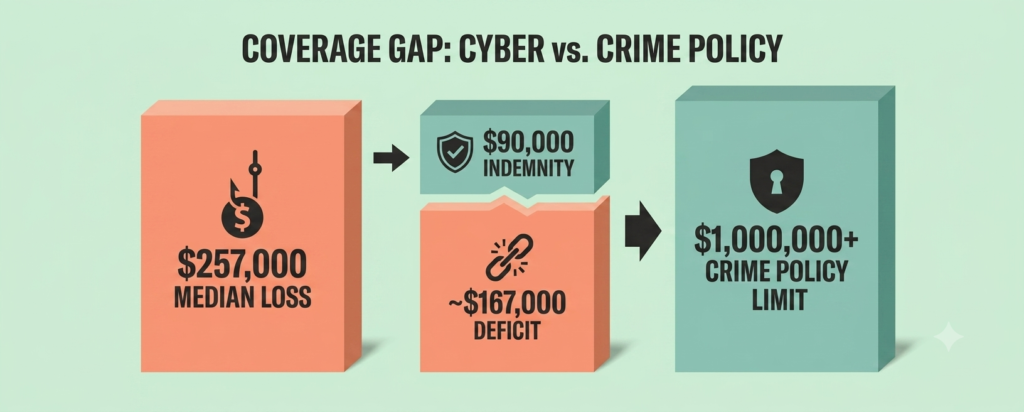
- A standard cyber insurance policy may carry a $1M overall limit, but the sub-limit specifically for social engineering fraud is often capped at $100,000 — far below the median $257,000 loss for title and law firms in a real estate wire fraud incident.
- The legal distinction between “Computer Fraud” and “Social Engineering” is the single biggest factor determining how much — or how little — your insurer pays after a wire diversion attack.
- Failing to report an incident to your carrier within 48-72 hours can result in a complete denial of the claim, even if the fraud itself is clearly covered under your policy.
- Standard Errors and Omissions (E&O) policies almost universally exclude wire fraud losses tied to third-party escrow funds — so there is no safety net to fall back on.
- Three targeted policy upgrades can close the coverage gap entirely — and the specific steps to get there are broken down later in this article.
Real estate closings move fast. Wire instructions fly through email threads, deadlines create pressure, and six-figure transfers are routine. That combination makes title agencies, escrow officers, and real estate brokerages one of the most targeted industries for Business Email Compromise (BEC) and wire fraud scams. Accounting firms carry a similar underwriting burden under federal financial-institution rules — see how much cyber insurance costs for accounting firms for how that plays out in premiums, and why those same firms often discover their policy won’t pay out at all once a breach forces a forensic audit.. What many firms don’t realize until it’s too late is that their insurance policy — the one they’re counting on to cover the loss — has a built-in real estate cyber insurance gap that leaves most of the damage uninsured.
The gap isn’t hidden in fine print. It’s structural. It stems from how policies define different types of fraud, what triggers each coverage bucket, and how courts have ruled on where one ends and the other begins. This is the same voluntary-parting exclusion covered in our breakdown of the 5 cyber insurance policy exclusions that deny claims — real estate just hits it harder and more often than most industries.
Your $1M Cyber Policy Won’t Cover a $250K Wire Fraud Loss
Here’s the reality that surprises most real estate firm owners: carrying a $1,000,000 cyber liability policy does not mean a $250,000 wire fraud loss is covered up to $250,000. The overall policy limit and the sub-limit that actually applies to your claim are two completely different numbers.
When a cybercriminal tricks a closing officer or homebuyer into wiring funds to a fraudulent account, that event is classified — in insurance terms — as a social engineering loss. Most cyber and commercial crime policies place social engineering claims under a separate endorsement with its own, much lower sub-limit. Industry analysis consistently shows these sub-limits commonly land at $100,000, regardless of how large the overall policy is. Meanwhile, the FBI’s Internet Crime Complaint Center (IC3) reports that real estate wire fraud losses regularly exceed that figure by a wide margin, with median incident losses for title and law firms frequently reaching $257,000 or more.
The math is painful: a $250,000 loss minus a $100,000 sub-limit minus a $10,000 deductible leaves a firm with just $90,000 in actual recovery — and a $160,000 out-of-pocket deficit. For a mid-size title agency or boutique brokerage, that gap can be business-ending.
Run your own numbers. The $250,000 example above isn’t unusual — it’s close to the median. But your policy’s actual limits are what matters. Enter your sub-limit, deductible, and a realistic loss estimate below to see exactly what your firm would recover, and what would come out of pocket.
If your result came back "Significant Gap" or "Critical Exposure," you're not alone — this is the coverage position most real estate and title firms are in without realizing it. The next sections explain exactly why the gap exists (the Computer Fraud vs. Social Engineering distinction) and the three specific endorsements that close it.
Computer Fraud vs. Social Engineering: The Definition That Costs You
The entire coverage question hinges on a single definitional split inside the policy. Understanding it is not optional — it is the difference between a full recovery and an uncovered loss.
Computer Fraud: What It Actually Requires
The "Computer Fraud" insuring agreement in a commercial crime or cyber policy is written to respond to one specific scenario: an unauthorized actor breaches a computer system and uses that access to programmatically force a transfer of funds. The machine itself is compromised. No human decision-maker is manipulated into approving the transaction.
Covered examples under this agreement include a threat actor deploying malware to harvest banking credentials and directly manipulate ACH instructions, or a hacker gaining system access to an unattended logged-in session and executing an illicit transfer without any employee involvement. When the unauthorized breach is the direct cause of the fund movement, the full policy limits are potentially available. The key word is unauthorized: the system was forced to act, not an employee.
Social Engineering: Why "Voluntary Parting" Kills Your Claim
Social engineering flips the scenario. In a BEC attack, the threat actor doesn't break into a bank system. Instead, they spoof an executive, a vendor, or a title officer — and send convincing fraudulent wire instructions to someone inside the firm, or directly to the homebuyer. The employee or buyer, believing the instructions are legitimate, voluntarily initiates the transfer.
That word — voluntarily — is the legal trigger that sends the claim to the social engineering sub-limit bucket. Insurance policy language universally calls this a "voluntary parting" of assets. Because an authorized person chose to execute the transfer (even though they were deceived), the loss does not qualify as an unauthorized computer intrusion. The Computer Fraud agreement is denied, and the claim is redirected to the social engineering endorsement with its capped sub-limit. The firm's $1M policy effectively becomes a $100K policy for this exact type of loss — which is, by far, the most common type hitting real estate firms today.
How Courts Have Ruled on the Boundary
Federal courts across multiple circuits have spent years drawing this boundary, and the rulings are not uniform — which is precisely why insurers have tightened their policy language over time.
On the no-coverage side, the Ninth Circuit ruled in Pestmaster Services, Inc. v. Travelers Casualty and Surety Co. that a computer-facilitated transaction executed by an authorized user does not qualify as Computer Fraud, which requires an unauthorized transfer. Similarly, the Fifth Circuit's decision in Apache Corp. v. Great American Insurance Co. — involving a $2.4 million BEC loss tied to altered vendor bank routing details — held that emailing fraudulent instructions does not constitute computer hacking, and the computer's role was merely incidental to the social engineering scheme.
On the coverage-upheld side, the Second Circuit ruled in Medidata Solutions Inc. v. Federal Insurance Co. that spoofing email headers to reroute a $4.7 million transaction constituted a computer violation through "fraudulent entry of data," and that employee involvement did not break the direct causal link. The Sixth Circuit reached a similar conclusion in American Tooling Center, Inc. v. Travelers Casualty and Surety Co., finding that fraudulent vendor emails initiating a sequence of internal actions qualified as computer-enabled fraud.
The split across circuits has pushed underwriters to revise policy language explicitly. Modern policies now state in plain terms: any transaction requiring human authorization is excluded from Computer Fraud and must be addressed solely under a Social Engineering endorsement. The litigation uncertainty that once allowed some firms to recover under full limits has largely been closed off by updated policy wording.
The $150,000 Gap: A Common Escrow Wire Fraud Breakdown
Seeing the coverage gap in abstract terms is one thing. Watching it unfold in a real transaction makes the stakes concrete.
How the Attack Unfolds Step by Step
The attack begins quietly. A threat actor launches a phishing campaign targeting a title agency. An escrow assistant clicks a malicious link, and the attacker harvests their Microsoft 365 credentials. Rather than acting immediately, the attacker logs in silently and configures inbox rules to archive all emails related to high-value transactions — monitoring the thread without the user's knowledge.
When a residential closing with a $250,000 wire requirement is scheduled, the attacker registers a look-alike domain — something like escrow-agent.com instead of escrowagent.com — and intercepts the email thread. Using the spoofed domain, they send an email directly to the homebuyer, impersonating the closing agent, with modified bank routing and account numbers. The email cites urgency: a banking cutoff or a sudden internal account change. The homebuyer, seeing no reason to doubt the communication, instructs their bank to wire $250,000 to the fraudulent account.
The attacker immediately moves the funds across multiple accounts and digital payment platforms. By the time the seller's agent flags the missing funds five days later and the title agency audits the transaction, the money is highly unlikely to be recovered. A cyber forensics firm is retained to confirm the email compromise — a cost that comes out of the incident response portion of the cyber policy.
What the Insurer Actually Pays (And What It Doesn't)
The title agency files a claim under both its cyber liability and commercial crime policies for the $250,000 loss. The claims department evaluates each insuring agreement in turn.
Computer Fraud Insuring Agreement — Denied. The insurer argues that although the firm's email system was compromised to monitor the thread, the actual transfer was never executed through an unauthorized intrusion into the firm's bank account — the homebuyer voluntarily initiated the wire based on deceptive communications. Voluntary parting applies, and the primary agreement does not respond.
Social Engineering Endorsement — Triggered, but capped. The insurer accepts coverage under the social engineering endorsement — at the sub-limit and deductible shown in the table above.
The math: the firm receives $90,000 in actual indemnity ($100,000 sub-limit minus $10,000 deductible). Against a $250,000 loss, that leaves a $160,000 out-of-pocket gap the firm must fund from operating capital — with no other policy to turn to.
| Criteria | Computer Fraud | Social Engineering |
|---|---|---|
| What triggers it | An unauthorized actor breaches a system and programmatically forces a transfer — no employee involved. | A threat actor deceives an authorized person (employee or buyer) into voluntarily initiating a transfer. |
| Human involvement | None — the machine acts, not a person. | Required — a real person "voluntarily parts" with the funds, even though deceived. |
| Outcome in the article's escrow case study ($250K loss) | Denied — the transfer was executed by the homebuyer's own bank instruction, not a direct system breach. | Triggered, but capped — $100,000 sub-limit minus $10,000 deductible. |
| Typical payout on a $250,000 loss | Full limits, if it applies at all — but rarely applies to BEC-style wire fraud. | $90,000 net recovery — a $160,000 out-of-pocket gap. |
| Case law | Coverage upheld under this theory: Medidata Solutions v. Federal Insurance; American Tooling Center v. Travelers. | No computer fraud coverage — classified as social engineering: Pestmaster Services v. Travelers; Apache Corp. v. Great American Insurance. |
Why Delaying Your Report Can Void the Entire Claim
Even when a loss clearly falls within the social engineering endorsement, the claim can still be denied entirely — not because of how the fraud happened, but because of when the firm reported it.
Why Internal Triage Is a Costly Insurance Mistake
When a wire diversion is first discovered, the instinct is understandable: reset passwords, audit server logs, call the bank's local branch manager, and brief internal leadership before escalating externally. It feels responsible. In insurance terms, it is a costly mistake.
Modern cyber policies operate on a "claims-made and reported" structure. Unlike a general liability policy that responds based on when an event occurred, a cyber policy requires that a potential claim-triggering event be discovered and formally reported to the carrier within the active policy period — and within a specific timeframe after discovery. Standard cyber forms mandate notice within 48 to 72 hours of discovery.
Critically, "discovery" does not begin when the internal investigation is complete. Under policy definitions, the discovery clock starts the moment any principal or employee first becomes aware of facts that would cause a reasonable person to suspect a security breach or misdirected wire has occurred. Spending 48 hours on internal triage before notifying the carrier is not an acceptable reason to miss the window — it is a breach of the notice condition.
The FBI's 72-Hour Window and Your Policy's Notice Condition
There is a practical reason insurers set aggressive reporting deadlines — and it matters beyond policy compliance. The commercial banking system's window to freeze and claw back fraudulently wired funds is extremely narrow, typically 24 to 48 hours from the time the wire is executed. Cyber insurers maintain rapid-response teams capable of initiating interbank freeze agreements through the FBI's IC3 and the Financial Fraud Kill Chain process.
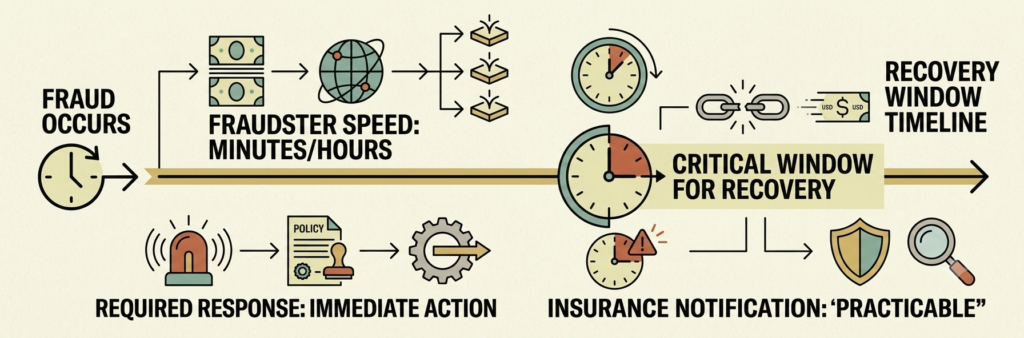
When a firm delays notification past the 72-hour mark, two things happen simultaneously. First, the insurer can deny the claim outright for breach of the notice condition — in many jurisdictions, without needing to prove they were commercially harmed by the delay. Second, even if the insurer waives the notice issue, the window to recover the funds has already closed. The carrier can then deny indemnity on the additional grounds that the insured breached its contractual duty to mitigate, since the delay directly allowed the stolen capital to exit the domestic banking system. Both defenses are available to the insurer at the same time.
The operational lesson is straightforward: the moment a wire diversion is suspected, the carrier's incident response hotline gets called — before any internal investigation, before the bank branch call, and before the internal briefing document is drafted.
The Callback Warranty: One Missed Step, Zero Coverage
As wire fraud claim frequency and severity have climbed in the real estate sector, insurers have moved beyond simply evaluating security controls during the application process. They are now writing those controls directly into the policy as enforceable Warranties or Conditions Precedent to Coverage. The most consequential of these is the Callback Warranty.
The Sourcing Rule: Never Use the Number in the Email
The Callback Warranty — also referred to as a Verification Condition Precedent or Fraudulent Instruction Verification Clause — requires that before executing any wire transfer, ACH payment, or acting on any instruction to change bank account or routing details, the insured must perform an out-of-band verbal verification. The specific mechanics of this requirement are where most firms fail.
The verification call must be placed to a number sourced from the original, physical contract, a validated paper file, or an independent public directory. The phone number provided in the incoming email requesting the payment change cannot be used under any circumstances — that line is controlled by the threat actor. This is not a suggestion or a best practice. It is a warranty condition baked into the policy. Using the number from the fraudulent email means the callback warranty is technically breached, even if the employee believed they were performing due diligence.
Verbal Confirmation Must Be Backed by Documented Independent Verification
Making the call is only half of the requirement. The callback warranty typically demands that the verification be documented in writing at the time it occurs. A verbal confirmation with no contemporaneous record is treated the same as no verification at all.
The documentation must capture: the exact date and time of the verification call, the specific phone number dialed and its source, and the name of the authorized party — whether a customer, vendor, or closing agent — who verbally confirmed the transaction details.
This is exactly the kind of ongoing, audit-ready documentation an MSSP is built to maintain continuously — most firms handling this manually eventually miss an entry.
When a claim is filed, the insurer's forensic claims adjuster will request the verification log for the specific transaction in question as a first step. If the log does not exist, if the employee dialed the number from the fraudulent email, or if the call was made but not documented, the condition precedent is considered breached. Under standard insurance contract law, a breach of a condition precedent suspends the insurer's liability for that occurrence entirely — not partially. The coverage for that claim is void, and the recovery is zero dollars.
Why Your E&O Policy Won't Bail You Out Either
After a cyber or crime policy denies a wire fraud claim — or pays only the $90,000 net on a $250,000 loss — many firms turn to their Errors and Omissions (E&O) or Professional Liability policy as a fallback. In the real estate and title sector, that fallback does not exist.
The Fund Misappropriation Exclusion
E&O policies are designed to cover professional mistakes: a misrepresentation of property conditions, a missed disclosure, an error in contract preparation. They are not structured as fidelity bonds or fund guarantees. Standard E&O forms contain absolute exclusions for any claims "based on, arising out of, or in any way attributable to" the theft, conversion, commingling, or misappropriation of funds or trust accounts.
This exclusion applies whether the theft was committed by an internal employee or an external cybercriminal. Courts have consistently upheld this interpretation. In Helms v. Hanover Insurance Group, homebuyers who wired their down payment to a fraudster sued their real estate broker for negligence, alleging the broker's use of unencrypted email exposed the transaction details that enabled the scam. Hanover denied coverage under the policy's false pretenses exclusion, which bars coverage for any transfer of funds induced by trick, artifice, or fraudulent misrepresentation — including social engineering and phishing — regardless of who committed the fraud. The federal district court of Arizona upheld the denial, rejecting the argument that the exclusion applied only to fraud committed by the insured. Similarly, in Authentic Title Services, Inc. v. Greenwich Insurance Co., a New Jersey title agent who wired funds to a spoofed account was denied E&O coverage, with the court granting summary judgment to the insurer on the same exclusion grounds.
Exclusions Related to Third-Party Funds Held in Trust
Real estate and title firms routinely hold millions of dollars in third-party consumer closing costs, lender funds, and earnest money deposits in escrow and IOLTA trust accounts. When those funds disappear, the firm faces immediate professional liability exposure from buyers, sellers, and lenders demanding replenishment.
E&O carriers address this directly through the Care, Custody, or Control (CCC) exclusion. Because escrow funds are in the insured's custodial possession at the time of the transfer, the CCC exclusion is triggered the moment the funds go missing. Professional liability underwriters categorize the holding and transfer of third-party funds as a fiduciary or administrative duty — not a specialized professional real estate service — which places the entire exposure outside the policy's intended scope.
Cyber Event Carve-Outs in E&O Policies
Modern professional liability policies for real estate firms have added a third layer of exclusion to eliminate what underwriters call "silent cyber" exposure — situations where traditional policies were inadvertently paying for cyber-related losses. Explicit cyber exclusions now carve out any claims arising from unauthorized network access, data breaches, computer systems fraud, and social engineering or fraudulent wiring instructions. The language is designed to force all cyber-related claims exclusively to the cyber and crime markets — exactly the same markets that are already applying the social engineering sub-limit. The E&O policy, in other words, actively closes the door that small business owners assume is open.
How to Actually Close the Coverage Gap
The coverage gap is real, but it is not permanent. With the right policy architecture in place, real estate and title firms can shift from partial recovery to near-complete coverage for wire fraud events. This requires moving away from off-the-shelf policies and working with a broker to build a coordinated risk-transfer structure across cyber and crime lines.
1. Add an Electronic Theft of Third-Party Funds Endorsement
Standard cyber policies are structured around first-party losses: data restoration costs, business interruption, forensic investigation fees, and notification expenses following a privacy breach. Direct financial assets — especially funds held in escrow or trust on behalf of clients — are routinely excluded unless the policy is specifically modified.
The fix is a dedicated "Electronic Theft of Third-Party Funds Held in Escrow" endorsement. This expands the definition of covered property to include funds the insured holds in a fiduciary or custodial capacity, explicitly overriding the standard Care, Custody, and Control exclusion. Without this endorsement, the loss of client escrow funds may not be covered as a first-party loss under a cyber policy at all — even before the social engineering sub-limit issue arises.
2. Demand Social Engineering Coverage That Explicitly Includes APP Fraud
The voluntary parting exclusion in standard crime policies is the structural root of the coverage gap. Closing it requires an endorsement that explicitly removes that exclusion for losses caused by deception. The endorsement to seek is an Authorized Push Payment (APP) Fraud or Cyber Deception endorsement added to the commercial crime policy.
The language must be reviewed carefully. A generic social engineering endorsement that retains ambiguous causation language will still be contested by adjusters. The endorsement should explicitly cover the impersonation of any vendor, client, business partner, escrow officer, or executive — not just internal employees — and should remove the voluntary parting defense for all deception-induced transfers. Equally important: the sub-limit on this endorsement needs to match the realistic exposure. A $100,000 sub-limit on an endorsement designed to cover $250,000 average losses is not coverage — it is a partial transfer of risk.
3. Coordinate Your Crime and Cyber Policies to Eliminate Sub-Limit Conflicts
When both a commercial crime policy and a cyber liability policy are active, a single wire fraud event can trigger both programs at the same time. Without explicit coordination language, both carriers will invoke their "Other Insurance" clause, each positioning their policy as excess over the other. The result is a legal standoff — not a claims payment.
Coordination requires three specific structural fixes endorsed into the policies:
- Define primary and excess allocation in writing. The recommended structure designates the cyber liability policy as primary for network security failures, forensics, notification costs, and third-party liability. The commercial crime policy is designated primary for direct financial loss, including social engineering and fraudulent instruction claims, with the cyber policy providing excess coverage once crime limits are exhausted.
- Align sub-limits across both policies. The social engineering sub-limit on the crime policy and the corresponding endorsement on the cyber policy should be reviewed together. A mismatch — where one policy's sub-limit creates a coinsurance gap relative to the other — can leave a portion of the loss in a coverage vacuum between the two programs.
- Eliminate duplicate deductibles. When both policies respond to the same event, applying separate deductibles to each program effectively doubles the firm's out-of-pocket contribution before any recovery begins. Coordination language should specify a single, unified self-insured retention that applies across both policies for the same claim event.
A $250K Loss With a $100K Sub-Limit Is a Business-Ending Gap — Audit Your Policy Now
Wire fraud is not a theoretical risk for real estate, title, and escrow firms. It is the most financially damaging cybercrime consistently targeting the sector, and the average loss per incident routinely outpaces the coverage that standard policies actually provide. The $160,000 gap between what an insurer pays and what a firm loses is not an edge case — it is the predictable arithmetic of how most cyber and crime policies are currently structured for social engineering losses.
The practical steps are clear: pull the social engineering sub-limit out of every active cyber and crime policy, compare it against the average wire value processed during a typical closing, and identify whether the endorsement language explicitly covers APP fraud and third-party escrow funds. Then check whether the callback warranty exists, whether it has been built into the firm's wire verification process, and whether documentation protocols are being followed on every transaction. Finally, confirm that the cyber and crime policies have explicit coordination language in place so that a single claim event doesn't trigger a coverage dispute between two carriers.
None of this requires an IT team or a legal department. It requires knowing what questions to ask before a loss happens — not after. The firms that discover the gap at claim time rarely recover fully. The ones that find it during a policy review do — the same review process that lets small law firms cut their premiums by implementing specific technical controls.
For small business owners in real estate, title, and escrow who want clear, practical guidance on closing coverage gaps before they become losses, our free cyber insurance readiness check is a practical starting point. It shows how your business measures up against the controls insurers commonly ask about, in plain English, with no technical background needed.