


Key Takeaways
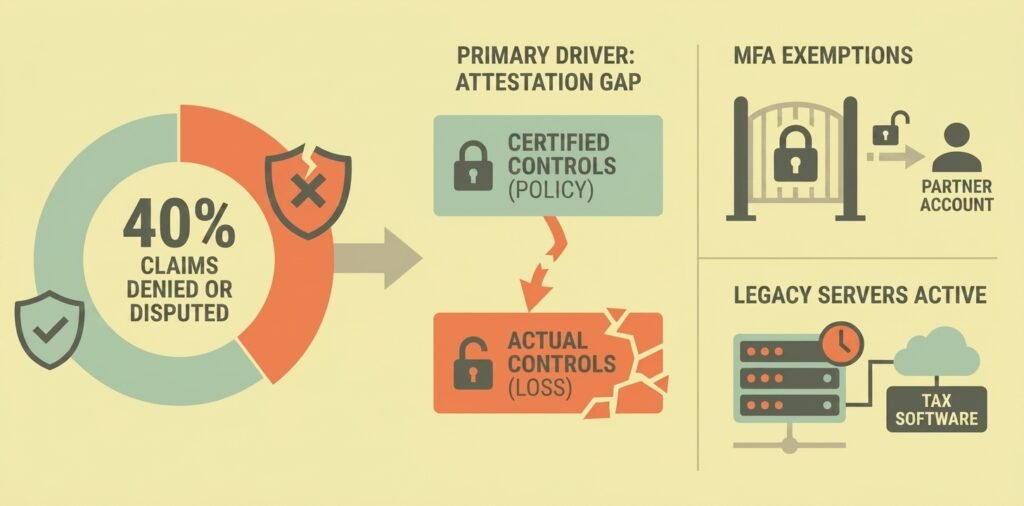
- A significant share of cyber insurance claims face denial or dispute industry-wide – accounting firms are among the most exposed businesses due to the sensitive financial data they hold.
- The most common reason for denial is not the breach itself – it is a mismatch between what your firm certified on the application and what forensic investigators actually find afterward.
- Business Email Compromise (BEC) wire losses are frequently excluded from standard cyber policies unless a specific endorsement is purchased, and even then, coverage is often capped at a fraction of the actual loss.
- Federal rules – including the FTC Safeguards Rule and IRS Publication 4557 – give insurers additional grounds to deny claims if your firm is not compliant at the time of a breach.
- Having cyber insurance and actually being covered are two very different things – the gap between them is where most accounting firms get hurt.
Buying accounting firm cyber insurance feels like solving the problem. For small accounting firms, the real issue surfaces after a breach – when forensic investigators arrive, audit every security control your firm claimed to have, and compare that to what was actually running. What they find can be the difference between a full payout and a voided policy. Here is what most accounting firm owners do not know until it is too late.
40% of Cyber Claims Are Denied – Accounting Firms Face Unique Exposure
A significant share of cyber insurance claims faced denial or significant disputes in 2024 and 2025, according to industry claims-data reporting. For accounting firms specifically, that number carries extra weight. Your firm holds Social Security numbers, corporate financial records, payroll data, and direct access to client wire channels – exactly what attackers want, and exactly why cyber insurance premiums for accounting firms run higher than most other industries. That concentration of sensitive data makes accounting practices high-priority targets, and it is also why insurers scrutinize claims from this sector so aggressively.
Before you keep reading, run a quick gut check. Most accounting firm owners assume their cyber policy will pay out because they bought one — not because they’ve verified what’s actually still active behind it. This 60-second checker walks through the same categories forensic investigators audit after a breach: MFA coverage, documentation, wire transfer controls, and endorsements. Answer honestly. The gaps it finds are the same gaps that turn a routine claim into a denial.
Cyber Insurance Coverage Gap Checker
Answer each question the way a forensic investigator would check it — not the way you hope it’s set up.
If you checked “No” on more than one item, you don’t have a coverage gap — you have a rescission risk. The good news is that every item on this list is fixable in a normal business quarter, not a fire drill. The firms that stay covered are the ones that treat this checklist as a recurring audit, not a one-time exercise before renewal.
Modern underwriting has changed. Carriers no longer rely solely on what you wrote on an application. They use external perimeter scanning, telemetry data, and post-breach forensic audits to verify whether the security controls you certified were actually active when the breach occurred. This is exactly the gap the Free Cybersecurity Health Check is built to surface — a 60-second way to see where your firm’s certified controls and actual controls diverge before a carrier finds it for you
Why Insurers Come After You Post-Breach
The Forensic Investigation You Don’t Expect
After a breach, the insurer assigns a specialized forensic investigation firm – not to help your firm recover, but to verify your claim. Investigators examine authentication logs, endpoint telemetry, backup configurations, and patch histories. Their goal is to determine whether the security controls listed on your application were genuinely active at the time of the incident. Any gap between what you certified and what they find gives the carrier grounds to act.
Claim Denial vs. Full Policy Rescission
These are two very different outcomes. A claim denial means the policy stays in force but the insurer refuses to pay for a specific loss – typically citing a policy exclusion or an unfulfilled condition. Policy rescission is far more damaging. The carrier voids the entire contract as if it never existed, refunds your premium, and leaves every pending and historical claim unrecoverable.
Rescission happens when an insurer proves a material misrepresentation was made on the application. The insurer does not need to prove the misrepresentation directly caused the breach – only that it was material to underwriting. In Travelers Property Casualty Co. of America v. International Control Services, Inc. (C.D. Ill. 2022), Travelers sought rescission after forensics revealed MFA was deployed only on the company’s firewall – not on email, VPN, RDP, or servers, as the application had represented. ICS agreed to rescission rather than contest the case, and the policy was declared void from inception – illustrating that the legal defect was the inaccurate attestation itself, not the specific entry point used by the attacker.
The Attestation Gap: Where Most Denials Begin
What You Certified vs. What Forensics Found
The attestation gap is the difference between what a firm checks on its insurance application and what is operationally active when a breach occurs. This is the primary driver of claim denials in the accounting sector. The cause is rarely intentional – it usually results from security drift over time, temporary exceptions that never got reversed, or a failure to understand how granular the application questions actually are.
The MFA Loophole That Voids Policies
Multi-factor authentication is the single most frequent failure point in cyber insurance claims. Insurers do not ask whether MFA is generally in place. They require affirmative confirmation that it is active across cloud email, VPN and Remote Desktop Protocol (RDP), administrative accounts, core accounting software portals, and non-human service accounts.
Common failure modes include legacy tax software servers excluded from Conditional Access policies, temporary MFA exemptions granted to senior partners that were never removed, and SMS-based authentication used where push-matching or hardware tokens are required. Any one of these gaps – even if the breach entered through an unrelated vulnerability – can be used to rescind the policy entirely.
Failure to Maintain Clauses Are a Hidden Trap
Misrepresentation is about what you said at application. Failure-to-maintain exclusions are about what you stopped doing during the policy term. Illustrated by Columbia Casualty Co. v. Cottage Health System (C.D. Cal. 2015) – a case dismissed on procedural grounds before reaching the merits, but widely cited as a cautionary example – insurers may argue that these clauses let them deny claims if a policyholder stops upholding the security practices they certified, even if those practices were accurate at the time of signing.
How Operational Shortcuts During Busy Periods Create Coverage Risk
Tax season creates a predictable window of exposure. Firms defer critical security patches to avoid downtime during peak filing periods. EDR agents get disabled during software troubleshooting and never re-enabled. Phishing simulation programs get paused for temporary or seasonal staff. Each of these shortcuts is a potential failure-to-maintain trigger. If a breach occurs during that window, the carrier’s forensic team will identify exactly when each control lapsed – and that timeline becomes part of the denial rationale.
Your BEC Wire Loss Is Probably Not Covered
Computer Fraud vs. Social Engineering Fraud
Business Email Compromise – where an attacker impersonates a client, vendor, or executive to trick an employee into wiring funds – is one of the most common cyber losses in the accounting sector. Standard cyber policies split financial fraud coverage into distinct categories with very different triggers:
- Computer Fraud: Covers losses where an attacker directly accesses your systems and manipulates payment software without human involvement.
- Funds Transfer Fraud: Covers fraudulent instructions sent directly to a bank to debit your account without employee knowledge.
- Social Engineering Fraud (SEF): Covers losses where an employee is manipulated into voluntarily executing a wire transfer based on deceptive communications.
Because BEC involves an employee voluntarily acting on fraudulent instructions, it falls under Social Engineering Fraud – a category that is typically excluded from standard cyber policies unless a specific SEF endorsement is added.
How Skipping Out-of-Band Verification Kills Your Claim
Even when a Social Engineering endorsement is in place, policies often include a warranty requiring staff to complete an out-of-band verification before executing any wire transfer above a set threshold – commonly $10,000. This means calling the requestor on a pre-established, independently verified phone number, not the number provided in the suspicious email. If an employee skips this step or verifies using a number from the fraudulent email, the carrier has valid contractual grounds to deny the claim entirely.
Sublimits That Leave Most of the Loss Uncompensated
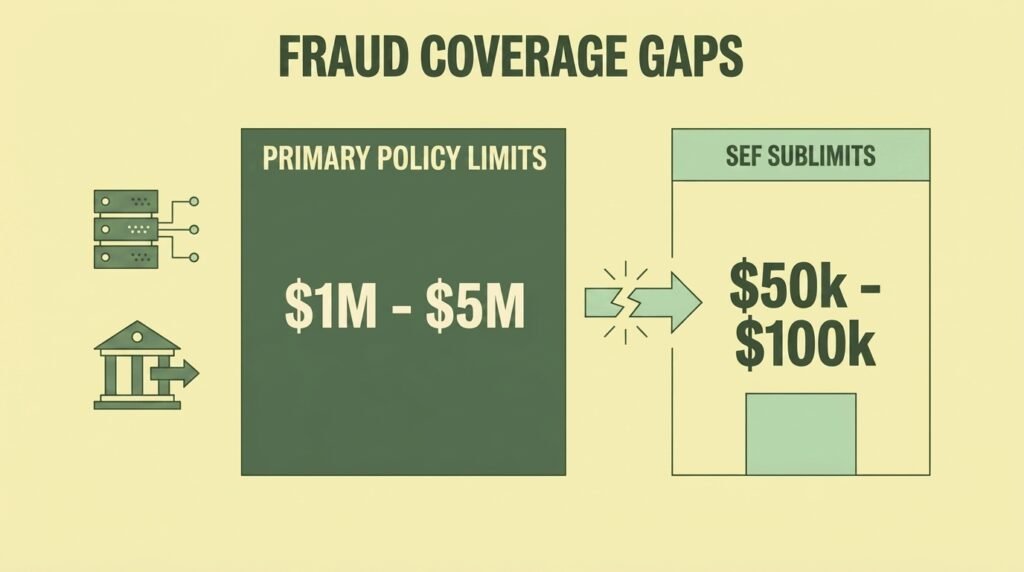
A properly structured Social Engineering endorsement rarely covers the full loss. While primary ransomware or breach response coverage may reach $1 million or more, SEF sublimits are frequently capped between $50,000 and $100,000 per occurrence. For a firm that wires $400,000 based on a spoofed vendor email, that gap falls entirely on the firm — real estate firms face the identical sub-limit trap on wire fraud claims, often with an even larger dollar gap.
Federal Rules Give Insurers More Grounds to Deny
FTC Safeguards Rule: You’re a Financial Institution
Under the FTC Safeguards Rule (16 CFR Part 314), updated in 2023, accounting practices and tax preparation services are legally classified as financial institutions. This requires firms to maintain a Written Information Security Program (WISP), designate a qualified individual to oversee it, implement MFA for all access to customer information, and encrypt client data both at rest and in transit — see what FTC Safeguards Rule-compliant MFA actually requires for the specifics carriers and regulators both check. Non-compliance can result in FTC civil penalties. If a breach occurs and the insurer’s legal team finds no active WISP – or that your MFA attestation was inaccurate – they can invoke both material misrepresentation and violation-of-law exclusions simultaneously.
IRS Publication 4557 Compliance as a Coverage Condition
IRS Publication 4557 applies to all tax professionals, regardless of how many returns they file annually. It mandates MFA enforcement, operational endpoint detection, immutable backups, drive encryption, and regular staff security training. Non-compliance exposes firms to FTC civil penalties and EFIN suspension. It also gives insurers a concrete regulatory benchmark to evaluate your security posture against, and any shortfall feeds directly into a denial argument.
Third-Party Vendors and Policy Gaps You Haven’t Planned For
When a Vendor Outage Exposes a Coverage Gray Area
Standard Cyber Business Interruption coverage responds to outages on the firm’s own network – not at a vendor. If a cloud tax software provider goes down during filing season and the firm loses revenue, that loss is typically not covered unless a Dependent Business Interruption (DBI) endorsement was explicitly negotiated and added to the policy. Most firms never negotiate it.
Where Cyber and E&O Policies Fail to Align
A cyber outage that forces a firm to miss a statutory filing deadline creates a layered problem. The third-party client claim for IRS penalties falls outside the cyber policy, which excludes professional service failures. The standard Errors and Omissions (E&O) policy likely contains a cyber exclusion, barring coverage for claims that originate from a network breach. Without explicit cross-policy language confirming the E&O policy responds to professional errors caused by a cyber event, the firm holds an unhedged gap on both sides.
Having Cyber Insurance Isn’t the Same as Being Covered
The policy on file can create a false sense of security that stops firms from taking the operational steps that would actually protect them. Real coverage requires that every security control certified on the application is genuinely active, continuously maintained, and defensible under forensic audit. That means enterprise-wide MFA with no legacy exceptions, immutable backups isolated from the primary network, documented out-of-band verification procedures for wire transfers, and a WISP that reflects how the firm actually operates.
If any of those elements drift during tax season – or were never fully implemented in the first place – the policy is a document, not a safety net. The accounting firms that survive breaches intact treat their insurance application as a living standard of operational practice, not a one-time checkbox exercise.
TechEd Shield helps small business owners understand exactly what protections need to be in place – take the Free Cybersecurity Health Check to see where your firm’s coverage assumptions and actual controls line up.