


Key Takeaways
- Florida ranked third among all states for cybercrime complaints and losses per the FBI’s 2024 Internet Crime Report, and Verizon’s 2025 Data Breach Investigations Report found ransomware featured in 88% of small business breaches
- The Florida Information Protection Act gives businesses just 30 days to notify affected residents after a breach, with fines reaching up to $500,000 for violations exceeding 180 days
- Small businesses handling defence contracts, healthcare records, or card payments each face distinct compliance rules covering CMMC, HIPAA, and PCI DSS
- Choosing between managed detection and response or standard endpoint protection depends heavily on business size, industry, and cyber insurance requirements
- Free resources from Cyber Florida and the Florida SBDC Network can help business owners gauge their risk before committing to a paid provider
Florida cybersecurity providers matter more than most small business owners realize, because running a business here means juggling customers, cash flow, and compliance paperwork, often without anyone on staff who understands network security. Yet the state’s mix of tourism, healthcare, defence manufacturing, and international trade makes it a magnet for cybercriminals looking for an easy target. Understanding the threats, the rules, and the providers built to handle both is now a basic part of running a business safely in the Sunshine State.
Florida SMBs Face Rising Cyber Threats
Phishing emails, ransomware attacks, and business email compromise scams hit Florida businesses with striking regularity. Small firms with limited defences are often the easiest targets, since attackers know these businesses rarely have dedicated security staff watching for warning signs, and the pattern extends well beyond large corporations.
This is exactly why Florida cybersecurity providers stay busy. The scale of the problem is significant – Florida ranked third among all states for cybercrime complaints and losses, with over 52,000 complaints and more than $1 billion in reported losses, as reported in the FBI’s 2024 Internet Crime Report.
Ransomware featured in 88% of small business breaches, according to Verizon’s 2025 Data Breach Investigations Report, which covers incidents from November 2023 through October 2024. For a business owner already stretched thin managing staff, stock, and sales, a single successful attack can mean lost revenue, damaged customer trust, and weeks of disruption while systems are rebuilt.
TechEd Shield has spent time helping business owners translate these risks into plain language, arguing that most companies can dramatically cut their exposure by getting a handful of basics right rather than chasing every possible defence. Florida’s overlapping regulatory environment isn’t unique — see our guide to cyber security firms for Texas medical practices for how a different state layers its own rules on top of federal ones. That same principle applies when weighing up the wider Florida cybersecurity market, where providers range from full-service audit-driven firms to lean regional specialists.
Why Florida Law Demands Action
This is why Florida cybersecurity providers structure their services around state law. Cybersecurity in Florida is a legal obligation baked into state statute, not simply a recommended practice. The Florida Information Protection Act, found in Florida Statutes § 501.171, applies to any commercial entity that collects or stores personal information belonging to Florida residents. There is no small business exemption, meaning a five-person shop faces the same notification duties as a national retailer.
FIPA’s Notification Window: 30 Days, Extendable to 45
Once a breach is discovered, businesses have a short window to act. FIPA requires businesses to notify affected individuals within 30 days, one of the tightest windows anywhere in the country. A 15-day extension is available, but only if the business submits written justification showing good cause to the Florida Department of Legal Affairs within that initial 30-day period.
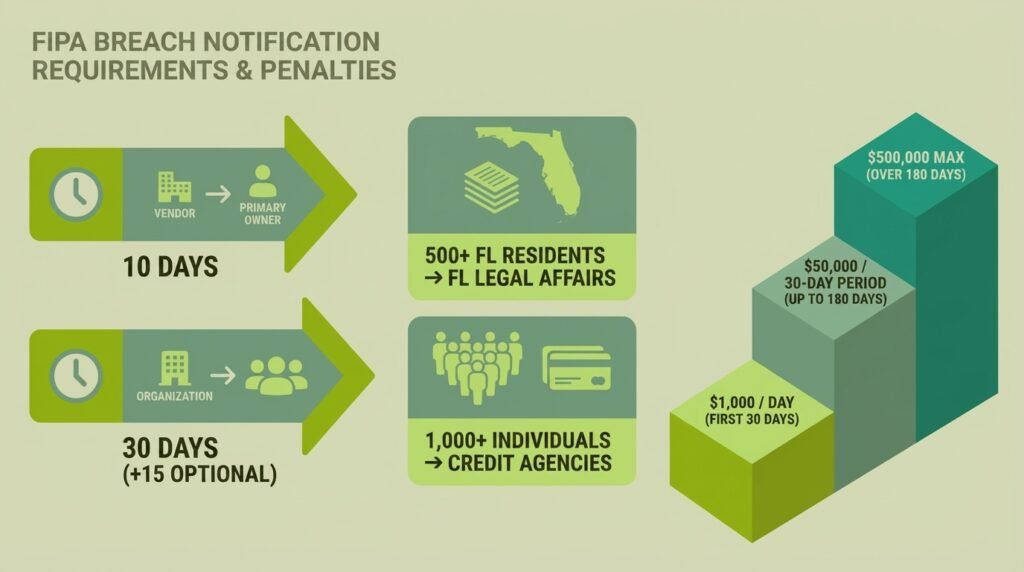
If more than 500 Florida residents are affected, the Florida Department of Legal Affairs must also be notified directly within the same timeframe. Breaches touching 1,000 or more people trigger an additional duty to alert nationwide consumer credit reporting agencies. FIPA’s civil penalties escalate the longer a business waits: $1,000 per day for the first 30 days of noncompliance, $50,000 for each subsequent 30-day period up to 180 days, and a maximum of $500,000 per breach for violations exceeding 180 days. Third-party vendors handling data on a business’s behalf must report incidents back to that business within 10 days, which makes vendor contracts and response plans just as important as internal safeguards.
CMMC, HIPAA and PCI DSS Obligations
Florida cybersecurity providers have to navigate more than FIPA alone. Layered on top of it are federal and industry-specific rules that apply depending on what a business does. Consider how differently these obligations land across sectors:
Businesses supplying the Department of Defense supply chain, common across Florida’s Space Coast and Central Florida manufacturing clusters, must meet NIST SP 800-171 and DFARS 252.204-7012 requirements to protect Controlled Unclassified Information, pursuing CMMC Level 1 or Level 2 certification.
- Healthcare practices and their billing or technology partners must maintain HIPAA and HITECH Act compliance, though FIPA’s stricter 30-day breach reporting timeline overrides HIPAA’s usual 60-day allowance for Florida residents.
- Retail, hospitality, and e-commerce businesses processing card payments must satisfy PCI DSS requirements, covering network segmentation, encrypted storage, and regular vulnerability scanning. PCI compliance alone doesn’t close every gap, though — see our 9 ecommerce security risks PCI compliance leaves unprotected.
Each of these frameworks demands documentation and technical proof, not just good intentions, which is why many small businesses turn to specialist providers rather than attempting compliance alone.
Cyber Insurance Now Requires Proof of Controls
Insurance requirements are another reason to work with established Florida cybersecurity providers. Getting cyber liability insurance used to be straightforward, but that has changed considerably. Insurers now expect businesses to demonstrate active endpoint detection and response, multi-factor authentication across every remote access point, immutable data backups, and continuous monitoring through a security operations centre before they will issue a policy or pay out on a claim. See does cyber insurance require a pen test or vulnerability scan for the full picture of what carriers verify before writing a policy. A business without these controls in place may find itself either uninsurable or facing a denied claim at the worst possible moment.
Providers Protecting Florida Businesses
Florida cybersecurity providers span a wide range, from firms built around formal audits to regional specialists focused on fast local support. The right fit depends heavily on industry, headcount, and existing compliance pressure.
| Provider | Location | Best For | Typical Size Served |
|---|---|---|---|
| The Scarlett Group | Orange Park (Jacksonville, Orlando, Tampa) | Audit-driven Compliance-as-a-Service (CMMC, HIPAA, PCI DSS) | 20-2,000 employees |
| Rolle IT | Melbourne (Space Coast) | Defense contractors, CMMC certification, Zero Trust (NIST 800-207) | Not specified |
| Blue Light IT | Boca Raton | Risk-mapped monitoring for legal, financial, medical, professional services | 10-100 employees |
| PCe Solutions | Tampa | Bundled managed IT + security, 30-minute SLA response | 10-50 employees |
| CyberSec Op | Deltona | Incident response, vCISO governance, ransomware containment | Mid-market |
| Artemis IT | Melbourne (Space Coast) | Unified managed security, compliance, and infrastructure | Not specified |
| Alltek Services | Lakeland | Flat-rate MDR, backup/DR, cloud security | 10-50 employees |
The Scarlett Group: Audit-Driven MSSP in Jacksonville
Headquartered in Orange Park with collaboration centres in Jacksonville, Orlando, and Tampa, The Scarlett Group was founded by information technology auditors and built its services around that audit-first mindset. Its offering spans 24/7 managed detection and response, endpoint and network protection, identity and access management, data backup and disaster recovery, and Compliance-as-a-Service designed to guide businesses through CMMC, HIPAA, and PCI DSS audits. Services are delivered through an in-house team rather than outsourced overseas operations, with staff holding credentials including CISA, CRISC, and CGEIT. The firm typically serves organisations with 20 to 2,000 employees across healthcare, defence, finance, legal, and architecture and construction sectors.
Rolle IT: Defense Contractor Specialists in Melbourne
Based in Melbourne on Florida’s Space Coast, Rolle IT has built its reputation around the defence industrial base. Its focus sits squarely on helping Department of Defense contractors and tech startups protect Controlled Unclassified Information and prepare for CMMC audits, drawing on staff certified as Cyber AB Certified CMMC Professionals and Registered Practitioners. The firm’s security operations centre applies artificial intelligence and machine learning to hunt threats around the clock, built around a Zero Trust architecture aligned with the NIST 800-207 standard. For a defence subcontractor trying to make sense of CMMC Level 2 requirements, this kind of specialist knowledge can shortcut months of confusion.
Blue Light IT: Risk-Focused Security in Boca Raton
Down in Boca Raton, Blue Light IT takes a distinctly people-first approach to security, arguing that protecting a business is fundamentally about judgement rather than software alone. Founder Amir Sachs has written two books on cybersecurity, and the firm has been named to CRN’s Security MSP 100 list for three consecutive years. Rather than selling a fixed product, Blue Light IT starts by mapping out a client’s financial transaction paths, intellectual property, and access permissions before building contextual monitoring around those specific risks. This approach suits legal, financial, medical, and professional services firms with 10 to 100 employees, particularly those recovering from or trying to avoid ransomware incidents.
Regional Players in Tampa, Deltona and Lakeland
Beyond the larger names, several regional providers serve specific pockets of the state well. In Tampa, PCe Solutions bundles managed IT and cybersecurity together from day one rather than treating security as an add-on, backed by a 30-minute service level agreement response guarantee for local firms with 10 to 50 employees. CyberSec Op, based in Deltona, focuses on incident response, virtual chief information security officer governance, and ransomware containment, making it a natural fit for mid-market businesses needing urgent help after a breach has already happened.
Artemis IT in Melbourne rounds out the Space Coast offering with managed security, compliance support, and infrastructure management aimed at businesses wanting one unified IT partner. Meanwhile, Alltek Services in Lakeland provides managed endpoint detection and response, backup and disaster recovery, and cloud security designed for small businesses with 10 to 50 employees seeking predictable, flat-rate protection.
Seven providers, seven different specialties. Answer two questions to get a starting point.
Which Florida Provider Fits Your Business?
Answer 2 questions to get a starting recommendation.
This is a starting shortlist, not a final answer — confirm current service areas and headcount fit directly with the provider before reaching out.
Choosing Between MDR and Endpoint Protection
Most Florida cybersecurity providers offer both standard endpoint protection and managed detection and response – the choice comes down to how much risk a business carries and how much internal capacity it has to respond to alerts.
Understanding this distinction helps when comparing Florida cybersecurity providers. Standard endpoint protection relies on automated, signature-based detection – effective against known threats, but someone on staff still has to review and act on every alert.
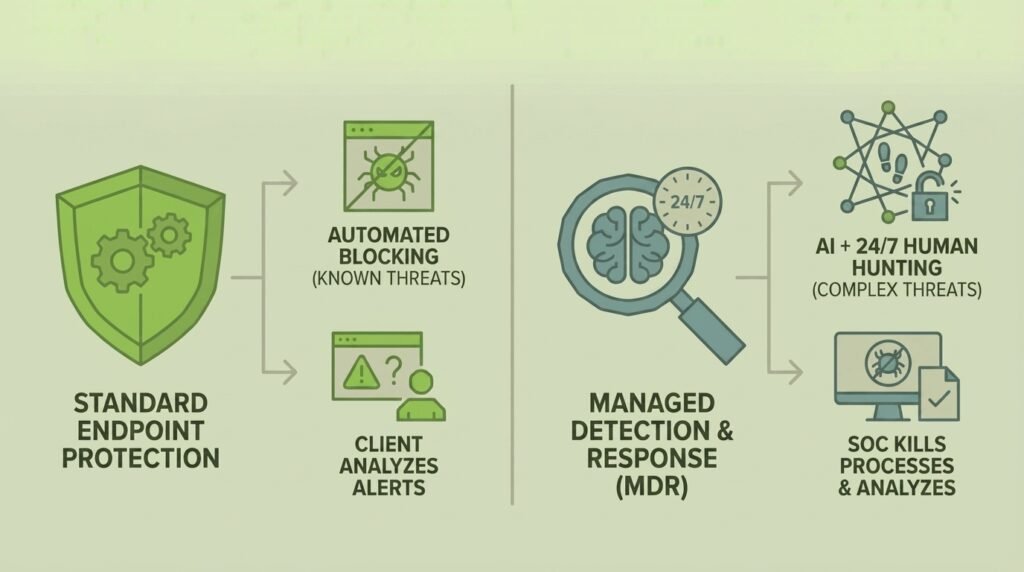
Managed detection and response adds a human-led security operations centre on top of that automation, actively hunting threats and containing them directly rather than just flagging them. See the table below for the full comparison.
| Factor | Standard Endpoint Protection | Managed Detection and Response (MDR) |
|---|---|---|
| Detection method | Automated, signature-based rules | Automated tools + human-led SOC actively hunting threats |
| Who acts on alerts | Internal staff must review and respond | Analysts investigate and contain directly |
| Catches | Known malware strains, automated exploits | Stolen credential logins, lateral movement, living-off-the-land attacks |
| Best fit | Micro-business (under 10 employees), minimal regulatory exposure | FIPA-covered data, regulated sectors, cyber insurance requiring 24/7 oversight |
For a micro-business with fewer than ten employees, minimal regulatory exposure, and a staff member capable of managing occasional alerts, standard endpoint protection may cover the basics adequately. Businesses with distributed teams, sensitive customer data covered by FIPA, operations in regulated sectors such as healthcare or defence contracting, or cyber insurance policies demanding round-the-clock oversight will generally need the fuller coverage that managed detection and response provides.
Free State Resources Worth Using
Not every step toward finding the right Florida cybersecurity providers needs to come with a monthly invoice. Florida has invested in public resources specifically designed to help small businesses assess their risk before committing budget to a paid provider.
Cyber Florida’s Threat Room and Florida Cyber Risk Assessment
Hosted at the University of South Florida in Tampa, Cyber Florida was established by the state legislature to strengthen cyber defence and workforce development statewide. Its Threat Room portal gives small business managers access to current threat advisories, scam alerts, and technical vulnerability reports at no cost. The Critical Infrastructure Protection programme goes further, offering the Florida Cyber Risk Assessment, a customised instance of the CSET tool aligned with the NIST Cybersecurity Framework 2.0, along with standardised incident response plan templates that a business owner can adapt without hiring a consultant.
Florida SBDC Network’s NIST-Based Self-Assessment
The Florida Small Business Development Center Network provides a free online Cybersecurity Awareness Risk Self-Assessment built around the NIST Cybersecurity Framework, which takes about 15 minutes to complete and gives business owners a clear sense of where their weak points lie. Beyond the self-assessment, the network provides no-cost, confidential consulting to help businesses build a customized defence plan, making it a sensible first stop for anyone unsure where to begin.
Compliance Is Now Essential, Not Optional
This is the core argument for working with established Florida cybersecurity providers: treating cybersecurity as an occasional IT chore no longer holds up against the state’s legal and commercial reality. FIPA’s strict notification timeline, the layered demands of CMMC, HIPAA, and PCI DSS, and insurers’ tightened underwriting standards all point in the same direction: businesses that can prove they have reasonable safeguards in place fare far better than those scrambling to explain their absence after a breach.
None of this means every small business needs to sign an expensive contract with Florida cybersecurity providers overnight. Starting with a free risk assessment, understanding which regulations actually apply to a specific business, and then matching that risk profile to an appropriately sized provider builds a far stronger foundation than reacting only once something has already gone wrong. For business owners ready to take that first step, reviewing small business cybersecurity basics before contacting Florida cybersecurity providers is a practical place to begin closing the gap between awareness and real protection.