

Key Takeaways
- Cyber insurance premiums continued to soften through 2025, but projections point to increases in 2026 — and policies are quietly getting stricter — more exclusions, tighter sub-limits, and more conditions tied to proof of security controls.
- How you use AI tools now directly affects your insurance underwriting — both for better and for worse, depending on whether you have governance in place.
- Standard policies often have critical gaps around payment page compromises, account takeovers, and third-party outages — gaps that small e-commerce operators rarely know exist until a claim is denied. Knowing the five policy exclusions that most commonly deny claims is the first step to making sure your policy actually works when you need it.
- PCI DSS 4.0 compliance is no longer just a card-processing checkbox — insurers are using it as a condition for paying out claims after a breach.
- There are concrete, practical steps you can take now to protect yourself before an incident forces the issue — and this breakdown covers all of them.
Buying an e-commerce cyber insurance policy and assuming you’re covered is one of the most expensive mistakes a business owner can make. The fine print in 2026 policies is doing a lot of heavy lifting — and not in your favor. This guide walks through the real picture: where coverage is tightening, what’s quietly being excluded, and how to make sure your policy actually works when you need it most.
Rising Premiums, Shrinking Coverage: The 2026 Reality
Here’s the headline that looks good on the surface: cyber insurance pricing stabilized through 2025, and for businesses with strong security practices, some carriers offered softer baseline rates heading into early 2026. That sounds like a win. But the full picture is more complicated.
S&P Global Ratings projects cyber insurance rates will increase 15-20% in 2026, reversing two years of declining premiums — with the steepest increases falling on businesses that cannot demonstrate strong security controls. At the same time, policies are getting narrower regardless of where premiums land. Insurers are tightening coverage through exclusions, reducing payout caps with sub-limits, and making more coverage conditional on documented security controls. The practical result? You might pay more — while carrying significantly more uncovered risk than before.
This is what some analysts describe as the premium-exclusion gap — a situation where a policy that looks affordable on paper may deliver far less recovery after an incident than expected. For small e-commerce operators running lean without a dedicated IT team, that gap can be the difference between recovering from a breach and shutting down because of one. The core message is consistent: an attractive headline premium can be misleading if you haven’t examined the exclusions, sub-limits, warranties, waiting periods, and evidence requirements underneath it.
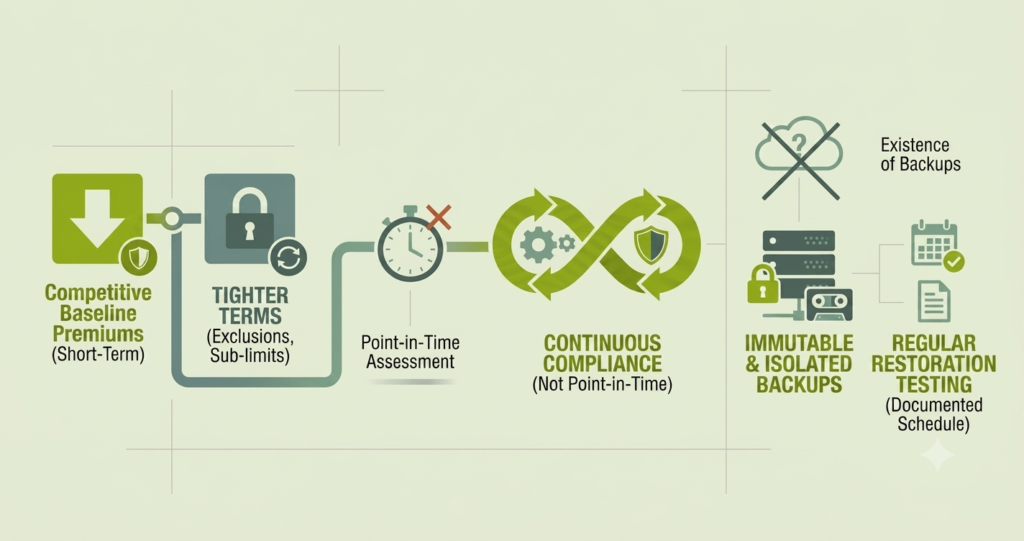
The key underwriting themes shaping e-commerce policies in 2026:
- Baseline premiums that appeared competitive in early 2026 may not hold — S&P projects meaningful rate increases across the year
- Security-control warranties are increasingly central to whether claims get paid
- Exclusions are expanding around AI use, payment-page scripts, tracking pixels, and third-party tech providers
- Documentation has become as important as the security control itself — having a control in place isn’t enough if you can’t prove it was continuously maintained
AI Tools Are Now an Underwriting Issue
Artificial intelligence has moved from a buzzword to a formal underwriting consideration. Insurers are no longer treating AI exposure as something silently bundled into a standard cyber policy. Instead, AI-related risk is being broken out — and assessed based on how a business actually uses it.
Defensive AI Can Work in Your Favor
There’s a meaningful upside here for businesses using AI the right way. E-commerce operators that deploy mature defensive automation — such as automated endpoint detection, vulnerability scanning, secure configuration monitoring, or tools that reduce incident response time — may receive more favorable underwriting treatment. If AI is helping you find and fix problems faster, some insurers will reward that with better terms.
NIST has published an AI Risk Management Framework that some insurers are beginning to reference when evaluating AI governance posture — and aligning internal AI practices with that framework puts businesses in a stronger underwriting position at renewal. Aligning internal AI practices with those guidelines puts businesses in a stronger position at renewal.
Unmanaged AI Use Raises Red Flags
The other side of the equation is more concerning. Insurers are growing cautious about businesses that use AI tools without clear governance in place. During underwriting, expect questions about whether employees can use personal AI tools on company devices, whether customer data is being entered into third-party AI platforms, and whether there’s any human review of AI-generated outputs that affect business decisions.
Common AI-related concerns that can affect your policy:
- Employees using unauthorized AI tools without guidelines or oversight
- Customer or proprietary data entered into third-party AI platforms without controls
- AI-generated content creating intellectual property or privacy exposure
- Deepfake-related fraud or impersonation incidents
- Failing to follow the AI governance procedures disclosed during underwriting
That last point carries real weight. If an application states that AI use is governed by documented policies, but a post-incident review finds those policies were never enforced — or didn’t exist — the insurer may use that inconsistency to challenge coverage. The lesson is straightforward: insurers may reward defensive AI, but they’re increasingly likely to exclude or restrict poorly governed AI risk.
Where Your Policy Has Gaps
Most cyber policies look solid until an actual incident reveals how narrowly they’re written. For e-commerce businesses, three areas consistently produce the biggest surprises at claim time.
Payment Page Compromise: Proving PCI Compliance After a Breach
Payment page compromise is one of the most serious risks for any online retailer. Unauthorized code on a checkout page can silently expose customer payment data — and the financial fallout extends well beyond cleanup costs.
From a first-party standpoint — meaning your own direct costs — business interruption coverage is often limited if your storefront technically stays online and you voluntarily pause checkout to investigate. Many policies require a defined network disruption before business interruption kicks in, meaning a self-imposed shutdown to contain an incident may not qualify.
The larger exposure is usually third-party liability. Customers, payment processors, acquiring banks, and card brands may all bring claims or assessments after payment data is exposed. And here’s the trap most merchants miss: standard cyber policies may exclude payment card liabilities assumed under merchant processing agreements unless a specific payment-card or PCI assessment endorsement has been purchased. Shopify sellers hit this gap especially often — see 5 cyber insurance gaps that void a Shopify merchant’s claim for the platform-specific breakdown. Even with that endorsement, it may carry a dedicated sub-limit — and require proof of PCI compliance to pay out at all.
The practical question to ask your broker: Does the policy explicitly cover payment page compromise, third-party script exposure, PCI assessments, card-brand costs, and related legal defense?
Account Takeovers: When Standard Policies Fall Short
Customer accounts in e-commerce stores hold a lot of value — saved payment methods, loyalty balances, order history, personal data. That makes them attractive targets for attackers reusing credentials stolen from other breaches.
The insurance reality is frustrating: standard cyber policies often won’t reimburse stolen loyalty points, unauthorized purchases made through compromised accounts, refund abuse, or individual customer account losses. Covered first-party expenses typically top out at forensic validation, password reset campaigns, customer notifications, and legal review — not the actual financial losses customers experienced.
Third-party claims in these situations often allege that the merchant failed to implement reasonable controls like rate limiting, multi-factor authentication (MFA), or suspicious login monitoring. If MFA and access controls were represented as active during underwriting — but post-incident evidence shows they were absent or inconsistently applied — that gap between the application and reality becomes a serious claim risk.
Third-Party API Failures: Cyber vs. Tech E&O Disputes
Modern e-commerce stores are deeply connected to external systems — payment gateways, inventory platforms, logistics providers, loyalty programs — mostly through APIs. When an API fails or improperly exposes data due to weak authorization controls, the insurance response can get complicated fast.
The core problem: the API may still be technically running even while it’s returning data it shouldn’t. That makes business interruption coverage hard to trigger. On the liability side, a cyber insurer may call the incident a software design failure, while a Technology Errors and Omissions (Tech E&O) insurer may call it a security event. Both point to the other policy — and the business is left in the middle of a dispute with neither paying.
The best way to close this gap is to place Cyber and Tech E&O coverage with the same carrier, or negotiate policy language upfront that clearly defines which policy responds when a software weakness and unauthorized access overlap. Don’t wait for an incident to find out which coverage was meant to apply.
PCI DSS 4.0 Can Make or Break a Claim
PCI DSS 4.0 — the latest payment card security standard — has quietly become one of the most consequential documents in e-commerce cyber insurance. It’s no longer just a compliance requirement from your payment processor — though it’s worth remembering certification doesn’t cover threats like account takeover, DDoS, or cloud misconfiguration, which sit entirely outside its scope. Insurers are now actively using it in both underwriting and claim decisions.
Continuous Compliance, Not Just Annual Audits
The traditional approach of passing an annual PCI audit and moving on isn’t going to hold up in a claim anymore. Many policies are written with language that treats PCI compliance as a warranty — a promise that controls are continuously maintained throughout the policy period — or as a condition precedent, meaning compliance must be demonstrably in place before the insurer has any obligation to pay.
That’s a significant shift. A single point-in-time assessment doesn’t prove continuous compliance. If an incident exposes that controls drifted between audits, that drift can become the basis for a coverage denial. The standard is no longer “did you pass your last audit?” — it’s “can you prove you maintained controls every day leading up to this incident?” It’s the same shift behind the question of when insurers require a penetration test, not just a scan — proof is replacing self-attestation across the entire underwriting process. For many small businesses, outsourcing to managed security services for small businesses is the most practical way to maintain that continuous documentation.
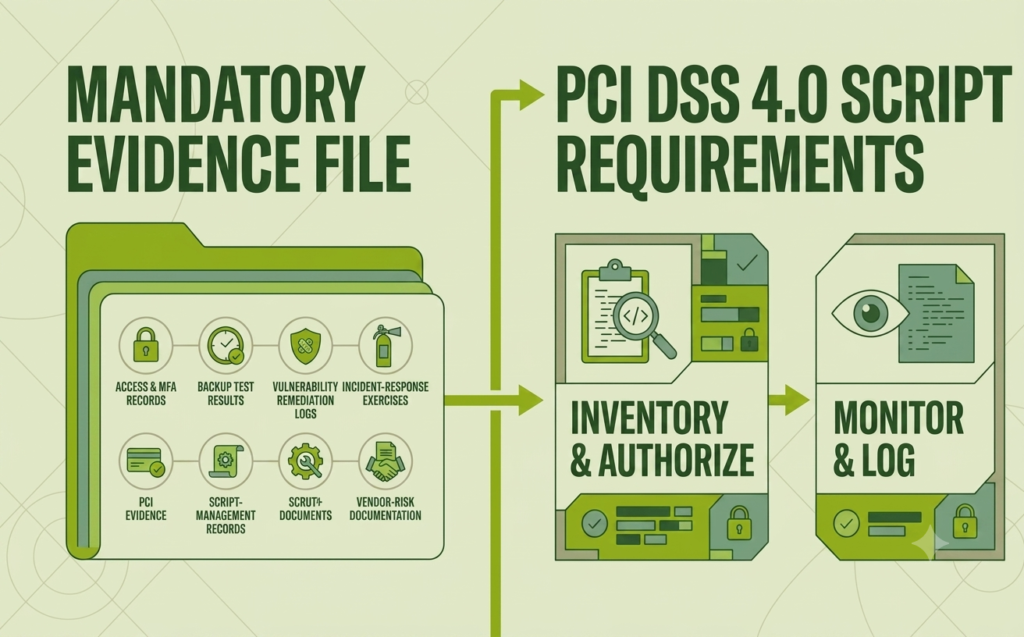
Script Inventories and Tamper Monitoring as Evidence
Two specific PCI DSS 4.0 requirements are getting particular attention from insurers: payment page script management and tamper detection monitoring.
For script management, merchants need a documented inventory of every script running on payment pages, along with the business reason for each one — and only authorized scripts should be permitted to run. For tamper detection, merchants need to actively monitor payment pages for unauthorized changes, unexpected new scripts, or anything that alters how the page behaves, with logs retained in a way that can be presented to insurers or investigators.
These aren’t just technical best practices. They’re increasingly the evidence file that determines whether a payment-related claim gets paid. If clean logs showing continuous monitoring can’t be produced, the claim conversation gets very difficult, very quickly.
Your Tracking Pixels May Not Be Covered
This is one of the least-discussed gaps in e-commerce cyber insurance — and one of the fastest-growing sources of claims. Privacy litigation around website tracking technologies has been accelerating, and insurers have responded by adding exclusions that many business owners have never read.
Wrongful Collection Exclusions Are on the Rise
Many cyber policies now include what’s called a wrongful collection exclusion. These clauses restrict or remove coverage for claims involving the collection, tracking, interception, or sharing of personal information through cookies, pixels, analytics tags, session replay tools, or similar technologies.
The distinction insurers are drawing is important: an external hacker stealing customer data is a security event. A business collecting, sharing, or transmitting user data without valid consent is a business practice. Insurers are generally far less willing to cover liabilities that arise from intentional and systematic business decisions — even if the company didn’t realize it was violating privacy law. Intent doesn’t matter much when the exclusion is written around the conduct itself.
Insurers Are Assessing Pixel Use at Underwriting
This isn’t just a claims issue — it’s showing up at the application stage. Underwriters are increasingly asking about how e-commerce businesses use tracking technologies, what consent mechanisms are in place, and whether the technical behavior of the site actually matches the privacy policy.
The practical protection here is a consent-first tracking architecture: non-essential tags and pixels should not load until a user has given documented consent. Consent records should be auditable and consistent with what’s published in the privacy policy. Running regular technical scans to confirm non-essential trackers are blocked before consent is a meaningful step — and the kind of evidence that demonstrates responsible data practices to both regulators and insurers.
When Your Payment Processor Goes Down
One of the scenarios that hits e-commerce businesses hardest isn’t a direct attack on their own systems — it’s a critical third-party provider going offline. Payment processors, shopping cart platforms, cloud hosts, logistics providers: if any of these go down, revenue stops, even if everything you own is working perfectly. The question is whether your insurance actually covers that.
What Dependent Business Interruption Actually Covers
Dependent Business Interruption (DBI) — sometimes called Contingent Business Interruption — is the coverage designed for exactly this situation. In theory, it covers lost income when a key third-party provider experiences a covered cyber event that disrupts operations.
In practice, the coverage is narrower than most business owners assume. Industry observations from major third-party outages — including incidents involving large payment processors and cloud providers in 2024 and 2025 — consistently show e-commerce companies facing significant uninsured losses because DBI policy wording was too restrictive to respond to the actual circumstances of the event. That outcome is not uncommon.
The Sub-Limit, Vendor Naming, and Waiting Period Problem
There are four specific policy variables that determine whether DBI coverage actually pays out — and all four can quietly eliminate recovery:
- Named vendor requirements: Many policies only cover outages from explicitly named providers. If your payment processor isn’t listed by name, the claim may be denied regardless of the loss.
- Covered event triggers: DBI typically only applies when the outage was caused by a defined cyber event — technical glitches, human error, or misconfigurations are often excluded entirely.
- Waiting periods: Coverage doesn’t start the moment the outage begins. There’s usually a waiting period before the clock starts on a recoverable loss, meaning short outages may produce zero payout.
- Sub-limits: Even where DBI triggers, the maximum payout is often capped at a sub-limit far below total revenue loss — sometimes a fraction of total policy limits.
Before the next renewal, pull out the DBI section of the policy and specifically check for these four variables. Then map them against the actual list of critical third-party providers. If the two don’t align, there’s a gap worth addressing before an outage forces the issue.
Build the Evidence File Before You Need It
Every coverage gap, exclusion, and warranty discussed above shares a common thread: documentation determines the outcome. Having security controls in place isn’t enough if they can’t be proven to have been continuously maintained at the time of the incident. Insurance applications ask high-level questions, but claim investigations go much deeper — comparing what was declared on the application against what was actually running in the environment.
The businesses that recover well from cyber incidents aren’t just the ones with the best defenses. They’re the ones who can hand an insurer a clean, audit-ready evidence file proving those defenses were real and operational. That file should be built before an incident, not assembled in a panic afterward.
Most e-commerce owners assume their cyber insurance policy is solid — until a claim gets denied. Use this quick checklist to identify where your current coverage may have gaps before your next renewal. Each item maps to a real exclusion or condition that insurers are applying in 2026.
E-Commerce Cyber Insurance Gap Checker
Answer 14 questions about your current policy and security controls. We’ll identify which coverage gaps apply to your business.
If you flagged three or more gaps, your policy may leave you significantly exposed — especially around payment page compliance and third-party outages. Before your next renewal, bring these findings to your broker and ask specifically about PCI endorsements, DBI vendor naming, and AI governance documentation. The cost of closing these gaps at renewal is almost always lower than discovering them mid-claim.
Here’s a practical pre-renewal evidence checklist every e-commerce operator should work through:
- ✅ Cyber and Tech E&O coverage are coordinated — no gap between “security failure” and “software failure”
- ✅ Payment-card and PCI assessment coverage is confirmed — including endorsements where needed
- ✅ Payment page script inventory is maintained and current
- ✅ Tamper detection monitoring logs are retained and accessible
- ✅ MFA is enforced for admin, privileged, and key third-party access — with records to prove it
- ✅ Account-abuse controls are active for customer-facing accounts
- ✅ Backups include at least one isolated or immutable copy — and restoration tests are documented
- ✅ Consent management technically blocks non-essential tracking before consent is recorded
- ✅ Tracking pixels and tags are scanned regularly for unauthorized additions
- ✅ Critical vendor dependencies are mapped and checked against DBI policy wording
- ✅ Business interruption calculations are supported by revenue records
- ✅ AI governance policies are documented if AI tools are used anywhere in the business
- ✅ Incident response roles and procedures are written down — not just assumed
- ✅ Every underwriting answer can be backed by actual evidence
This isn’t a one-time exercise. The shift happening in cyber insurance is toward continuous, documented compliance — not annual checkbox reviews. The merchants who come out ahead will be the ones who treat their evidence file like a living document, updated alongside their security controls, and ready to present at any point in the policy period.
For small e-commerce operators looking for clear, practical steps to build this kind of security foundation, start with a free cyber insurance readiness check, a plain-English look at how your store measures up against the controls insurers commonly ask about, in about three minutes, built specifically for businesses running without a dedicated IT team.