


Key Takeaways
- PCI DSS is a critical baseline for protecting payment data, but its scope is intentionally limited to the Cardholder Data Environment (CDE) – leaving the ecommerce security risks PCI compliance doesn’t cover wide open across large parts of your online store.
- Account takeovers, malicious scripts, bot attacks, and business logic exploits are all real threats that PCI compliance was never designed to stop.
- Non-payment customer data – including shipping addresses, email addresses, and purchase history – sits completely outside PCI’s protection, exposing you to GDPR and CCPA liability.
- The average cyberattack costs a small business around $254,000, and roughly 19% of small businesses face a real risk of bankruptcy following a serious breach, according to Verizon’s 2025 DBIR.
- Staying truly secure means treating PCI compliance as a starting point, not a finish line – and there are practical, non-technical steps any business owner can take to close the gaps.
Ecommerce security risks PCI compliance doesn’t cover are exactly why a PCI-compliant store can still get breached. If you run an online store and you’re PCI compliant, that’s genuinely good news – but here’s the uncomfortable reality: compliance with PCI DSS tells you your payment processing environment meets a defined standard. It says almost nothing about the security of the rest of your store – and that “rest” is where most modern attacks actually happen.
PCI Compliance Has Limits – and Evolving Threats Are Exploiting Them
PCI DSS (Payment Card Industry Data Security Standard) was built to protect one specific thing: cardholder data. It does that reasonably well. But e-commerce businesses are complex ecosystems – customer accounts, marketing scripts, APIs, loyalty programs, shipping data – and most of that ecosystem sits well outside what PCI was ever designed to cover.
The problem is not that PCI DSS is a bad standard. Treating it as a complete security solution is a dangerous assumption – one that leaves the ecommerce security risks PCI compliance was never built to catch completely unaddressed. Law firms hit the identical wall with their own compliance frameworks — see 9 cyber risks law firms miss even when fully compliant. Cybercriminals have figured this out. They routinely bypass payment systems entirely, targeting the unprotected parts of a store instead. Resources like TechEd Shield exist specifically to help small business owners understand this gap – translating the technical complexity of modern cyber threats into clear, actionable steps that don’t require an IT department.
What PCI DSS Actually Covers (And What It Doesn’t)
The CDE Boundary Problem
PCI DSS protects the Cardholder Data Environment – the systems that store, process, or transmit payment card data. That’s it. To keep compliance costs down, most businesses use network segmentation to wall off their CDE from everything else. Smart move for audit purposes. But it creates a very clear map for attackers: everything outside that wall is less defended.
Your customer login portal, your marketing analytics scripts, your product search API, your loyalty rewards system – none of these typically touch raw card data, so none of them fall under PCI’s protection requirements. This is where the real ecommerce security risks PCI compliance leaves open start to add up.
Why Network Segmentation Can Work Against You
The very segmentation designed to reduce your compliance burden can increase your overall risk. When security resources and attention are funneled into the CDE, adjacent systems get less scrutiny. Attackers don’t need to crack your payment vault if they can walk through an unlocked side door. Common issues – like weak access controls or improperly stored customer information – compound the problem, creating vulnerabilities even within a technically compliant environment.
Account Takeovers: Your Customer Login Is the Open Door
Account Takeover (ATO) is one of the fastest-growing ecommerce security risks PCI compliance doesn’t touch, and one of the fastest-growing threats in e-commerce overall. Attackers buy leaked username and password combinations from previous data breaches – available cheaply on the dark web – then use bots to try those credentials across thousands of stores simultaneously. This is called credential stuffing, and it has become a widespread and largely automated threat.
How Credential Stuffing Bypasses Standard Alerts
The reason it’s so hard to catch is that the attacker logs in with a real password. To your system, it looks like a legitimate customer. Once inside, they can drain loyalty points, redirect shipments, save new payment methods, or quietly harvest personal data. No alarm goes off because nothing technically broke in.
Where PCI’s MFA Rules Stop at the Storefront
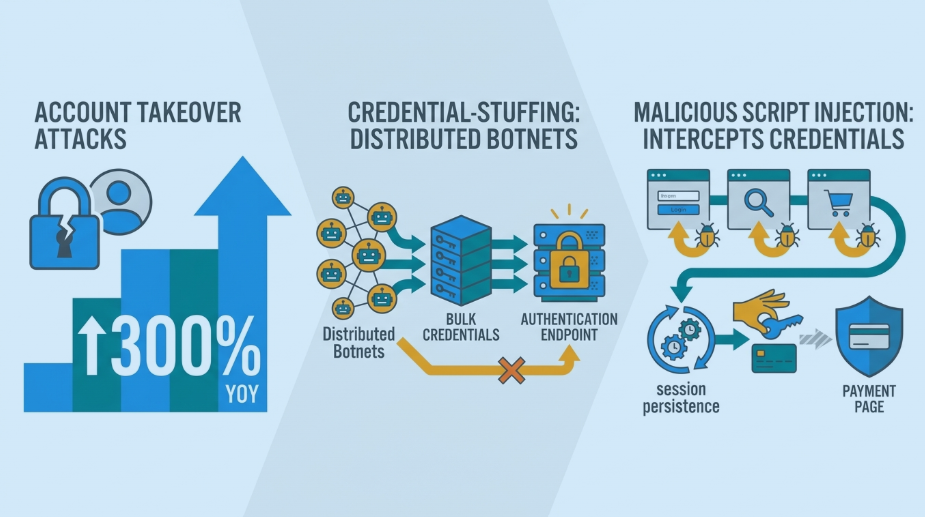
PCI DSS v4.0.1 Requirement 8.4 mandates multi-factor authentication (MFA) for all access into the CDE, whether by administrators or general staff. Customer-facing login pages are not covered. Because customer portals don’t store raw card numbers (they use tokenized payment data), they’re segmented out of the CDE scope entirely. That means your customers’ accounts may be protected by nothing more than a reused password.
Malicious Scripts Are Stealing Card Data Between Formal Scans
The Magecart Playbook
Magecart attacks are a category of supply chain attack where malicious JavaScript is quietly injected into a checkout page – often through a compromised third-party tool like a chat widget, analytics tracker, or CDN library. As a customer types their card number, the script copies it in real time and sends it to an attacker-controlled server. The store owner sees nothing unusual.
These Magecart-style attacks are among the most damaging ecommerce security risks PCI compliance can miss entirely, and they are not hypothetical. British Airways had 380,000 customers’ payment details stolen via this exact method. Ticketmaster was hit the same way. Magecart-style attacks have affected thousands of hosts globally, and most victims had no idea anything was happening while it occurred.
The Gap Between Formal Scans and Continuous Threats
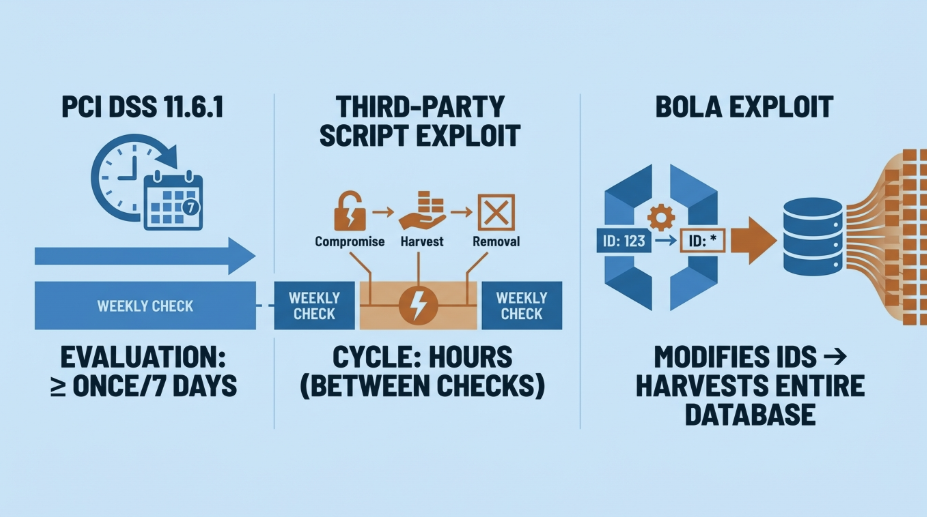
PCI DSS v4.0.1 does address this – Requirements 6.4.3 and 11.6.1 require script inventories and change-detection monitoring on payment pages. But the official testing procedures allow compliance checks at least once every seven days. An attacker can inject a script, harvest thousands of card numbers, and remove all evidence within a few hours – well inside that weekly window. Worse, if the malicious script is injected on a page before the checkout page (like the login or cart page), it may not be covered by PCI’s scope at all.
Bot Attacks PCI Was Never Built to Stop
Credential Stuffing, Carding, and Inventory Hoarding
Bot attacks are among the most persistent ecommerce security risks PCI compliance leaves unaddressed, and a widespread problem for e-commerce stores generally. PCI DSS Requirement 1 focuses on firewalls and network traffic routing – it has no specific provisions for stopping bots that mimic legitimate human behavior at the application layer. Three bot-driven threats hit e-commerce stores hardest:
- Credential stuffing – automated login attempts using stolen passwords.
- Carding – bots make small test purchases to verify stolen card numbers before selling them or using them for larger fraud.
- Inventory hoarding – bots reserve limited-stock items without completing purchase, locking out real customers and enabling resale scalping.
All three look like normal traffic to a standard firewall. Stopping them requires behavioral analysis tools that operate at the application layer – tools PCI compliance doesn’t require you to have. See our roundup of the best cybersecurity tools for small businesses with no IT team for options that cover this without a dedicated security hire.
Business Logic Flaws That Traditional Scanners Struggle to Detect
Business logic flaws round out the list of ecommerce security risks PCI compliance can’t detect – exploits that abuse how your store is supposed to work, rather than breaking anything technically. Classic examples: intercepting an order request and changing a $100 item price to $0.01, submitting 100 simultaneous redemption requests for a one-time coupon code before the system marks it as used, or skipping the payment step entirely by calling the order-confirmation page directly.
Automated vulnerability scanners – the kind used in PCI-required quarterly scans – check for code-level issues like SQL injection or outdated software. They cannot understand your business rules. They don’t know that a coupon should only be redeemed once, or that a price shouldn’t be modifiable by the user. These flaws require manual, context-aware testing to find – and PCI doesn’t mandate that level of scrutiny for non-CDE systems.
Non-Payment Customer Data Is Outside the Compliance Fence
Shipping, Email, and Purchase History Are Fair Game
Non-payment data exposure is one of the more overlooked ecommerce security risks PCI compliance ignores. Think about what your store actually holds beyond card numbers: full names, home addresses, email addresses, phone numbers, order histories, browsing behavior. None of this is cardholder data. All of it is segmented outside the CDE. All of it sits completely outside PCI’s protection requirements – and all of it is highly valuable to attackers for identity theft, phishing, and fraud.
The Real Regulatory Risk: CCPA and GDPR Fines
Here’s where the stakes get serious for small businesses. While PCI handles payment data, CCPA and GDPR govern all personal data. A breach of customer shipping addresses or email lists doesn’t trigger PCI penalties – but it absolutely triggers GDPR and CCPA liability. These are separate regulatory regimes with their own fines, and being PCI compliant provides zero defense against them.
The True Cost of These Gaps for Small Businesses
Small businesses are disproportionately targeted. 46% of all cyberattacks target businesses with fewer than 1,000 employees – largely because limited budgets, smaller teams, and no dedicated IT support make them easier targets. The financial consequences are severe: the average cost of a cyberattack for a small business is approximately $254,000, with long-term losses potentially exceeding $1 million. Most critically, Verizon’s 2025 DBIR puts real bankruptcy risk after a cyberattack at around 19% for small businesses.
Web applications are now the top venue for retail breaches, yet the standard designed to protect retail payments doesn’t fully address how web applications are actually attacked today. That gap leaves businesses exposed on both the compliance front and the broader security front at the same time.
PCI compliant doesn’t mean fully protected. Check which of these gaps your store has actually closed.
The PCI Blind Spot Checker
Check every gap your store has already closed.
PCI DSS was never designed to cover any of the items above — that’s not a compliance failure, it’s a scope limit. Closing these gaps is a separate job, and it’s one worth doing before an attacker finds the box PCI never checked.
PCI Compliance Is the Floor – Not the Ceiling of Your Protection
PCI DSS is worth having, and it forces good habits around payment data, network segmentation, and access controls – but it doesn’t close every one of the ecommerce security risks PCI compliance leaves behind. The same principle holds outside ecommerce too — see the 7 critical areas a small business security audit actually covers. But it was designed to protect a specific data type in a specific environment – not to serve as a complete security strategy for a modern online business.
The threats actually hitting small e-commerce stores right now – account takeovers, injected scripts, bot fraud, logic exploits, and non-payment data theft – largely fall outside what PCI was built to address. Closing those gaps doesn’t require becoming a security expert overnight. Understanding where the real risks are, prioritizing the actions that matter most, and building security habits that go beyond a compliance checklist are the steps that make the real difference.
For small business owners looking to understand and close these gaps without needing a technical background, TechEd Shield offers straightforward cybersecurity education and practical tools built specifically for businesses running without IT support. Take the free Cybersecurity Health Check to see which of your store’s gaps need attention first.