


Key Takeaways
- Small healthcare clinics typically pay between $1,500 and $7,000 per year for cyber insurance, depending on revenue, patient record volume, and security controls in place – though clinics with weaker controls or prior breach history can see quotes reach $15,000 or more.
- Healthcare pays more than almost every other industry, because patient data is uniquely valuable and frequently targeted.
- A $1 million policy sounds like solid protection, but hidden sub-limits can cap your ransomware payout at just $250,000.
- Nearly 1 in 4 cyber insurance claims gets denied – often because a clinic let a required security control slip after the policy was signed.
- Simple security steps like enabling multi-factor authentication (MFA) can reduce your annual premium by 10-20%.
Cyber insurance for small clinics is not one-size-fits-all – and the price tag alone does not tell the whole story. What your policy actually covers when disaster strikes depends on details most clinic owners never read until it is too late.
What Small Clinics Actually Pay
For most small healthcare clinics with annual revenues under $5 million, cyber insurance premiums typically fall between $1,500 and $7,000 per year for a $1 million policy. That said, healthcare clinics generally sit at the higher end of small-business pricing. A solo practitioner or micro-clinic with fewer than five staff members may find basic coverage starting near $1,500, but many small medical practices begin closer to $2,500-$3,500. Practices with 20 to 99 employees handling larger patient volumes generally land in the $3,000-$7,000 range. Clinics with weak security controls or a prior breach history can see quotes reach $15,000 or higher.
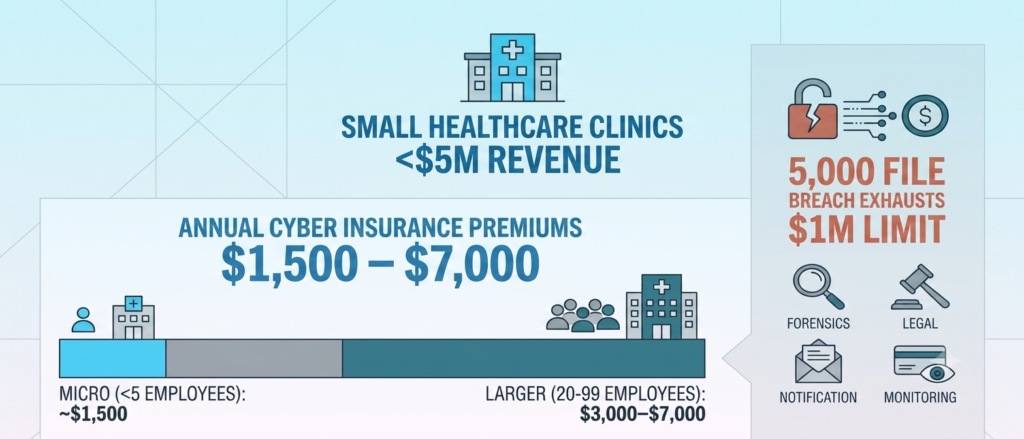
Where your clinic lands depends on three things: how much revenue you bring in, how many patient records you store, and how seriously you have locked down your systems.
TechEd Shield breaks down the real-world cost drivers behind these numbers, including how security audit and compliance costs stack up against premiums, and helps non-technical clinic owners understand what they are actually buying – and what gaps their policy might be leaving open.
Why Healthcare Pays More Than Other Industries
The broader cyber insurance market has gotten cheaper for many industries, with average premium reductions of around 11% for lower-risk sectors. Healthcare has not enjoyed that same trend. Premiums for medical providers continue to edge upward year over year.
The reason is straightforward: patient health data is extraordinarily valuable on the black market. A stolen credit card number sells for a few dollars. A complete medical record – with insurance details, Social Security numbers, and diagnosis history – can fetch many times more. That makes clinics a high-priority target, and insurers price accordingly.
Small clinics face a particularly difficult position. They are held to the same federal HIPAA security standards as major hospital networks, but they defend their systems on a fraction of the budget.
Is a $1M Policy Enough for Your Clinic?
A $1 million aggregate policy is the standard target for small clinics in the $1,500-$7,000 premium range – and it sounds like more than enough. In practice, a single serious breach can push against that limit fast. Forensic investigation, legal counsel, patient notification services, and credit monitoring for even 5,000 affected records can exhaust the full limit before any lawsuit or regulatory fine is paid.
The Sub-Limits That Catch Clinics Off Guard
The headline number on a cyber policy is the aggregate limit – the absolute maximum the insurer will pay across all claims combined. Buried in the policy language are sub-limits: separate, lower caps that apply to specific types of losses. These are part of the overall policy limit, not extras on top of it — a dynamic that plays out just as painfully in other industries, like the $160,000 sub-limit gap hitting real estate firms after wire fraud.
A few sub-limits that frequently surprise clinic owners:
- Social engineering and wire fraud: Often capped at just $50,000-$100,000, even on a $1M policy.
- Business interruption: May carry an 8-12 hour waiting period before coverage kicks in, acting as a time-based deductible.
- Regulatory fines and HIPAA penalties: Frequently sub-limited to $250,000-$500,000 – and excluded entirely if the clinic showed willful neglect.
Ransomware Payouts Are Often Capped at $250K
Ransomware coverage is one of the most dangerous sub-limits in small clinic policies. Even with a $1 million policy in hand, the ransomware-specific payout is routinely capped at $250,000 to $500,000 via endorsement. Some policies also include a co-insurance clause, meaning the clinic absorbs a percentage of the ransom cost out of pocket.
The 2026 federal court ruling in CiCi Enterprises, LP v. HSB Specialty Insurance Company showed that courts can push back on overly vague ransomware sub-limits – ruling in favor of the policyholder when the endorsement language was too ambiguous to clearly restrict the broader coverage. Tighter endorsement language is already being rolled out across the market in response.
Security Controls That Determine Your Premium
Insurers do not just ask whether you have security tools in place – they want documented proof. The shift from questionnaire checkboxes to verifiable technical audits is one of the defining changes in modern cyber underwriting — a shift covered in more depth in our breakdown of when insurers require a penetration test. Three controls carry the most weight.
MFA: The Non-Negotiable Baseline
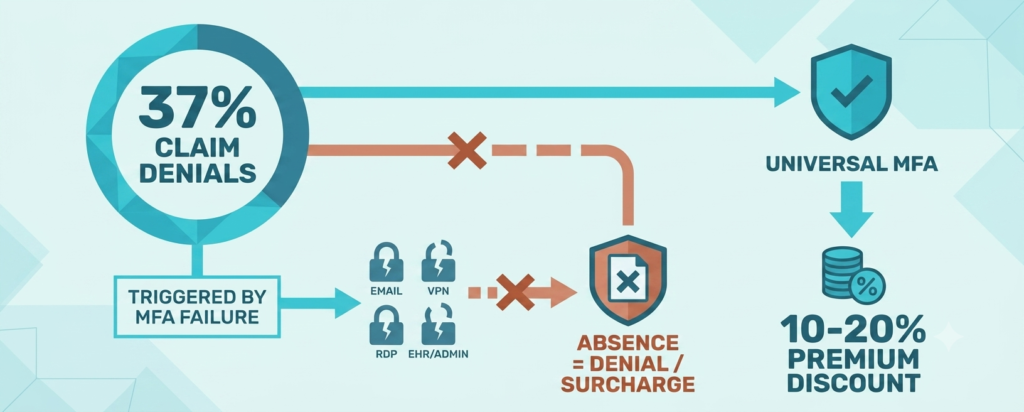
Multi-factor authentication (MFA) is the single most important item on any underwriter’s list. It must be enforced on every access point that touches your clinical environment – web-based email, cloud systems, VPNs, remote desktop connections, your EHR platform, and any admin accounts.
Basic SMS text-message verification is increasingly viewed as insufficient, since SMS and push-based MFA can still be bypassed by real-time relay attacks. Insurers now favor authenticator apps, push notifications, or hardware security keys. Clinics that can demonstrate universal MFA enforcement typically earn a 10-20% premium discount. Those that cannot may face outright denial or a 200%+ surcharge.
EDR: Why Antivirus Is No Longer Enough
Traditional antivirus software – the kind that checks files against a list of known threats – no longer meets underwriting standards. Insurers now require Endpoint Detection and Response (EDR) tools on all workstations and servers. EDR uses behavioral analysis to catch threats that do not match any known signature, including new ransomware variants.
EDR must be actively monitored, either by an internal team or a 24/7 managed detection and response (MDR) provider. Listing only standard Windows Defender or a consumer-grade antivirus without centralized oversight leads to premium surcharges of 30-50%, or a rejected application altogether.
Backup Rules Insurers Require
Backup practices are evaluated under what the industry calls the 3-2-1 rule: three copies of your data, stored on two different types of media, with at least one copy kept offsite or completely offline in an air-gapped environment. The offline copy is critical – ransomware that can reach your backup server will encrypt it too.
Beyond the architecture, insurers want proof the backups actually work. Documented restoration drills – with system-generated logs showing a successful recovery – are required at least once per year. Missing this step can result in ransomware coverage being excluded from your policy entirely.
How Much Good Security Can Cut Your Premium
Security controls do not just unlock coverage – they directly lower what you pay. Here is what verified documentation of each control is worth:
- Universal MFA enforced: 10-20% premium reduction
- Phishing-resistant MFA (hardware keys or number-matching): Additional 5-10%
- EDR with 24/7 SOC oversight: 10-15% reduction
- Immutable or offline backups: 10-15% reduction
- Tested incident response plan (documented within the past 12 months): 5-10% reduction
Stack these controls together and a clinic that would otherwise pay $5,000 annually could realistically bring its premium below $3,500 – while also being dramatically better protected.
You’ve seen the ranges. You’ve seen what MFA, EDR, and offline backups can shave off a premium. Now put your own clinic’s numbers into it. This quick estimator uses the pricing bands and discount percentages covered above to give you a realistic starting range — not a quote, but a far better guess than the sticker price on a generic policy.
Your estimate is only as good as your documentation. Insurers do not take your word for MFA or EDR coverage — they want configuration exports, admin logs, and restoration records to back it up. Use this number as a target, then build the evidence file that proves you’ve earned it.
HIPAA Fines Your Policy May or May Not Cover
Cyber insurance and HIPAA compliance overlap more than most clinic owners realize. A breach does not just cost you to fix – it can trigger a federal investigation and civil monetary penalties on top of everything else. Whether your policy covers those fines depends on which category your violation falls into.
The Four Penalty Tiers Insurers Watch
HIPAA penalties are structured in four tiers based on the level of fault. The statutory annual cap is $2,190,294 per violation category, though OCR currently applies lower discretionary caps for Tiers 1-3 (roughly $36,500-$365,000) — only Tier 4 carries the full cap in practice:
- Tier 1 – Unknowing Violation: $145-$73,011 per violation. The clinic had no reasonable way to know. Policies typically cover defense costs and fines here.
- Tier 2 – Reasonable Cause: $1,461-$73,011 per violation. The clinic should have known but could not fully prevent it. Usually covered.
- Tier 3 – Willful Neglect (Corrected): $14,602-$73,011 per violation. The clinic knew and did not act – but fixed it within 30 days. Coverage becomes conditional.
- Tier 4 – Willful Neglect (Uncorrected): $73,011-$2,190,294 per violation. The clinic knew, did not act, and did not correct it. Policies routinely exclude this tier entirely.
The HHS Office for Civil Rights has increased enforcement actions against small and mid-sized providers specifically – not just large hospital systems. In the Bryan County Ambulance Authority case, a $90,000 settlement was accompanied by a three-year federal corrective action plan. In the Vision Upright MRI case, OCR settled for just $5,000 despite a breach affecting nearly 22,000 patients — showing that even the smallest providers face enforcement for skipping a required risk analysis.
Why So Many Cyber Claims Get Denied
According to NAIC’s 2025 Cybersecurity Insurance Report, nearly three-quarters of closed 2024 cyber claims received no payout — though this includes claims below deductible or withdrawn by the policyholder, not just formal denials. Separate industry tracking estimates 20-27% of claims involve policy exclusions tied to controls like MFA, unpatched systems, and late breach notification.
The $18.3M MFA Mistake of the City of Hamilton
In February 2024, the City of Hamilton, Ontario suffered a ransomware attack that knocked out critical municipal systems for months. The attack — carried out by an unidentified but sophisticated ransomware group, according to city officials — has been linked by the city’s insurer to a gap in MFA enforcement, though city leadership disputes that MFA was the deciding factor. Restoration costs and operational losses were estimated at approximately $18.3 million CAD. While Hamilton is a municipality rather than a clinic, the insurer’s “root cause” finding and resulting $18.3 million bill mirror what insurers cite in denied healthcare claims daily — though Hamilton officials have disputed that MFA alone determined the outcome.
Misrepresenting Controls Can Void Your Policy Entirely
If a clinic states on its application that MFA is enforced everywhere – and an investigation after a breach shows it was not – the insurer can void the policy retroactively from the date it was issued. This is called rescission from inception, and it leaves the clinic with zero coverage for the incident, regardless of what was paid in premiums.
This risk applies to unintentional misrepresentations too. The Columbia Casualty Company v. Cottage Health System dispute illustrates the exposure: the insurer alleged Cottage had misrepresented its security controls on its application and sought to avoid paying a $4.125 million settlement tied to a breach of about 32,500 patient records. The case was ultimately dismissed on procedural grounds before the coverage dispute was resolved on the merits, so it’s a cautionary example rather than binding precedent.
Maintaining Coverage Is as Important as Buying It
Buying a policy is the starting line, not the finish. What determines whether a claim gets paid is whether the clinic maintained everything it promised in the application – every day of the policy term, not just at renewal.
A few practical steps that make a real difference:
- Run a controls gap assessment 60-90 days before renewal to catch any drift from your stated security posture before the insurer does.
- Keep an evidence file with configuration exports, admin policy logs, and backup restoration records – having these ready speeds up claims and counters disputes.
- Know your panel vendors. Most policies require you to use the insurer’s pre-approved forensic and legal teams. Hiring outside those vendors without approval can trigger a denial on cooperation grounds.
- Verify your retroactive date when switching carriers. Advancing this date at renewal creates an uninsured gap for any breach that was silently underway before the new policy started.
Cyber insurance works best when treated as an ongoing risk management practice – not a one-time purchase. Many of the same MFA, vendor-outage, and audit-evidence gaps show up across the five cyber insurance gaps medical practices miss most, and a free cybersecurity health check is a good place to start closing the gap between what your policy assumes and what your clinic actually has in place.
The clinics that get paid when it matters are the ones that kept their controls current, documented their compliance, and read the fine print before they needed it.