


Key Takeaways
- Regulatory compliance sets a baseline – it does not prevent sophisticated, targeted cyberattacks against law firms.
- MFA can be fully bypassed through session token hijacking, a method increasingly used in MFA-bypass incidents and well-documented by major security vendors.
- Deepfake voice fraud, poisoned eDiscovery files, and metadata leaks are active threats that standard compliance audits never address.
- Supply chain risk extends beyond direct vendors – unvetted AI sub-processors embedded in compliant tools can silently route client data to unauthorized third parties.
- Understanding where these cyber risks law firms miss hide is the first step; the sections below break down each risk with real-world scenarios and concrete fixes.
Cyber risks law firms miss are often hiding in plain sight, even at firms that hold some of the most sensitive data in existence – merger details, trade secrets, litigation strategy, client finances. That makes them a top-tier target. A firm can pass every compliance audit on the calendar and still be one phishing link away from a catastrophic breach. The average data breach at a law firm now costs $5.08 million – 14% higher than the cross-industry average – and that number keeps climbing. Accounting firms face the same dynamic under GLBA and the FTC Safeguards Rule — see how much cyber insurance actually costs for accounting firms. TechEd Shield covers the gap between checking compliance boxes and actually being secure, and the nine risks below are exactly where that gap lives.
Compliance Checks a Box. Attackers Don’t Care.
Compliance frameworks like the ABA Model Rules, GDPR, and ISO 27001 were built to establish minimums – not to anticipate every tactic a motivated attacker will use next quarter. This is the same gap a standard audit leaves open — see the 7 critical areas a small business security audit covers for what a baseline review actually checks. In the past year alone, 20% of U.S. law firms were targeted by cyberattacks, with 8% suffering actual data loss. Compliance didn’t stop any of it. The sections below cover the cyber risks law firms miss most often – the ones that live just outside the audit checklist.
MFA Isn’t Enough When Attackers Steal Your Session
How Token Hijacking Bypasses MFA Entirely
Session hijacking works by stealing a valid session token after the user has already authenticated – meaning MFA has already done its job and the attacker still gets in. Using Adversary-in-the-Middle (AitM) phishing proxies or malicious OAuth consent requests, attackers intercept the session cookie and import it directly into their own browser. The server sees a recognized, authenticated session and raises no alert. Security researchers and major vendors have consistently identified session token abuse – not stolen passwords – as the dominant method behind MFA-bypass incidents. Even without this bypass, incomplete MFA rollout alone is enough to void a cyber insurance claim — see our MFA gaps: is your law firm’s cyber claim at risk? guide.
What’s Actually at Risk Inside Your DMS
Session hijacking is one of the cyber risks law firms miss most often, because for a law firm, a compromised session means silent, persistent access to the Document Management System (DMS) – deposition drafts, deal memos, privilege logs. The fix isn’t to abandon MFA; going further is what closes the gap. FIDO2 or WebAuthn hardware security keys bind authentication to the legitimate domain, making AitM proxies useless. For the full seven-control framework this fits into, see our 7 ways law firms can prevent client data breaches. Note that “MFA enabled” is also just the baseline insurers check — see does cyber insurance require a pen test or vulnerability scan for what else they verify. Pairing that with short token lifetimes (10-12 hours) and device-bound token policies significantly narrows the window of exposure.
Deepfake Wire Fraud Is a Corporate Reality – and a Legal Sector Warning
The $25M Transfer That Fooled a Multinational Firm
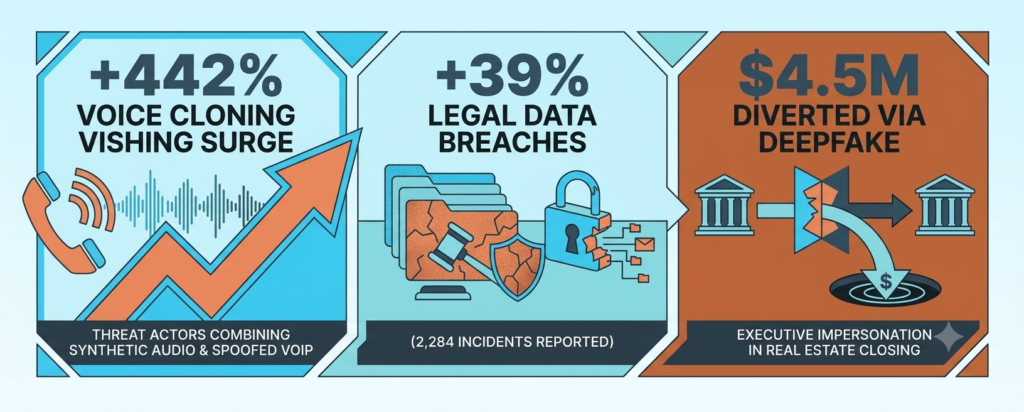
In 2024, an employee at Arup Group’s Hong Kong office was tricked into wiring $25.6 million to fraudsters who ran a deepfake video call impersonating the company’s CFO. The voice, the face, the cadence – all synthetic. Deepfake incidents in the fintech sector surged 700% in 2023, according to Deloitte, and the legal sector faces comparable exposure given the high-value wire transfers tied to real estate closings, settlements, and escrow accounts. See our breakdown of the real estate cyber insurance gap for how this same fraud pattern plays out on the closing side.
Why Email Authentication Can’t Stop a Cloned Voice
DMARC, DKIM, and SPF verify email headers. They do nothing when the attack arrives as a phone call from a spoofed number carrying a cloned voice. The countermeasure has to be procedural: a strict out-of-band callback protocol to a pre-registered number for any changes to wire instructions, combined with a pre-arranged verbal code word that a synthetic voice can never guess. Reducing public audio of firm leadership – conference recordings, webinar clips – also shrinks the training data available to attackers.
Your Forensic Report Could Become Evidence Against You
When Privilege Doesn’t Protect Post-Breach Findings
Forensic report exposure is one of the more overlooked cyber risks law firms miss – after a breach, firms instinctively call their IT security vendor. The problem is how that call is structured. If the forensic investigation is initiated under a standing Master Service Agreement managed by the IT department, courts routinely rule the resulting report was created for ordinary business purposes – and order it produced in discovery. That report, which may document years of unpatched systems, becomes a roadmap for plaintiffs’ counsel. The fix is structural: outside legal counsel must retain the forensic vendor under a dedicated, matter-specific Statement of Work that explicitly names anticipation of litigation as the purpose. Factual remediation tasks and legal exposure analysis must be kept in separate documents.
Vetted Vendors, Unvetted Sub-Processors
AI Quietly Embedded in Third-Party Legal Tools
Shadow AI is quietly becoming one of the cyber risks law firms miss entirely – a SOC 2-certified contract drafting platform is not the same thing as a secure platform. Many legal tech vendors have silently embedded generative AI engines – OpenAI, Anthropic, Google Gemini – into their products through API integrations. When a firm uploads a client document into that compliant tool, the document may be routed programmatically to an unvetted fourth-party AI sub-processor in a jurisdiction that doesn’t recognize legal privilege. GDPR Article 28 prohibits exactly this kind of unauthorized sub-processing, but the violation happens invisibly. Ecommerce businesses face a parallel exposure with non-payment customer data sitting entirely outside PCI’s scope — see 9 ecommerce security risks PCI compliance leaves unprotected.
How Client Data Reaches Unauthorized Fourth Parties
The proliferation of unauthorized AI tools – sometimes called shadow AI – is one of the fastest-growing threats to client confidentiality. Vendor contracts need non-delegable data-sovereignty clauses that explicitly prohibit routing client data to sub-processors without prior written authorization. Every major vendor update should also trigger an architecture review to verify where processed data actually travels.
eDiscovery Files Are an Open Door for Malware
Among the cyber risks law firms miss, eDiscovery files rank high – large eDiscovery productions are trusted by default. They’re whitelisted on firewalls, exempt from size-restricted scanning, and loaded directly into review platforms – which makes them an ideal delivery mechanism for malware. Sophisticated attackers embed malicious macros in Excel files or exploits in PDFs, buried inside compressed folders of native database files. The fix requires isolated, network-segmented environments for all incoming productions, multi-engine heuristic scanning in both directions, and global disabling of active scripting on litigation support workstations.
Documents You Send May Expose More Than You Think
Metadata That Reveals Settlement Strategy
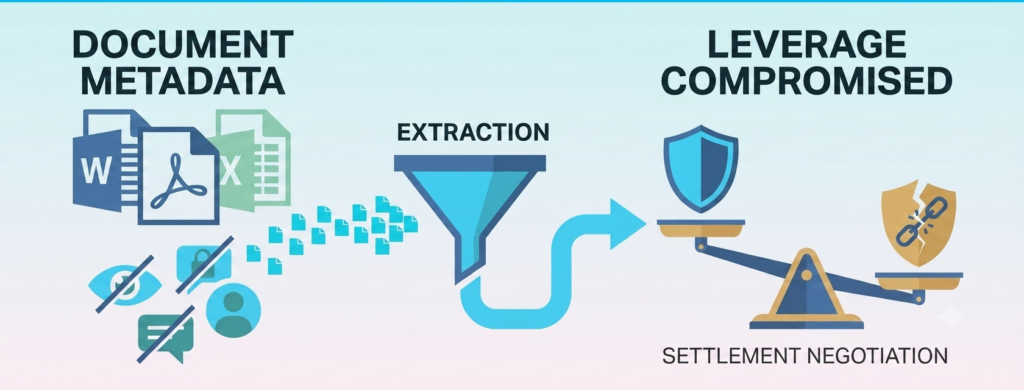
Metadata leaks round out the cyber risks law firms miss most consistently – every Word document and PDF carries hidden XML metadata: tracked changes, deleted comments, author names, revision history. Sending files without stripping this data is an ethical violation under MRPC 1.1 and 1.6 – and a negotiating disaster. In a high-stakes trade secret dispute, opposing counsel running basic forensic metadata analysis could uncover tracked edits that reveal a client’s internal vulnerabilities and their authorized settlement floor. Automated gateway metadata scrubbing and a firm policy of PDF distillation before any outbound transmission eliminates this exposure.
Three More Risks Hiding in Plain Sight
Misconfigured DMS Permissions That Undermine Ethical Walls
Many legacy DMS platforms use fail-open permission models – if an integration error occurs during a system upgrade, the software defaults to granting broad access rather than denying it. A single IT migration event can silently collapse an ethical wall, exposing active litigation files to a conflicted lateral partner. Under MRPC 1.10, that single failure can trigger firm-wide disqualification. The only safe configuration is fail-closed: deny access on any resolution error, and run automated hourly audits of DMS access control lists to catch drift immediately.
Unprotected Client Intake Portals Before Retainer Is Signed
Intake portals live on public-facing web servers managed by marketing vendors, not security teams. The duty of confidentiality begins before a retainer is signed – UK-regulated firms are bound by this even at the prospective-client stage under SRA Code of Conduct Paragraph 6.3, and U.S. firms face comparable exposure under ABA Model Rule 1.18’s protections for prospective clients. A whistleblower who uploads sensitive corporate documents through a portal with an insecure API endpoint is fully exposed if that portal is compromised. Zero-knowledge encryption at the browser level, single-tenant hosting, and regular web application penetration testing are non-negotiable for any public intake infrastructure.
Legacy Logging Gaps That Leave Breaches Invisible
Older logging infrastructure – particularly on legacy DMS platforms or systems running past end-of-life – frequently lacks the granularity to detect lateral movement, privilege escalation, or quiet data exfiltration. Attackers who gain access through any of the methods above can operate for weeks without triggering an alert. Firms that delay infrastructure upgrades to control costs are trading short-term savings for long-term blind spots. Modern SIEM integration with behavior-based alerting closes this gap in ways that compliance audits simply cannot mandate.
You passed your last compliance audit. That’s not the same question as whether these nine gaps are actually closed. Check the ones your firm has addressed.
The Compliance Gap Checker
Check every gap your firm has already closed.
Every box left unchecked is a gap no auditor was ever going to flag. That’s the entire point of this list — compliance tells you what you’re required to do. It doesn’t tell you what attackers are actually doing.
Compliance Won’t Defend You – Proactive Security Will
Every risk outlined above is one of the cyber risks law firms miss on a standard compliance checklist – and all of them are actively exploited. Session tokens get stolen from MFA-protected accounts. Deepfake voices authorize fraudulent wire transfers. Forensic reports written for IT become exhibits in civil litigation. Compliant vendors pass client data to unchecked AI sub-processors. eDiscovery files carry ransomware payloads. Settlement strategy leaks through document metadata. Ethical walls collapse on upgrade night. Intake portals expose prospective clients before an engagement letter exists. Logs go dark just when visibility matters most. Passing an audit is not the same as being secure – and for legal professionals, the gap between those two things carries real financial, ethical, and reputational consequences, including higher cyber insurance premiums that these same gaps can trigger.
For law firms ready to move beyond the checklist, TechEd Shield provides practical, plain-language cybersecurity guidance built specifically to help organizations close the gaps that compliance frameworks leave open. Take the free Cybersecurity Health Check to see where your firm’s exposure actually sits.