
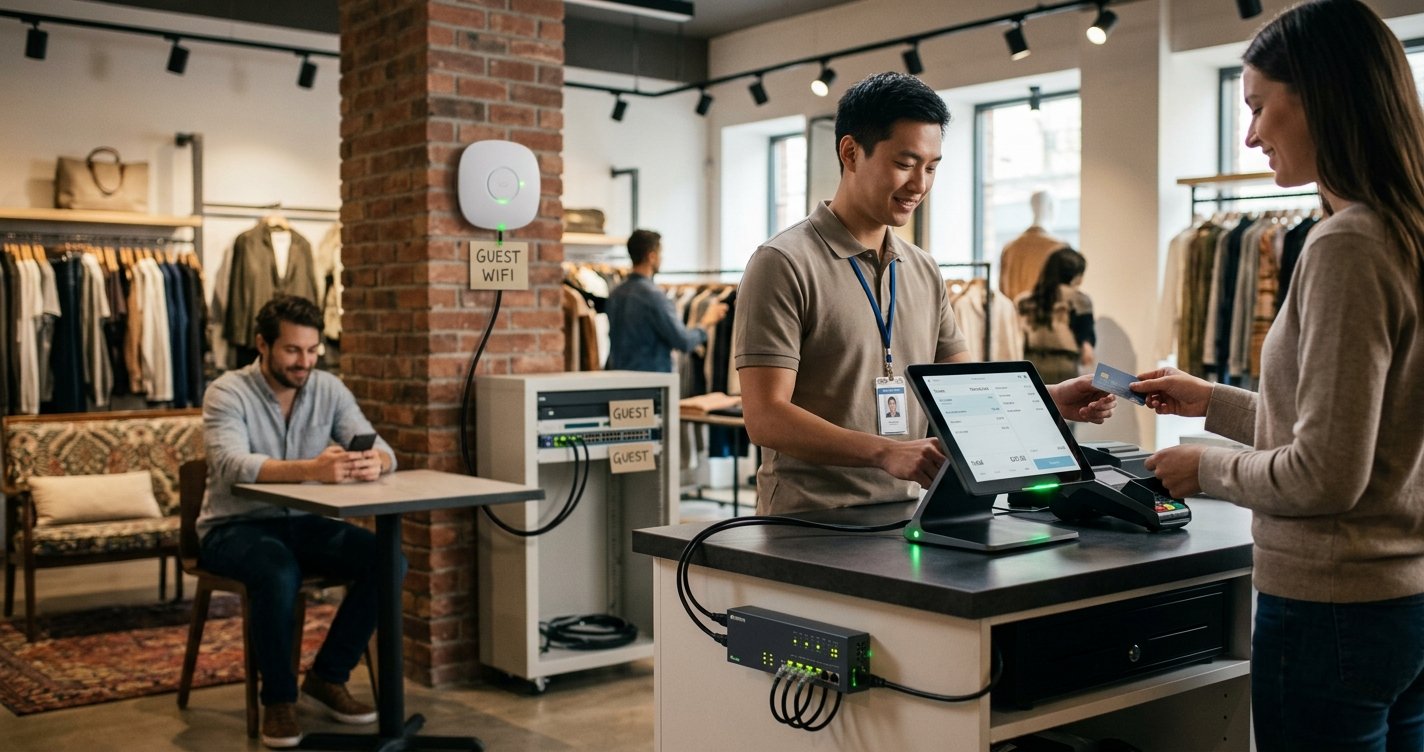

Key Takeaways
- Guest WiFi and Point of Sale systems need to be kept on separate, isolated networks to stop attackers using customer devices as a stepping stone into payment data.
- RAM-scraping malware targets the brief moment payment card data sits unencrypted in a till’s memory, which is why endpoint protection alone is not enough.
- PCI DSS v4.0 does not force retailers to segment their network, but it does demand strict boundary controls that make segmentation the practical, cost-saving choice.
- Tools such as VLANs, client isolation, firewalls and microsegmentation work together to limit how far an attacker can travel if one device is compromised.
- A short network safety check can reveal whether a store’s guest and payment traffic are actually separated, or only appear to be.
Learning how to secure retail network traffic is essential when running a shop today, since it means juggling a lot more than a till and a stockroom. Customers expect free WiFi while they browse, staff rely on stock systems that talk to the cloud, and every card payment depends on a network working quietly in the background. That convenience comes with a catch worth understanding properly.
One Flat Network, One Big Risk
Learning to secure retail network setups often starts with spotting how they grew in the first place. Many small retail networks grow the way a shop itself grows: bit by bit, without a master plan. A router gets added for guest WiFi, a new card reader joins the same switch as the office PC, and before long every device in the building can technically talk to every other device. This is what’s known as a “flat” network, and it’s one of the most common weaknesses found in independent retail stores.
This is the exact danger any plan to secure retail network traffic has to address: if a customer’s phone on the guest WiFi picks up malware, or an attacker deliberately connects a device to that free WiFi, there’s often nothing stopping that device from reaching across to the till system. A free WiFi security checker can show fairly quickly whether a shop’s guest network is genuinely walled off from its payment systems, or only appears that way on paper.
Modern shops also carry a wider mix of connected kit than most owners realise, including guest WiFi access points, POS terminals, smart sensors, and inventory systems that sync to the cloud. Each device adds another point of entry, and understanding that wider mix is the first step toward closing the gaps that matter most.
Why Your POS Is a Prime Target
This is exactly why POS protection is central to any plan to secure retail network traffic. Card readers and tills handle something criminals can turn into cash almost immediately: card numbers, magnetic stripe data, and PINs. That immediate payoff makes POS systems far more attractive to attackers than, say, a stockroom laptop, and it explains why so much criminal effort goes into finding ways past a shop’s defences.
RAM Scraping: Stealing Data From Memory
Card data is supposed to be encrypted the moment it’s captured, but there’s a brief window during processing when the payment application has to hold that data in plain text inside the till’s memory (RAM) to read and process it. RAM-scraping malware exists purely to catch that fleeting window, quietly copying card numbers before encryption locks them away again.
This risk has already played out at scale. Malware built specifically for this purpose, including well-documented families such as BlackPOS, Backoff, and ModPipe, has been used in some of the largest retail breaches on record. The 2013 attack on Target used BlackPOS to steal roughly 40 million payment card records, along with personal information – names, addresses, phone numbers, emails – for up to 70 million additional customers.
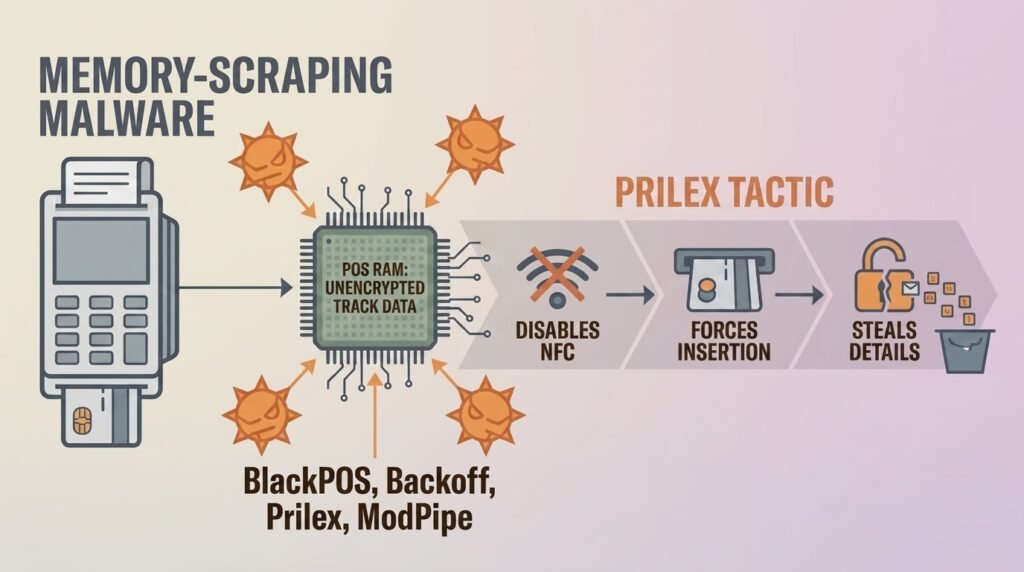
More recently, Prilex malware has evolved to disable contactless NFC payments on infected terminals, forcing customers to insert their physical card so the malware can capture the transaction data as it moves through the till. A successful attack of this kind doesn’t just cost money directly; it can trigger fines for falling short of payment security standards and lasting damage to customer trust.
Guest Devices as an Entry Point
Guest WiFi is one of the first places to look when trying to secure retail network traffic. Free WiFi is often the softest part of a shop’s defences, and it’s usually the part attackers try first. When a guest network allows devices to see and talk to each other, a compromised phone or laptop can scan for weak points on the same network, hunting for outdated software, default passwords, or an unprotected path toward the till system. Without Layer 2 client isolation blocking device-to-device chatter, an opportunistic attacker sitting in a café-style seating area can do a surprising amount of digital snooping before anyone notices.
What PCI DSS Actually Requires
PCI DSS compliance is a major reason businesses work to secure retail network traffic in the first place. Any business processing card payments needs to meet the Payment Card Industry Data Security Standard, now in its latest version, PCI DSS v4.0.1 (a clarifying update to v4.0, with the same core requirements). It sets out what “good enough” security looks like for handling cardholder data, and it applies whether a shop is a single high-street store or a nationwide chain.
Segmentation Isn’t Mandatory, But Validation Is
Here’s a detail that trips up a lot of shop owners: PCI DSS v4.0.1 doesn’t explicitly force a business to segment its network. What it does insist on is strict control over anything that can reach cardholder data, along with regular testing to prove those controls actually work. In practice, that makes proper segmentation the sensible route, because it’s the most reliable way to keep guest devices and everyday store operations away from payment systems in the first place.
The Audit Cost of an Unsegmented Network
Skipping segmentation has a real financial consequence at audit time. If a network is flat, every connected device, including guest smartphones and wireless access points, falls inside the scope of your business’s annual PCI compliance validation (commonly a Self-Assessment Questionnaire for smaller retailers), meaning far more systems need to be checked, documented, and defended. Physical segmentation is only part of the picture — see our 9 ecommerce security risks PCI compliance leaves unprotected for the gaps that persist even in a compliant environment. A shop with proper segmentation can typically show assessors a clean, contained payment environment rather than the entire building’s network, saving both time and hassle when the audit rolls around.
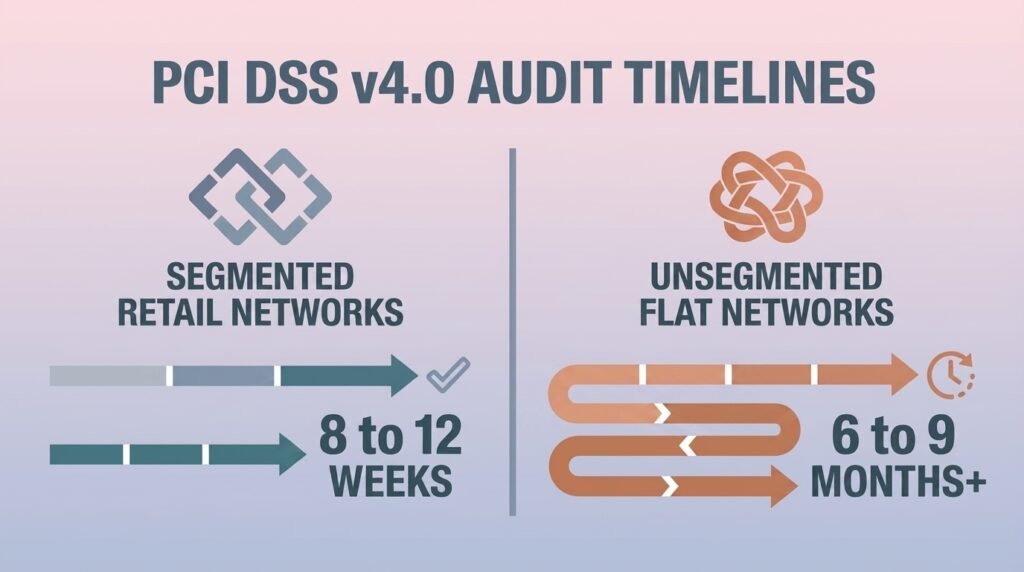
Compliance specialists estimate that businesses with clean, segmented networks can reach PCI DSS compliance in as little as 8 to 12 weeks, while those with flat, unsegmented networks can face timelines of 6 to 9 months or more.
Separating Guest WiFi From POS
Segmentation is the practical way to secure retail network traffic. Keeping guest WiFi and POS systems apart doesn’t require ripping out existing hardware and starting again. Several layered techniques, often used together, achieve strong separation on infrastructure a small shop already owns.
VLANs and Client Isolation
Virtual Local Area Networks, or VLANs, let a shop split one physical network into separate logical zones without buying separate cables and switches for each one. A typical setup might give the till system its own VLAN, general store operations another, and guest WiFi a third, so devices on one zone simply can’t see devices on another.
Alongside VLANs, Layer 2 client isolation stops devices connected to the same guest WiFi network from talking to each other at all. See our small business WiFi security checklist: 8 fixes that matter for the full router-level setup behind this. This closes off a common trick attackers use, where one compromised phone probes nearby devices for weaknesses, and keeps casual customer traffic strictly limited to browsing the internet.
Firewalls Between Wireless and Payment Systems
A firewall sitting between the wireless network and the payment environment acts like a locked door with a very specific list of who’s allowed through. Traffic from the guest network should be blocked by default from reaching payment systems, with only the narrow, necessary connections, such as a card reader talking to its payment processor, explicitly allowed. Anything outside that defined list gets refused automatically, which closes off the vague, catch-all rules that leave so many small networks exposed.
SD-WAN and Zero Trust for Extra Control
For shops with multiple locations or a bit more technical appetite, Software-Defined Wide Area Networking (SD-WAN) adds centralised visibility across every store’s network from one dashboard, making it easier to spot unusual activity early. Zero Trust Network Access takes a stricter stance still, treating every device as unproven until it verifies its identity, rather than assuming anything already inside the building’s WiFi deserves automatic trust. Many security teams now favour this approach for retail environments, recognising that trusting a device just because it’s physically on-site is no longer a safe assumption. For specific platforms that deliver this at the hardware level, see our 7 business WiFi security tools to stop small business breaches.
Microsegmentation Limits the Damage
Microsegmentation is the next layer to secure retail network traffic beyond basic VLANs. Even with VLANs and firewalls in place, it helps to plan for the worst case: what happens if a device does get compromised? Microsegmentation answers that question by dividing the network into much smaller, tightly controlled zones, sometimes down to the level of an individual device or application, rather than one broad payment zone.
The benefit shows up clearly in a breach scenario. If a till is compromised under a microsegmented setup, the attacker finds themselves boxed into that one narrow segment, unable to reach the CCTV system, the stock management server, or other tills nearby. Industry research on microsegmentation shows it significantly limits how far malware can spread once it gains a foothold, turning a potential full-scale breach into a single, containable incident.
Before you read another checklist, it’s worth finding out where your own store actually stands. The five questions below take about a minute and are based on the exact controls covered in this article — VLANs, client isolation, firewall rules, and blast-radius containment. Answer honestly; “I think so” and “not sure” both count as no.
Quick Check: Is Your Guest WiFi Actually Separated From Your POS?
If most of your answers were “no,” that’s not a reason to panic — it’s a reason to prioritize. Segmentation is built in layers, and even a single VLAN separating guest WiFi from your POS closes off the most common path attackers use to reach payment data. Start with the gap that scored lowest above, and treat the rest as a roadmap rather than a to-do list for one afternoon.
Segregation Protects Money and Trust
Taking the steps to secure retail network traffic is a direct safeguard for the two things a small shop can least afford to lose: the money moving through its tills and the trust customers place in handing over their card details, well beyond being a technical box to tick for auditors.
The steps involved, from VLANs and firewalls through to Zero Trust checks and microsegmentation, don’t need to happen all at once. Starting with the basics of proper separation, then layering on stronger controls over time, gives a shop realistic, steady progress rather than an overwhelming to-do list. For a practical next move toward a more secure retail network, running a network safety test is a straightforward way to see exactly where guest WiFi and payment systems currently stand in relation to each other.