

Key Takeaways
- HIPAA compliance is a legal floor, not a security ceiling — passing your audit does not mean your practice is protected from today’s most damaging cyberattacks.
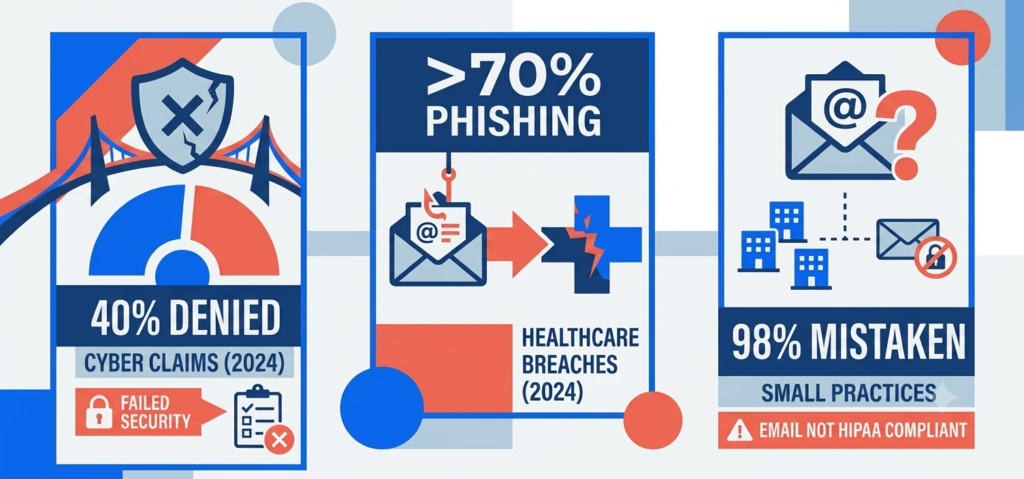
- Nearly 1 in 4 cyber insurance claims were denied in 2024, often because practices assumed their coverage was broader than it actually was.
- Five interconnected threats — tracking pixels, vendor outages, connected medical devices, AI voice fraud, and ransomware — are quietly creating millions in uninsured exposure for small practices right now.
- TechEd Shield breaks down exactly where these gaps appear and what small practice owners can do about them, without needing an in-house IT team.
- Keep reading to see a line-by-line financial model of what a ransomware attack actually costs a 5-doctor practice — the numbers are more specific, and more alarming, than most owners expect.
There is a dangerous assumption running through waiting rooms, billing offices, and administrator desks across the country: that a clean HIPAA audit means the practice is protected. It doesn’t — and the 9 cyber risks small medical practices face today prove it. HIPAA was designed in the 1990s to govern how patient data is handled — not to defend a modern clinical operation against ransomware gangs, AI-powered fraud, or catastrophic vendor outages. The gap between those two things is where small practices are getting hurt most.
HIPAA Is a Baseline, Not a Bulletproof Vest
HIPAA’s administrative, physical, and technical safeguards were built for a different era of technology. They require practices to encrypt patient portals, train staff, sign Business Associate Agreements, and document security policies. All of that matters. But the framework is retrospective by design — it tells practices what they should have had in place, not how to outmaneuver threats that didn’t exist when the law was written.
The modern threat environment has moved far past what any compliance checklist can cover. Today’s attacks target cloud platforms, Internet of Medical Things (IoMT) devices, third-party SaaS vendors, and AI-generated impersonation — none of which HIPAA directly addresses with meaningful technical specificity. In 2024 alone, over 275 million patient records were compromised in healthcare data breaches, a 63.5% increase over the prior year, driven largely by the Change Healthcare breach alone (HIPAA Journal / HHS OCR). That number didn’t rise because practices stopped doing their compliance paperwork. It rose because attackers moved faster than the regulation did.
Understanding where HIPAA ends — and where real operational risk begins — is exactly the kind of clarity small practice owners need, and it’s worth knowing the same compliance-isn’t-security gap facing accounting firms plays out almost identically outside healthcare.
The Coverage Gaps Most Practices Don’t See Coming
HIPAA Provides a Foundation Cyber Threats Have Already Outpaced
Compliance frameworks are built on consensus — they represent the minimum that regulators, industry groups, and legal teams could agree upon at a given point in time. By the time a requirement makes it into a federal rule, the threat it was designed to address has often already evolved into something more sophisticated. HIPAA’s Security Rule still references risk analysis and workforce training as core controls. Those are valid. But they say nothing about firmware vulnerabilities in infusion pumps, session-token hijacking that bypasses multi-factor authentication, or AI voice clones targeting billing staff.
The result is a compliance posture that looks complete on paper and is genuinely incomplete in practice. A practice can pass every line of a HIPAA audit and still be running unpatched devices, exposed tracking pixels, and a cyber insurance policy full of exclusions it doesn’t know about.
1 in 4 Cyber Claims Were Denied in 2024
The insurance piece is where the compliance illusion becomes most financially dangerous. Industry data shows that roughly one in four cyber insurance claims filed in 2024 resulted in partial or full non-payment — not because the attack didn’t happen, but because the policyholder failed to meet the specific coverage gaps that trigger those denials, buried in the cyber insurance coverage language. Insurers have hardened dramatically. What used to be a relatively flexible market has become a strict, evidence-based process where underwriters expect documented proof of security controls before they pay out.
For small practices, this often comes as a complete shock. They purchased a policy, paid the premium, and assumed they were covered. The denial letter arrives weeks after the incident, citing a condition precedent clause or a security requirement the practice never knew it needed to document.
Silent Cyber Creates Dangerous Coverage Uncertainty in Traditional Policies
Compounding the problem is a phenomenon known as silent cyber — the space between what a standalone cyber policy covers and what traditional commercial general liability or medical malpractice policies exclude. Historically, older non-cyber policies were simply silent on digital events, occasionally allowing physical or statutory damages triggered by a cyberattack to slip through. Insurers noticed, and they closed that door.
Modern malpractice and general liability policies now contain broad, absolute cyber exclusions. Standalone cyber policies, in turn, exclude bodily injury and property damage. The net effect is that a connected medical device harmed by a firmware attack, or a patient notification lawsuit triggered by a data breach, can fall into a gap where neither policy responds. The practice ends up self-insuring losses it assumed were covered — often totaling hundreds of thousands of dollars.
What a Ransomware Attack Actually Costs a Small Practice
14-18 Days of Clinical Paralysis Is the Norm
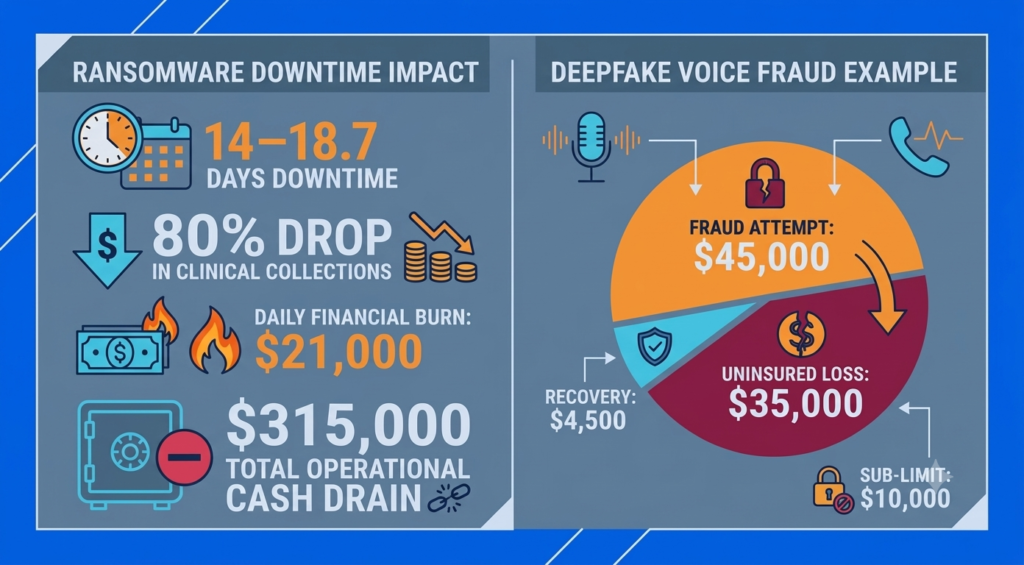
The healthcare industry tends to discuss ransomware in abstract terms — significant disruption, temporary service interruption. The reality on the ground is far more specific and far more damaging. Healthcare organizations experience an average of 17 days of operational downtime following a ransomware attack, according to Comparitech’s analysis of incidents since 2018 — with annual peaks as high as 27 days. During that window, EHR access is locked, scheduling systems are inaccessible, insurance eligibility cannot be verified, and billing codes cannot be captured or submitted. Even practices that attempt a manual paper-based fallback experience an estimated 80% contraction in actual clinical collections — because the workflows that make a modern practice run are almost entirely digital.
Daily Burn Rate: Revenue Stops, Overhead Doesn’t
Consider a high-performing 5-doctor independent primary care group. Based on recent industry data, physician net revenue figures vary significantly by specialty and practice type, with many primary care physicians generating between $1.7 million and over $2 million annually on behalf of their clinic. For modeling purposes, using a conservative mid-range estimate of $1.5 million per physician, a 5-doctor practice generates approximately $7.5 million per year — or about $31,250 per clinical day across 240 operating days. Overhead costs — covering facilities, EHR and billing software licensing, and clinical support staff who cannot be laid off during a temporary crisis — typically consume a substantial portion of gross revenue. Even on days when the practice collects nothing, fixed operating costs continue to accumulate.
Over a standard 15-day complete outage, the direct operational cash drain — lost revenue plus ongoing overhead — reaches into the hundreds of thousands before a single forensics invoice is paid.
The Long Tail: Forensics, Fines, and Mandatory Patient Notifications
The operational paralysis is only the first wave. The technical, regulatory, and legal remediation phase arrives immediately after and runs for months. For a practice with an average active patient panel of 15,000 records, the post-incident cost profile includes the following estimated line items, which should be validated against current vendor quotes and legal counsel rates at the time of an incident:
| Cost Category | Estimated Amount / Range | Basis |
|---|---|---|
| Digital Forensics & Incident Response (DFIR) | ~$42,000 | Forensic specialists billing $300–$500/hour to identify entry point and analyze malware |
| Specialized Legal Counsel (Breach Coach) | Varies significantly | Regulatory response guidance, law enforcement coordination, state/federal notices — budget as a significant line item; confirm current rates with healthcare-focused counsel |
| System Reconstruction | Tens of thousands of dollars upward | Emergency IT consulting to rebuild servers, reset Active Directory, restore clean workstation images — depends on infrastructure complexity |
| Mandatory Patient Notification Mailings | Varies by vendor/scope | Physical mailings plus a 90-day toll-free call center for 15,000 patients under the HIPAA Breach Notification Rule; per-record costs range from a few dollars to higher amounts |
| Identity Theft Monitoring | ~$45,000 | 12 months of coverage at ~$30/person, assuming a conservative 10% enrollment rate among 15,000 patients |
| Regulatory Defense & HIPAA Fines | ~$75,000 | Negotiating civil monetary penalties with HHS Office for Civil Rights or State Attorneys General |
Combined with the primary operational cash drain, the total financial exposure for a single ransomware attack on a 5-doctor practice can represent roughly 15% of annual gross revenue — or more than 30% of net operating income. That level of loss threatens the financial solvency of the clinic outright. This is precisely where speed of detection determines the outcome — see the numbers behind how managed security cuts ransomware dwell time and cost.
Tracking Pixels Are a Lawsuit Hiding on Your Website
Pixels Fire Before Consent Banners Even Load
Most small practice websites use standard marketing tools — scheduling widgets, Google Analytics, Meta’s advertising pixel. These are ordinary, widely deployed tools. They are also, in a healthcare context, a significant and largely unrecognized legal exposure.
When tracking pixels are embedded on a practice’s public website, patient portal, or scheduling intake forms, they automatically transmit patient browsing behavior, searched symptoms, IP addresses, and appointment details directly to third-party advertising platforms. This happens in real time — often before any cookie consent banner has even loaded in the visitor’s browser. The practice is, without realizing it, running an unconsented data-sharing program that routes sensitive health information to AdTech networks that have no Business Associate Agreement in place.
The HHS Office for Civil Rights has explicitly stated that using third-party tracking technologies on healthcare websites without a BAA constitutes a HIPAA violation if protected health information is collected and transmitted. The landmark Kaiser Permanente case resulted in a class-action settlement of up to $47.5 million after web trackers were found on authenticated patient pages. The FTC’s $1.5 million civil penalty against GoodRx — the first enforcement action under the Health Breach Notification Rule — followed similar pixel-based disclosures. Plaintiffs’ attorneys are actively bringing these cases under California’s Invasion of Privacy Act (CIPA), which imposes statutory damages that can reach into the tens of millions even when no individual financial harm is proven.
Why Cyber Insurance Coverage for Pixel Claims Is Limited or Excluded
Here is where the situation becomes particularly damaging for practices that think their cyber policy will absorb the loss. Most standalone cyber policies contain a Wrongful Collection Exclusion — sometimes called an Unlawful Gathering Exclusion — that denies coverage for claims arising from the non-compliant tracking of personally identifiable or protected health information. The reasoning from the insurer’s perspective is straightforward: the data transmission was not caused by an external hack. It was caused by an intentional design feature of marketing software the practice chose to install.
The practical consequence is that a class-action wiretapping lawsuit triggered by a standard website pixel — a lawsuit that could carry seven-figure statutory damages — lands entirely outside the coverage the practice was paying for. Addressing this requires both removing non-consented tracking scripts from any authenticated or clinical page, and negotiating a specific endorsement during cyber policy renewal that explicitly carves back coverage for statutory privacy claims.
Your EHR Vendor Getting Hacked Shuts You Down Too
Change Healthcare Disrupted Care for a Confirmed 192.7 Million Individuals
The Change Healthcare ransomware attack of 2024 is the clearest large-scale proof point for this risk. A single attack on one clearinghouse and claims-processing vendor exposed data for a confirmed 192.7 million individuals — the largest healthcare data breach in U.S. history — and caused weeks of widespread disruption to healthcare billing and payments across the entire U.S. system. Practices whose own local workstations were completely untouched were still unable to verify insurance eligibility, submit claims, or process reimbursements. The operational paralysis was total — and it came from outside the practice’s own walls.
BAAs Don’t Transfer Financial Liability — Vendor Contract Caps Do
A common and costly misconception: many practice administrators treat a signed Business Associate Agreement as a financial liability transfer. It is not. A BAA is a regulatory requirement that obligates the vendor to assist with breach response — but under HIPAA, the Covered Entity (the practice) retains primary regulatory responsibility for its patients’ data. If a vendor is breached, the Office for Civil Rights will hold the practice liable for failing to conduct documented, ongoing due diligence on that vendor’s actual security controls.
More damaging still is what is buried in the vendor’s standard Master Services Agreement, signed alongside the BAA. Nearly every SaaS vendor’s MSA includes a Limitation of Liability clause capping their aggregate financial responsibility to the practice at a nominal amount — typically the fees paid in the preceding 12 months. If a vendor outage costs a practice $400,000 in unrecoverable billing, but the practice pays $1,200 per month for that software, the maximum contractual recovery is $14,400. The remaining $385,600 is entirely self-insured.
Contingent Business Interruption Coverage Is Routinely Denied or Severely Sub-Limited
The insurance problem compounds the vendor liability problem. Commercial property policies deny claims for vendor-related outages because there is no direct physical loss or damage to the practice’s physical premises. Standard cyber policies either lack Contingent Business Interruption (CBI) coverage entirely, or carry it at a restrictive sub-limit — sometimes as low as $10,000 — subject to a 24-hour waiting period before any coverage triggers. For a practice losing $22,000 per day in revenue and overhead, a $10,000 sub-limit with a 24-hour waiting period is effectively no coverage at all.
Connected Medical Devices Sit in a Serious Coverage Gap
99% of Healthcare Organizations Run IoMT Devices With Known Vulnerabilities
Network-connected medical devices — infusion pumps, patient vital monitors, anesthesia machines, EKG systems — have transformed clinical care. They have also introduced a category of cyber-physical risk that most practices are entirely unprepared for. Claroty’s analysis of over 2.25 million IoMT devices across 351 healthcare organizations found that 99% of hospitals and healthcare delivery organizations operate IoMT devices with known exploited vulnerabilities (KEVs), and 60% of medical devices run on end-of-life operating systems that no longer receive security patches. Small outpatient practices using network-connected clinical devices face comparable risks. These devices run software and firmware that is frequently years behind on updates, connected to the same network as administrative workstations, and rarely included in any security audit.
An attacker who gains access to the administrative network through a phishing email or an unpatched workstation can move laterally into the clinical device network, alter medication delivery rates, disable alarms, or interfere with life-sustaining equipment. The consequences move from financial into clinical — patient harm, lawsuits, and permanent reputational damage.
Malpractice and Cyber Policies Each Point Away From Device-Harm Claims
When patient harm results from a compromised medical device, the practice faces a coverage gap with no clean exit. The medical malpractice carrier denies the claim, citing an absolute Cyber Exclusion Endorsement that was quietly added to the professional liability policy. The standalone cyber insurance carrier also denies the claim, pointing to the policy’s standard Bodily Injury and Property Damage Exclusion. The lawsuit sits entirely between the two policies — and the practice absorbs it without insurer support.
Closing this gap requires two specific actions: negotiating an affirmative Bodily Injury Cyber Carve-back on the standalone cyber policy, and removing absolute cyber exclusions from the malpractice policy. On the technical side, placing all IoMT devices on an isolated network segment — a separate VLAN governed by an internal firewall — blocks the lateral movement that makes device compromise possible in the first place.
AI Voice Clones Are Already Defrauding Medical Offices
A Cloned Voice Plus One Compromised Email Can Trigger Significant Unauthorized Transfers
A 2025 survey found that 38% of Americans had received scam calls impersonating a healthcare provider — reflecting how accessible AI voice-cloning technology has become and how effectively it is being deployed against healthcare administrative staff who are trained to respond quickly to clinical leadership.
The attack sequence is straightforward. An attacker scrapes publicly available audio of a practice’s medical director or owner — from a promotional video, a webinar, or a public podcast — and generates a realistic real-time voice clone. Combined with a compromised or spoofed email account, the attacker calls a billing coordinator, impersonates the physician with a convincing voice, and requests an urgent wire transfer to a new vendor. The email confirmation arrives from the physician’s actual Microsoft 365 account, compromised earlier via an undetected session-hijacking attack. The billing coordinator initiates the transfer. The funds are gone within hours and are not reversible by the bank. This is exactly the scenario our deepfake defense training is built around — out-of-band verification is the single most effective control against it.
Social Engineering Sub-Limits Often Fall Far Short of Actual Losses
When the practice files the claim, the cyber policy’s response is limited in two distinct ways. First, the policy contains a Social Engineering Sub-limit — often capping coverage at $10,000 to $50,000 on policies with million-dollar aggregate limits. A $45,000 fraudulent wire transfer hits that ceiling immediately. Second, most modern cyber policies insert a Callback Verification Provision as a condition precedent to coverage: if the practice cannot document that a staff member verbally confirmed the transfer request using a pre-registered phone number before executing it, the carrier denies the claim entirely — including the portion within the sub-limit.
The operational fix is an out-of-band dual-authorization policy for any financial transaction. Every request to transfer funds or modify bank routing details must be verbally confirmed using a phone number stored in an offline registry — never a number provided in the incoming email. Every step must be logged with date, time, and verifying employee names. On the insurance side, the practice’s broker must negotiate a dedicated Social Engineering Endorsement that raises the sub-limit to a meaningful threshold and removes the callback clause as an automatic grounds for total denial.
Compliance Gets You Audited. Proactive Security Keeps You Open.
Each of the risks covered here shares a common thread: they all exist within, or directly adjacent to, a practice that is fully HIPAA-compliant. The tracking pixels fire on a compliant website. The vendor outage hits a practice with a signed BAA. The IoMT device sits on a network that passed its last risk assessment. The voice clone targets staff who completed their annual security training. Compliance, in every case, was present — and insufficient.
The shift that protects practices isn’t about doing more compliance paperwork. It’s about moving from a retrospective, checkbox-driven mindset to a proactive, operationally focused one. That means understanding what a cyber insurance policy actually covers — not what it’s assumed to cover. It means auditing a website for tracking scripts before a plaintiff’s attorney does. It means knowing which connected medical devices are running unpatched firmware. It means having a verified callback procedure in place before the fraudulent wire transfer request arrives.
None of these fixes require an in-house IT department or a Fortune 500 security budget. They require clarity — a clear picture of where the real exposures are, in plain language, with specific actions attached. Practices that close even a handful of the gaps outlined here move meaningfully ahead of the overwhelming majority of small medical offices that are still treating HIPAA as the finish line.
You’ve just read where the gaps hide. Here’s where yours might be.
This 30-second checker walks through the same five risk areas covered above — tracking pixels, vendor dependency, connected devices, wire fraud controls, and ransomware readiness — and gives you a directional exposure score with specific next steps for anything flagged.
The Compliant But Exposed Gap Checker
Five questions covering the exposures a clean HIPAA audit doesn’t touch. Answer honestly — most practices flag at least two.
However you scored, the fix for each flagged gap is the same in spirit: know exactly what your policy covers, document the controls insurers expect to see, and close the specific technical gap before an incident forces the question. None of it requires a security budget most small practices don’t have — it requires knowing where to look.
The practices that stay open after a serious cyber event are not the ones with the thickest compliance binders. They’re the ones that knew exactly where their real gaps were and closed them before something went wrong. For small practice owners who want that same clarity, including how an insurer is likely to view their security controls, our free cyber insurance readiness check is a quick, plain-language starting point. It takes about three minutes, requires no technical knowledge, and shows which gaps could slow your application or put a claim at risk.