

Key Takeaways
- Cyber Essentials certification checks five technical control areas: firewalls, secure configuration, security update management, user access control and malware protection
- Some Cyber Essentials certifications come bundled with cyber liability cover, but that cover has a £25,000 total limit and excludes electronic theft and cyber fraud
- Certification alone does not guarantee that a separate cyber insurance claim will be paid, because insurers still assess each business on its own merits
- A £1,000 excess (rising to £5,000 for US or Canada-related claims) and a six-hour network interruption retention apply to the associated cover, details worth checking before assuming it fills every gap
- Before renewing a cyber policy, it pays to check that scope, exclusions and conditions actually match the controls stated on the application, something a readiness check can help work through step by step
Cyber Essentials vs cyber insurance is a question UK small business owners ask at almost every renewal: if the business already holds certification, is that enough to satisfy an insurer? The honest answer sits somewhere between yes and no, and understanding why matters just as much as the answer itself.
Does Cyber Essentials Replace a Cyber Policy?
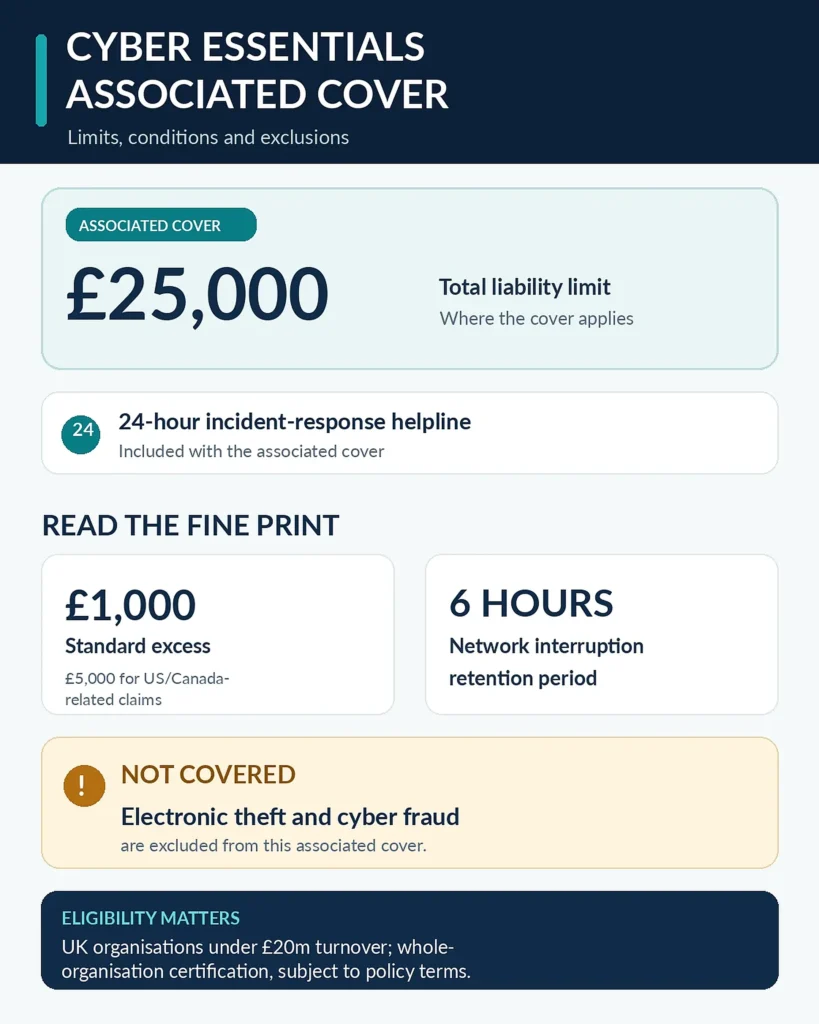
Cyber Essentials certification and cyber insurance exist to do different jobs. Certification is a government-backed scheme that checks whether a handful of important technical protections are in place and working. A cyber insurance policy, on the other hand, is a financial safety net designed to cover the costs that follow a cyber incident: legal fees, data restoration, business interruption and liability claims from affected clients.
Perhaps the most important detail is what the cover excludes rather than what it includes
The confusion arises because the two are often discussed together, and because some Cyber Essentials certifications come with a small amount of built-in cyber liability cover. That overlap can make certification and insurance feel like the same thing wearing different labels. They are not, and treating them as interchangeable is one of the more common mistakes small business owners make when they are short on time before a renewal deadline.
Getting this distinction right from the outset is something TechEd Shield focuses on when helping small business owners work out what their insurer actually expects, rather than what a certification badge alone might suggest. The sections below break down exactly what Cyber Essentials checks, what its linked cover does and doesn’t pay for, and why a standalone policy still needs its own careful read before renewal.
What Cyber Essentials Actually Checks
Cyber Essentials certification looks at a defined set of technical protections rather than every possible cyber risk a business might face. It is a useful starting point for understanding baseline hygiene, though it was never designed to stand in for a full risk assessment.
Five Technical Control Areas
The certification assesses five technical control areas:
- Firewalls – checking that boundary defences are configured to block unauthorised access from the internet
- Secure configuration – making sure devices and software are set up to reduce unnecessary risk, rather than left on default settings
- Security update management – confirming that software and systems are kept patched against known vulnerabilities
- User access control – checking that only the right people have access to the right systems and data
- Malware protection – verifying that defences are in place against viruses and other malicious software
These five areas address the kinds of common, internet-based attacks that catch out a large number of small businesses, such as automated scanning for unpatched systems or weak passwords. They are a sound foundation to build on, nothing more and nothing less.
Why the Certification Scope Boundary Matters
One detail that often gets missed is that Cyber Essentials certification can apply to an organisation’s whole IT infrastructure, or it can apply to a clearly defined subset of it. That boundary is defined at the start of the assessment and reviewed by the certification body, and it genuinely matters.
If a business certifies only part of its systems, perhaps a single office or business unit but not the rest of the organisation, the certification says nothing about the security of what falls outside that boundary. Cloud services that hold the organisation’s data must sit inside whatever boundary is chosen, but certification still says nothing about third-party systems the business does not control. A partial-scope certificate also does not qualify for the cyber liability cover bundled with certification, which requires the whole organisation to be certified. For a business renewing cyber insurance, this means checking that the systems an insurer expects to be protected are actually the ones covered by the certificate, rather than assuming the badge covers everything the business runs on.
The Cover Some Certifications Include
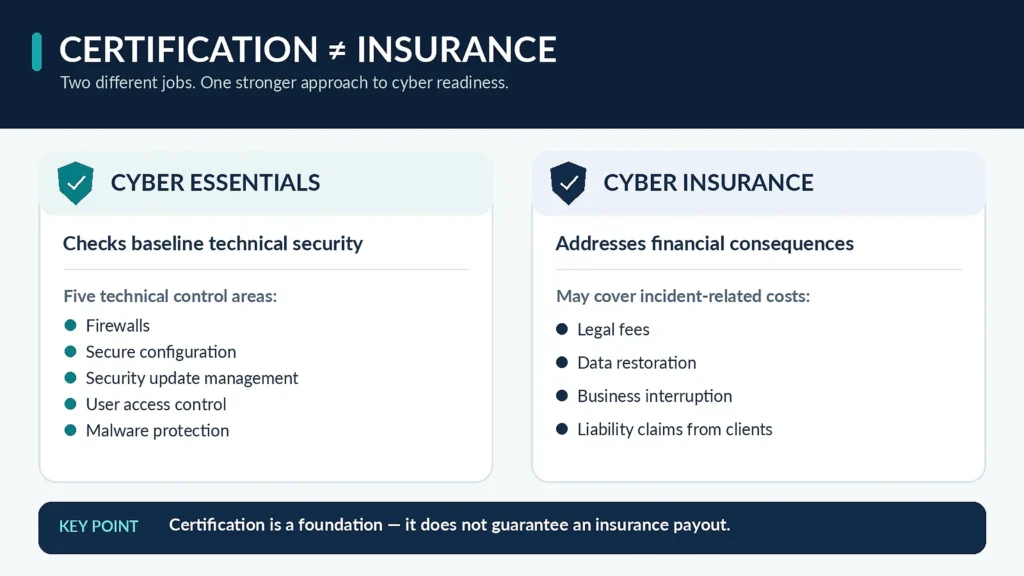
A detail that often surprises business owners is that certain Cyber Essentials certifications come with an element of cyber liability insurance attached, available to UK-based organisations with a turnover under £20 million that certify their whole organisation, subject to policy terms. This is a genuinely useful add-on, but its scope is narrower than many people expect.
What the Associated Cover Pays For
Where this associated cover applies, it typically comes with a total liability limit of £25,000 and access to a 24-hour incident-response helpline. That combination can be genuinely helpful in the earliest hours of an incident, when fast access to technical and legal guidance often matters more than the size of a payout.
This kind of cover tends to suit smaller, more contained incidents rather than major, multi-week disruptions. A modest limit can be exhausted quickly once forensic investigation, legal advice and system restoration costs start adding up, which is why it works best as a helpful starting point rather than a complete safety net.
Excess, Retention and the Electronic Fraud Exclusion
The fine print on this associated cover carries conditions worth knowing before a claim is ever needed. A £1,000 excess applies, rising to £5,000 for claims related to the USA or Canada, and a six-hour Network Interruption retention also applies, meaning a short initial period of disruption is not compensated.
Perhaps the most important detail is what the cover excludes rather than what it includes: electronic theft and cyber fraud are not covered by this associated cover. Given that business email compromise and wire fraud are among the most common ways small businesses lose money to cyber criminals, this exclusion matters. A business relying solely on certification-linked cover for protection against a fraudulent payment redirection scam would find itself without support precisely when it needs it most.
Why Certification Doesn’t Guarantee a Payout
Holding a valid Cyber Essentials certificate feels like proof of good practice, and in many respects it is. It does not, however, act as a guarantee that a separate cyber insurance policy will pay out when a claim is made.
Insurers Still Assess Each Business Individually
Certification does not guarantee insurance cover, a discount or improved policy terms. Insurers assess each business individually, looking at the specific answers given during underwriting, the nature of the business, and the particular wording of the policy being bought. Some insurers may offer a discount where Cyber Essentials is in place, but this is not automatic and should never be assumed.
This matters because a business might hold valid certification and still find a claim challenged, if the underwriting questionnaire described security controls that were not actually in place at the time of the incident, or if the incident falls into a category the policy simply does not cover. Certification demonstrates that five specific technical areas were checked at a point in time. It says nothing about whether staff have been trained to spot a phishing email, whether backups have actually been tested for restoration, or whether a wire transfer verification process exists. These are exactly the kinds of gaps that insurers probe during underwriting and that can determine whether a claim is paid in full, reduced or denied.
Checking Your Policy Before Renewal
Approaching a renewal with a Cyber Essentials certificate in hand can feel like the hard work is already done. The more useful habit is treating certification as one piece of evidence among several, and using the renewal period as a chance to check that everything else lines up.
Matching Stated Controls to Reality
It is worth checking what a policy covers and excludes, and whether the security controls stated in an application are actually in place. A renewal form completed in a hurry, ticking boxes that described the business as it was twelve months ago rather than as it stands today, is a common and avoidable reason cyber insurance claims get denied.
A few practical questions are worth asking before signing anything:
- Does the certification scope actually cover the systems and cloud services the business relies on day to day?
- Have the five technical controls been maintained since certification, not just achieved once and left alone?
- Are multi-factor authentication, tested backups, staff training and a payment verification process genuinely in place, not just assumed?
- Does the answer given on the insurance application still match reality at renewal time?
Holding a Cyber Essentials certificate tells you five technical areas were checked at one point in time. It doesn’t tell you whether your backups restore, whether staff would spot a phishing email, or whether your insurance application still describes the business accurately. This quick check walks through the points the article raises. Tick only what is true today.
Renewal gap check
Tick each statement that is true for your business today, not as it was a year ago.
Every unticked box above is a spot where a certificate on its own says nothing, and an insurer may still ask. Fix what you can before the renewal questionnaire arrives, then read your policy's scope, exclusions and conditions side by side. If you'd like a structured way to do that, run the cyber insurance readiness check.
Reading Scope, Exclusions and Conditions Together
Scope, exclusions and conditions work best read as a single picture rather than three separate sections of small print. A policy's scope defines what kinds of incidents and costs it is designed to address. Exclusions carve out specific situations, such as electronic fraud, that fall outside that scope entirely. Conditions set out what the business must keep doing, maintaining certain security controls, reporting incidents within a set timeframe, to keep the cover valid.
Missing any one of these three elements can leave a business with a nasty surprise after an incident, even when the policy looked perfectly adequate on paper. Reading them together, ideally well before a renewal deadline rather than the night before it, gives a much clearer picture of what protection actually exists.
Certification Is a Foundation, Not a Guarantee
Cyber Essentials certification demonstrates that a business has put key baseline protections in place across firewalls, secure configuration, patching, access control and malware defence. That is a genuinely valuable achievement and a sensible first step for any small business thinking seriously about cyber risk.
It was never designed to replace the detailed work of checking a cyber insurance policy's scope, limits, exclusions and conditions. The two sit alongside each other, each doing a different job, and a business that treats certification as the finish line rather than the starting point risks encountering the gap at the worst possible time, in the middle of a claim.
For business owners working through a renewal and wanting a clearer picture of where the gaps might be, a free cyber insurance readiness check can help identify which controls an insurer is likely to expect before the questionnaire arrives.