


Key Takeaways
- The average U.S. healthcare data breach cost $10.93 million in IBM’s 2023 report, falling to $7.42 million in IBM’s 2025 report – yet healthcare remains the most expensive industry for data breaches for the 14th consecutive year, and Texas clinics face compounding exposure from both federal HIPAA and the stricter Texas HB 300 law.
- Texas Senate Bill 2610 (SB 2610) offers a meaningful legal safe harbor against punitive damages after a breach – but only for practices that have a documented cybersecurity program in place before an incident occurs.
- Generic IT providers routinely miss the Texas-specific requirements that regulators actually enforce, from HB 300 training documentation to 30-day breach notices to the Attorney General.
- Specialized healthcare MSSPs structure their services around clinical workflows, medical device segmentation, and audit-ready compliance – capabilities that standard IT firms are not built to deliver.
Cyber security firms for Texas medical practices matter more than ever, because running a practice in Texas has always carried serious responsibility. Lately, that responsibility has extended well beyond patient care and into the server room. The regulatory environment around patient data is tightening, ransomware attacks on outpatient clinics are rising, and the financial exposure from a single breach can be existential for a small or mid-sized practice. This guide breaks down what Texas practice managers and clinic administrators genuinely need to understand – and what to look for when evaluating a cybersecurity firm built for healthcare.
Texas Clinics Face Substantial Breach Exposure
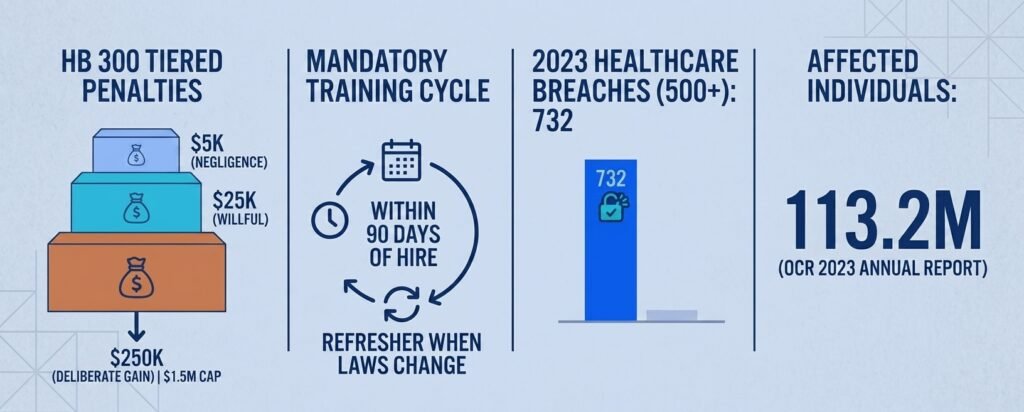
This is exactly why cyber security firms for Texas medical practices exist: healthcare has ranked as the most expensive industry for data breaches for 13 consecutive years. According to HHS OCR’s 2023 Annual Report to Congress, 732 healthcare data breaches affecting 500 or more individuals were reported that year, exposing the protected health information of over 113 million people. According to IBM’s 2023 Cost of a Data Breach Report, the average U.S. healthcare breach cost $10.93 million that year – more than double the cross-industry average. IBM’s most recent report (2025) puts the figure at $7.42 million, still the highest of any industry tracked. Smaller outpatient practices still face substantial costs: average data breach costs for small organizations reached $3.31 million in 2023, with small-practice breach settlements that regulators have documented in the tens of thousands to low hundreds of thousands of dollars, depending on scope and severity. No practice is insulated from the core cost drivers: regulatory penalties, patient notification, forensic investigation, litigation, and operational downtime.
This layered exposure is exactly what cyber security firms for Texas medical practices are built to address. For Texas clinics specifically, that exposure is compounded by a state legal framework that goes significantly beyond what most practice managers expect. Texas healthcare entities operate under overlapping layers of obligation – federal HIPAA, Texas HB 300, and SB 2610 – each carrying its own enforcement teeth. Understanding those layers is where protecting a practice actually begins. Resources like TechEd Shield provide healthcare-focused cybersecurity guidance built around the regulatory realities Texas clinics actually face.
HB 300 Goes Further Than HIPAA
Understanding HB 300 is central to what cyber security firms for Texas medical practices actually do. Most practice managers are at least familiar with HIPAA, but far fewer realize that Texas’s own Medical Records Privacy Act (HB 300), codified under Texas Health and Safety Code Chapter 181, imposes significantly stricter obligations – and that state regulators enforce them independently of HHS.
Broader Definition of Who Must Comply
Under HIPAA, covered entities are defined narrowly: healthcare providers, health plans, and clearinghouses. HB 300 expands that definition to any individual, business, or entity that obtains, collects, analyzes, stores, or transmits PHI in Texas. That scope captures IT vendors, data management firms, billing companies, and health tech platforms that HIPAA’s definition would otherwise exclude. For clinics, this means every vendor touching patient data – including their cybersecurity provider – must operate under the same compliance standards the clinic itself follows.
Stricter Training Timelines and Documentation
HIPAA requires workforce training within a reasonable period of time after hire. HB 300 replaces that flexibility with hard deadlines. New employees must complete role-based, tailored training within 90 days of hire (extended from the original 60-day requirement by a 2013 amendment), with refreshers required when relevant laws materially change. Documentation is not optional – signed employee verifications, training content records, attendance logs, and dates must all be retained for six years and be available for regulatory audit on demand.
Penalties Enforced by the Texas AG
Enforcement authority under HB 300 rests with the Texas Attorney General’s office, not HHS. Florida runs a parallel but distinct system under FIPA, with its own tight notification deadlines — see our guide to leading cybersecurity providers in Florida for small business. Civil penalties are tiered: $5,000 per violation for negligent noncompliance, $25,000 for willful violations, and up to $250,000 per violation per year where deliberate gain is involved. If violations constitute a pattern or practice, courts may assess penalties up to $1.5 million per year under Texas Health & Safety Code § 181.201. The AG can also pursue license revocation. These are not theoretical maximums – they represent the penalty structure regulators are authorized to apply per incident.
SB 2610: A Safe Harbor Many Practices May Be Overlooking
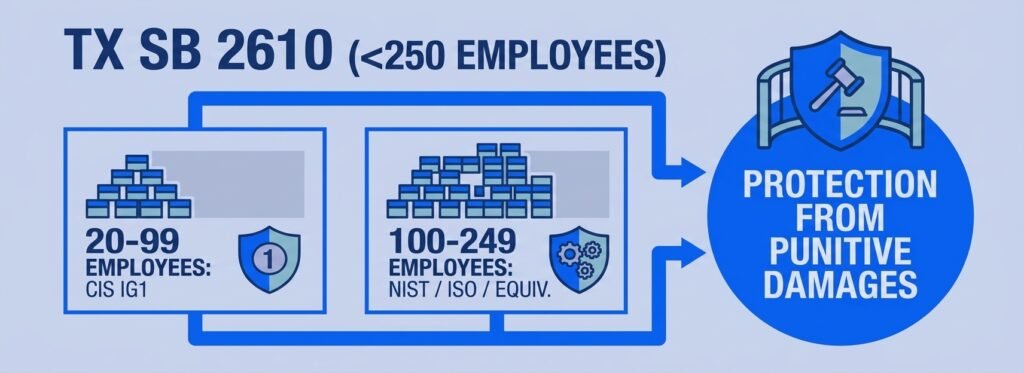
Navigating SB 2610 is another area where cyber security firms for Texas medical practices add real value. Texas Senate Bill 2610 introduced something rare in healthcare regulation: a pathway to reduce legal liability. Practices that implement a documented cybersecurity program aligned with a recognized framework receive statutory protection from punitive damages in post-breach civil litigation. That protection does not prevent a breach – but it can dramatically change the legal outcome if one occurs.
What Qualifies a Practice for Protection
To qualify for SB 2610’s safe harbor, a practice must maintain a written cybersecurity program aligned with an accepted framework before a breach happens. The law applies to Texas businesses with fewer than 250 employees, with requirements scaling by headcount: businesses with 20-99 employees must implement CIS Controls Implementation Group 1, while businesses with 100-249 employees must adopt a more advanced framework such as the NIST Cybersecurity Framework, ISO/IEC 27001, or CIS Controls in full. The program must be implemented, documented, and defensible – not just referenced in a policy document. A healthcare MSSP that explicitly builds toward safe harbor compliance will structure its controls, risk assessments, and documentation specifically to satisfy this standard.
CIS Controls IG1 as a Practical Entry Point
For practices with limited in-house IT resources and no dedicated security staff, CIS Controls Implementation Group 1 (IG1) represents the most practical on-ramp to SB 2610 protection. IG1 is designed for organizations with limited IT resources and focuses on a foundational set of high-impact safeguards: asset inventory, data protection, secure configurations, account management, and audit logging. It is achievable without an enterprise security team, and it directly satisfies the framework alignment SB 2610 requires. A qualified healthcare MSSP will map IG1 controls to both the safe harbor standard and the practice’s actual technical environment.
Why PHI Makes Healthcare a Primary Ransomware Target
This is exactly why cyber security firms for Texas medical practices focus so heavily on ransomware. Complete medical records contain Social Security numbers, insurance identifiers, clinical histories, and billing data – a combination that has been reported to command significantly higher resale value than stolen credit card numbers on dark web markets, since complete health records enable more durable identity fraud. That value drives sustained targeting. Double-extortion ransomware – where attackers both encrypt systems and exfiltrate data before demanding payment – has become a prevalent and impactful attack model against healthcare organizations precisely because PHI gives threat actors leverage beyond just locking files.
Weeks of Downtime: The Outpatient Reality
For outpatient clinics, ransomware is an operational crisis, not just a data problem. This same MFA-attestation and coverage-denial risk shows up on the insurance side too — see our 5 cyber insurance gaps medical practices miss in 2026. The average U.S. healthcare ransomware incident has produced 14-19 days of operational downtime in recent years, according to Comparitech’s tracking of healthcare ransomware attacks, with 2023 marking one of the worst years on record at nearly 19 days. For a busy outpatient surgical center or specialty group, that translates directly into canceled appointments, deferred procedures, revenue losses, and serious patient safety risks when clinical records become inaccessible. Recovering from verified, air-gapped backups is the difference between a contained incident and a prolonged shutdown.
What Generic IT Providers Get Wrong
This is where generic IT support falls short of what cyber security firms for Texas medical practices actually deliver. Standard managed IT providers are not built for healthcare, and the gaps are not minor – they represent direct regulatory exposure for any practice relying on them for compliance coverage.
- No Business Associate Agreement (BAA): Without a signed BAA, a vendor touching PHI creates immediate HIPAA liability for the practice. This applies to password managers specifically too — see our HIPAA password managers for small practices with no IT team guide for which vendors actually offer one.
- No HB 300 training documentation: Generic IT firms do not track role-based training completion, signed verifications, or six-year retention schedules – all of which Texas regulators can demand in an audit.
- No medical device segmentation: MRI machines, infusion pumps, and imaging equipment frequently run legacy operating systems that cannot be patched. This is one piece of the broader five-tool HIPAA stack — see our HIPAA cybersecurity for small clinics: no-IT-staff buyer’s guide. Without micro-segmentation isolating these devices from the clinical network, a single compromised device becomes a network-wide vulnerability.
- No SB 2610 alignment: Building toward the CIS Controls IG1 safe harbor requires intentional framework mapping – not standard IT monitoring.
- No 24/7 SOC: Ransomware typically deploys outside business hours. Without continuous monitoring and rapid threat response, detection comes after encryption has already spread.
Before you keep reading, run your own practice through this. The gaps below — no BAA, no HB 300 training logs, no device segmentation, no SB 2610 alignment, no 24/7 SOC — are the exact five things generic IT providers miss. Check off what you already have in place, and see where your exposure actually sits.
Wherever you landed on that checklist, the pattern holds: each gap above is a specific, named failure point regulators or attackers already know how to find. Closing them isn’t about buying more IT hours — it’s about working with a provider that builds compliance and monitoring around clinical workflows from the start.
How to Evaluate a Healthcare MSSP in Texas
Not every option among cyber security firms for Texas medical practices has the operational depth it claims. These are the core capabilities worth verifying directly during vendor conversations.
SOC Monitoring and Medical Device Segmentation
Ask whether the vendor operates a human-led, 24/7/365 Security Operations Center with documented threat neutralization SLAs. Then ask specifically about medical IoT – can they deploy Network Access Control (NAC) to isolate unpatchable clinical devices on segmented network lanes without disrupting clinical operations? This capability is non-negotiable for any practice running connected diagnostic hardware.
Compliance Coverage: HIPAA, HB 300, and SB 2610
The vendor should be able to articulate – not just claim – how their service addresses each layer. That means signed BAAs, documented Security Risk Analyses mapped to NIST SP 800-66, role-based HB 300 training logs retained for six years, and an explicit CIS IG1 alignment program for SB 2610 safe harbor. Ask them to walk through breach notification workflows, including the 30-day Texas AG deadline and OCR timelines.
Pricing Models That Fit Clinical Headcount
Texas healthcare MSSPs typically bill on a per-user monthly model, with rates varying by service tier and practice size. Per-user pricing is generally preferable to per-device for clinics, since medical practices often deploy multiple devices per clinician – tablets, exam room terminals, mobile devices – and per-device billing escalates quickly. For micro-practices under five seats, watch for minimum commitment floors that reflect the fixed cost of running a 24/7 SOC regardless of user count.
Ransomware Hit Your EMR – What Happens Next
This is where the right cyber security firms for Texas medical practices earn their keep: speed and structure in the first hour after a ransomware event determines how much damage is contained versus how much spreads.
Containment Steps in the First Hour
- Isolate immediately – sever Ethernet connections, disable Wi-Fi, and terminate active VPN bridges to EMR servers and network storage.
- Do not power down infected systems unless a forensics specialist instructs otherwise – volatile RAM holds critical evidence for identifying the attack vector.
- Activate the MSSP’s 24/7 SOC to execute remote endpoint isolation via EDR agents while maintaining forensic command channels.
- Isolate medical IoT devices via NAC protocols to prevent lateral spread into diagnostic networks.
- Execute a global password reset across Active Directory and EMR administrative environments, revoking all active session tokens.
Mandatory Reporting Deadlines
Once containment and forensic scoping are underway, the regulatory clock is already running. Texas clinics must satisfy two overlapping timelines:
- Texas Attorney General – 30 calendar days from breach discovery, for incidents affecting 250 or more Texas residents. Submission is electronic via the AG portal and must include breach description, total individuals affected, technical controls bypassed, and remediation steps taken.
- HHS Office for Civil Rights (OCR) – 60 calendar days from discovery, for breaches affecting 500 or more individuals. Breaches affecting fewer than 500 must be logged and reported annually within 60 days of the calendar year end.
- Affected patients must be notified without unreasonable delay under Texas HB 300’s “as soon as practicable” standard, which in practice should align with (and not exceed) the federal 60-day HIPAA deadline noted above..
Specialized Cybersecurity Is Now a Legal Baseline for Texas Practices
The combination of HB 300’s enforcement teeth, SB 2610’s safe harbor incentive, and sustained ransomware targeting has made cyber security firms for Texas medical practices a legal baseline rather than a best practice. This is the core argument for choosing specialized cyber security firms for Texas medical practices: those that rely on generic IT support for compliance coverage face real, documented liability exposure. The right healthcare MSSP builds the documented, audit-ready compliance infrastructure that protects a practice in a regulatory investigation, a post-breach lawsuit, and a cyber insurance renewal conversation.
For practice managers ready to evaluate cyber security firms for Texas medical practices, TechEd Shield provides healthcare-focused cybersecurity guidance built around the regulatory realities Texas clinics actually face.