


Key Takeaways
- Small law firms can potentially cut standalone cyber insurance premiums by 15-50% by implementing specific technical controls – MFA alone may deliver premium reductions of 15-30%, depending on the insurer.
- Professional Indemnity Insurance (PII) does not cover first-party losses like business interruption or system restoration – standalone cyber cover is essential.
- The ICO fined Merseyside-based DPP Law Ltd £60,000 after a cyberattack exposed 32.4 GB of client data – three failures any firm can avoid are detailed below.
- UK certifications like Cyber Essentials and LOCS:23 do not just satisfy regulators – they directly unlock premium discounts and, in some cases, free insurance cover.
- TechEd Shield is a cybersecurity education platform designed to help small businesses take practical security steps without needing an in-house IT team.
Your PII Will Not Save You From a Cyber Attack
Small law firm cyber insurance is one of those things everyone assumes they already have — usually because they’re confusing it with something else. There’s a widespread, costly belief that Professional Indemnity Insurance covers you if a cyberattack strikes. It doesn’t. Not fully
The SRA Minimum Terms and Conditions require PII to cover third-party civil liabilities – meaning client money lost to a hacker must be covered. But the same rules explicitly allow insurers to exclude first-party losses: the cost of restoring your systems, the forensic investigation, the business interruption while your firm is offline, the crisis communications. Those bills land directly on the firm.
A serious cyber attack costs UK businesses of all sizes an average of nearly £195,000 in direct damages, according to government-backed research – though for a firm the size of a typical small law practice, the full cost including business interruption, regulatory investigations, and client attrition can still climb well past £100,000. Standalone cyber insurance exists specifically to cover these gaps – and the controls required to get competitive premiums are the same ones that make a firm genuinely harder to attack. This is exactly the gap our free cybersecurity health check is built to close: a practical, step-by-step assessment designed for non-technical business owners.
Why Underwriters Are Rejecting Small Law Firms
The cyber insurance market has changed sharply. Underwriters no longer accept a self-completed questionnaire at face value. They run active external scans against a firm’s public IP addresses and DNS records before quoting. Firms with weak controls face punitive premiums, heavy exclusions, or outright rejection.
The True Cost of a Significant Cyber Attack on a UK Business
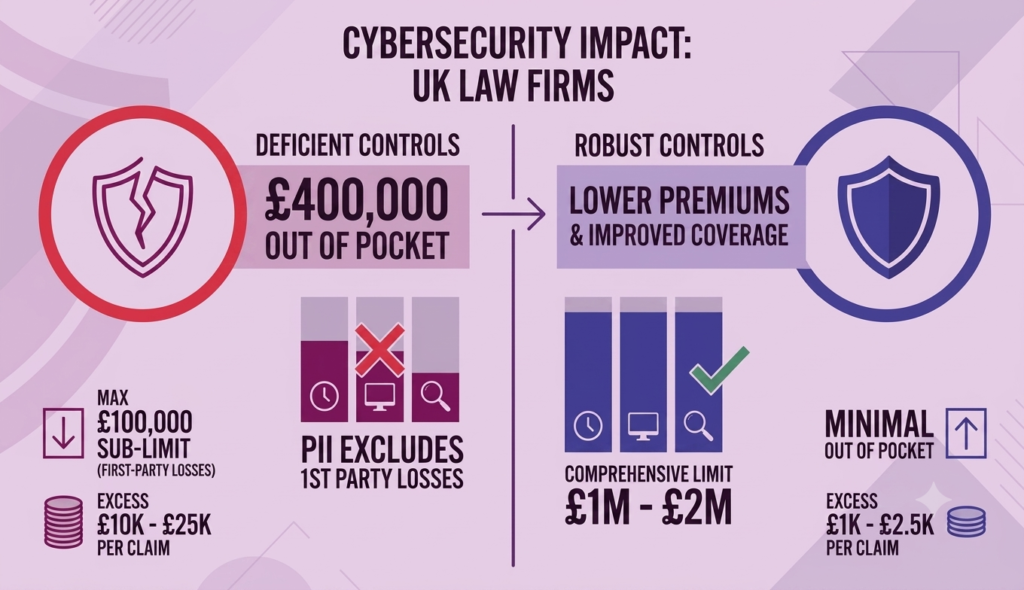
In an SRA thematic review of 40 firms that had reported cybercrime incidents, 75% said they had been the target of a cyberattack, with successful attacks resulting in over £4 million of stolen client funds across 23 of those cases – £400,000 of which firms had to repay from their own resources. Despite this, standalone cyber insurance adoption among UK law firms remains low.
What Insurers Actually Audit
Underwriters evaluate four areas above all others: identity and access management (particularly MFA), endpoint protection, backup resilience, and patch management. A firm that cannot demonstrate structured controls in these areas will either be declined or quoted at rates that reflect maximum assumed risk — and passing an underwriting questionnaire isn’t the same test as the cyber risks law firms miss even when fully compliant.
A Real ICO Enforcement Case: Three Failures to Avoid
On 14 April 2025, the ICO fined Merseyside-based DPP Law Ltd £60,000 following a June 2022 cyberattack that led to the exfiltration and dark web publication of 32.4 gigabytes of highly sensitive client data, affecting 791 individuals. The compromised files included court bundles, privileged legal advice, police body-cam footage, and records relating to vulnerable adults and children.
The penalty notice identified three systemic failures – each of which underwriters now treat as automatic red flags.
The Forgotten Admin Account
Attackers ran brute-force attempts over more than three months against a dormant administrator account named sqluser – created in 2001 for a case management system decommissioned in 2019. The account still carried full domain administrator privileges. The firm did not know the password, had never risk-assessed the account, and wrongly assumed a supplier was responsible for it. A routine account audit would have found and removed it.
The MFA Gap That Opened the Door
DPP Law enforced MFA for standard VPN connections – but not on the legacy admin account. Once attackers compromised a single end-user laptop, they authenticated straight through the unprotected admin account, moved laterally across the entire network, and deployed exfiltration tools. The delayed breach report – 43 days after the incident, and only after the NCA flagged the dark web exposure – was itself treated as a separate UK GDPR infringement, compounding the penalty.
MFA: The Control Worth Up to 30% Off Your Premium
Underwriters treat MFA as the single most critical baseline control. Failure to enforce it on even one active or legacy account is the leading cause of instant application rejection.
To satisfy underwriting standards, MFA must be enforced across all remote access routes, email environments, cloud-based Document Management Systems (DMS), Practice Management Systems (PMS), and every administrator account. Legacy authentication protocols that can bypass MFA filters must be actively blocked, and local admin accounts should be disabled entirely.
For firms running Microsoft 365 Business Premium (around £16.90-£18.10 per user per month, excluding Copilot, as of July 2026), the Conditional Access policies required are natively included. Enforcement across a 10-49 user firm typically takes one to two weeks. The reward: a potential premium reduction of 15-30%, depending on the insurer, and the removal of unprotected access exclusions that would otherwise void claims at the worst possible moment.
EDR, MDR, Backups, and Patching: The Underwriter Checklist
Once MFA is locked down, three further technical controls determine whether a firm gets competitive terms or a loaded premium.
Behaviour-Based Endpoint Protection
Legacy, signature-based antivirus is no longer accepted. Underwriters require behaviour-based Endpoint Detection and Response (EDR) – platforms like Microsoft Defender for Business, SentinelOne, or CrowdStrike Falcon – which use machine learning to detect suspicious actions like unauthorised PowerShell executions or rapid file-encryption attempts. For small firms without internal security staff, a Managed Detection and Response (MDR) service adds a 24/7 human-led Security Operations Centre (SOC). Standalone EDR costs £3-£8 per device per month; fully managed MDR runs £10-£25 per user per month. Monitored endpoints can improve first-party business interruption terms and lower primary policy deductibles.
Immutable Backups That Eliminate Ransomware Co-Insurance
Ransomware co-insurance clauses – which force the insured to pay 50% of any ransom claim – exist specifically because most firms cannot prove their backups are reliable. The solution is a 3-2-1-1 backup strategy: three copies of critical data, on two different media types, one copy off-site, and one copy stored in an immutable cloud repository that cannot be deleted or encrypted even if the primary network is fully compromised. Backups must be protected by separate MFA credentials and subjected to documented monthly restore testing. Cloud storage costs vary by provider and firm size – and a clean, documented restore history can eliminate the co-insurance clause entirely.
Patch Within 14 Days or Pay More
Insurers run automated external vulnerability scans during underwriting. Unresolved critical vulnerabilities – CVSS scores of 7.0 or higher – result in premium loading or denial. Critical and high-severity patches must be applied within 14 days of release; patches for edge devices within 72 hours. Any end-of-life software must be decommissioned or strictly network-segregated. Automated patching via Remote Monitoring and Management (RMM) software, typically bundled into managed IT packages at £45-£100 per user per month, can reduce first-party premium costs and helps avoid claim rejections under standard policy exclusions.
Cyber Essentials and LOCS:23: Certifications That Cut Premiums
Two UK-specific certifications carry direct, measurable insurance value – and both sit within reach of a small law firm.
£25,000 Free Cover for Eligible Firms
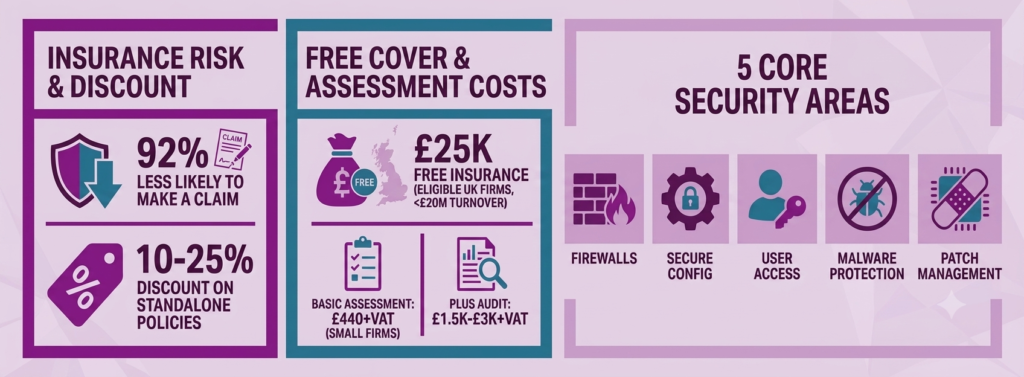
Cyber Essentials certifies compliance across five core areas: firewalls, secure configuration, user access controls, malware protection, and patch management. The IASME self-assessment fee is £320-£440 + VAT (scaled by headcount). Cyber Essentials Plus adds an independent technical audit and external vulnerability scanning, costing £1,500-£3,000 + VAT. The commercial benefit is substantial: basic certification delivers a 10-25% premium discount, and every eligible UK firm with a turnover under £20 million automatically receives £25,000 of free cyber liability insurance on certification – a solid base to top up through commercial markets. Cyber Essentials Plus can unlock up to 30% in premium discounts.
LOCS:23 as an ICO Mitigating Factor
Approved by the ICO in February 2024, the Legal Services Operational Privacy Certification Scheme (LOCS:23) outlines specific privacy controls across five areas including client file governance, operational privacy, and third-party data sharing. Under active ICO fining guidelines, certification serves as a formal mitigating factor during breach investigations – while non-compliance is treated as an aggravating factor. Underwriters view LOCS:23 as a strong signal of risk maturity, enabling certified firms to access preferred premium rates and broader policy terms.
Training and Banking Controls Underwriters Reward
Monthly Phishing Simulations and Deductible Discounts
Human error is widely cited as a factor in the large majority of UK cyber breaches, with estimates from various studies ranging from roughly 60% to over 90%. Annual training sessions are no longer sufficient – underwriters want to see continuous security awareness programmes with monthly interactive micro-learning modules covering phishing, password hygiene, and UK GDPR obligations, combined with regular simulated phishing campaigns. Employees who fail a simulation are automatically assigned remedial modules. Automated training platforms cost as little as £1.50-£3.00 per user per month. Some underwriters offer direct deductible reductions for firms that maintain high staff training completion rates – check policy terms with your broker for specific thresholds and amounts.
Dual-Authorisation to Unlock Crime Cover
Friday afternoon conveyancing fraud and Business Email Compromise (BEC) are among the most common claims in the UK legal sector – and standard cyber policies typically exclude the direct financial losses they cause, the same social engineering sub-limit gap that catches real estate and title firms off guard.
To unlock a standalone crime and social engineering endorsement, firms must implement four procedural controls: provide client bank details only in the physical engagement letter with a written note they will never change by email; require a verbal verification call over a trusted number before any transfer above a low threshold; enforce dual-authorisation banking (one person inputs, an independent partner approves); and configure SPF, DKIM, and DMARC email authentication records to prevent domain spoofing. Implementation requires process changes and roughly two to four hours of configuration time.
Deficient vs. Robust Controls: The Premium Gap in Numbers
For a typical small UK law firm with 25 users and £2 million annual turnover, the difference between weak and strong security controls is stark:
| Criteria | Deficient Controls | Robust Controls |
|---|---|---|
| Annual premium | £3,000–£8,000+ if cover is obtained at all | £1,500–£3,000 |
| Policy limit | Maximum £100,000 sub-limit for first-party losses | £1,000,000–£2,000,000 comprehensive limit |
| Excess per claim | £10,000–£25,000 | £1,000–£2,500 |
| Ransomware cover | Excluded, or subject to a 50% co-insurance clause | Full cover with specialist extortion negotiators |
| Social engineering and crime | Fully excluded | Fully covered via standalone crime endorsement |
The controls cost a fraction of the premium savings – and they prevent the kind of claim that ends a firm.
Fix These Controls First, Then Negotiate Your Policy
The fastest path to competitive insurance terms follows a logical sequence. Month one: audit and decommission legacy admin accounts, enforce MFA across 100% of email and remote access points, and eliminate any end-of-life software connected to the network. Month two: deploy EDR or MDR endpoint protection, establish immutable cloud backups with documented restore testing, and complete Cyber Essentials certification. Month three: implement verbal verification and dual-authorisation banking protocols, configure SPF, DKIM, and DMARC, and launch continuous security awareness training.
With these controls verified and documented, a firm can present a clean, audited security profile to a specialist Lloyd’s market broker – negotiating from a position of demonstrated risk maturity rather than hoping for leniency. The firms that wait until renewal are the ones that pay the most, for the least.
Every control in this article moves the needle on your premium by a different amount. Instead of re-reading the whole piece to work out where your firm stands, tick off what you’ve already implemented below and see roughly how much room you have left to negotiate.
Cyber Insurance Premium Reduction Estimator
Tick the controls your firm already has in place. Estimates are based on typical UK insurer discount ranges — always confirm exact figures with your broker.
Estimate only — not a quote. Actual discounts vary by insurer and are subject to full underwriting.
However many boxes you ticked, the gap between a deficient and a robust control set is not marginal — it’s the difference between a £3,000 policy with a £100,000 sub-limit and a £1,500 policy with £2 million of cover. The controls listed above cost far less than the premium spread they unlock.
A note on pricing: Prices correct at time of writing. Always check current pricing before purchasing.