

Key Takeaways
- New York City small businesses face two major cybersecurity laws — the NYDFS 23 NYCRR Part 500 and the NY SHIELD Act — each with real financial penalties for non-compliance.
- A widely cited 2018 industry analysis found 71% of ransomware victims were small businesses, and cyberattacks have since overtaken inflation as the #1 concern for 75% of small businesses nationally — making professional security support a practical necessity, not a luxury.
- Building security in-house in NYC costs $2M-$3M+ per year when combining personnel and technology; a qualified MSSP delivers equivalent protection for a small fraction of that cost.
- Not every IT provider is a cybersecurity provider — understanding the difference between an MSP and an MSSP can be the difference between staying protected and staying exposed.
- From regulated finance and healthcare to non-technical business owners, the right NYC cybersecurity firm matches your industry, your budget, and your compliance obligations — this post breaks down the seven best options.
Running a small business in New York City comes with a lot of moving parts — payroll, customers, vendors, real estate, and now cybersecurity compliance, which has quietly become a legal obligation that’s sending business owners of nearly every size in the five boroughs to search for NYC cybersecurity firms.
The rules are specific, the penalties are real, and the threats are growing. Ransomware demands targeting small businesses commonly range from the low hundreds of thousands of dollars, even as national average demands across all business sizes have climbed into the millions in recent years, and New York consistently ranks among the states most affected by cybercrime, both in overall financial losses and cyberattack risk exposure — while two state laws, one updated just recently, put the responsibility squarely on the business owner’s shoulders.
NYC’s Rules Put Your Business on the Hook
New York State has moved far beyond general recommendations on data security. For NYC businesses — in finance, healthcare, law, real estate, or any sector handling personal customer data — cybersecurity compliance is now a legal requirement with enforceable penalties, built around two primary laws that apply to small businesses and carry consequences that can dwarf the cost of complying. It’s exactly why most NYC cybersecurity firms build their service packages around these two laws specifically.
Two Laws Every NYC Small Business Must Know
NYDFS 23 NYCRR Part 500: What Changed in 2023
The New York Department of Financial Services Cybersecurity Regulation — known as 23 NYCRR Part 500 — was first introduced in 2017. A significant second amendment, adopted in late 2023, made most compliance programs built around the original standards effectively obsolete.
The updated regulation applies to financial entities, insurers, hedge funds, registered investment advisors (RIAs), and related businesses operating under a New York State license. The 2023 changes introduced and reinforced several demanding requirements:
- Multi-factor authentication (MFA)for all users accessing internal systems — NYDFS guidance recommends token-based MFA over SMS- or push-based methods due to SIM-swapping and social-engineering risks, though the regulation itself does not mandate a specific technology.
- Digital asset inventories under the amended Section 500.13, requiring businesses to track each asset’s classification, physical location, owner, support expiration date, and recovery time objectives — a new requirement introduced by the 2023 Second Amendment that only became mandatory on November 1, 2025.
- 72-hour incident reporting to the NYDFS for any event with a reasonable likelihood of causing material harm.
- 24-hour notification for any ransomware payment, followed by a detailed written justification within 30 days.
- Continuous risk assessments under Section 500.09 — while this requirement predates the 2023 amendment, the updated regulation reinforced that risk assessments must be treated as ongoing, documented processes rather than static, one-time exercises.
Financial entities also face vendor oversight requirements under Section 500.11 (in effect since 2019), meaning the security posture of attorneys, consultants, and third-party providers must be actively evaluated. The next major compliance certification deadline is April 15, 2026 — businesses that haven’t updated their programs since 2017 are already behind.
The NY SHIELD Act: How Small Businesses Are Classified
The New York Stop Hacks and Improve Electronic Data Security (SHIELD) Act casts a broader net, applying to any business that owns or licenses computerized data containing a New York resident’s private information — regardless of where the business is physically located.
The Act expands the legal definition of private information to include username and password combinations, biometric identifiers, and financial account numbers even without associated security codes. Businesses must implement a written Data Security Program covering three types of safeguards:
- Administrative safeguards: Designating security coordinators, assessing internal and external risks, training employees, and managing third-party vendor risks.
- Technical safeguards: Designing secure network architectures, running regular system tests, and deploying centralized anti-malware protection.
- Physical safeguards: Enforcing secure storage policies, validating data disposal processes, and controlling access to equipment and facilities.
The SHIELD Act provides modified standards for small businesses — defined as fewer than 50 employees, less than $3 million in gross annual revenue across the past three fiscal years, or less than $5 million in total year-end assets. These businesses can scale their Data Security Programs to their size and complexity, but are still legally required to maintain one — being small is not a legal defense.
What Non-Compliance Actually Costs You
The financial consequences of ignoring these laws are not theoretical. Under the SHIELD Act, civil penalties can reach $5,000 per violation for maintaining inadequate safeguards. Failing to properly notify affected individuals and the State Attorney General after a data breach carries penalties of up to $250,000.
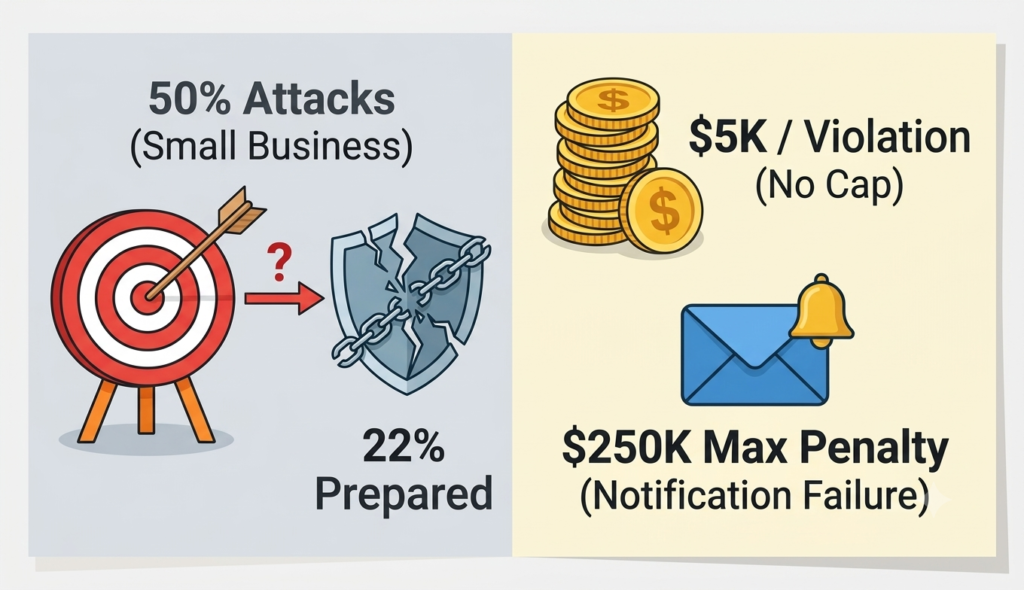
Under NYDFS Part 500, enforcement has escalated, with regulators prioritizing identity control failures and structural compliance gaps — penalties that stack on top of direct breach costs, which for a single incident triggered by one bad click can run into the hundreds of thousands of dollars.
Why Small Businesses Are the Primary Target
Cybercriminals are commonly assumed to target big companies — banks, hospitals, government agencies. In reality, small businesses are the preferred target, precisely because they have weaker defenses and fewer resources to fight back. It’s one of the main reasons NYC cybersecurity firms report such high demand from small business clients.
Ransomware Consistently Targets SMBs for Their Weak Defenses
Ransomware attacks nationally rose sharply in 2023, with demands against small businesses commonly running into the low hundreds of thousands of dollars. A widely cited 2018 analysis found 71% of ransomware victims were small businesses, and more recent data continues to show SMBs facing outsized risk. Weak password protection is a consistent entry point — attackers know small businesses rarely have 24/7 monitoring, dedicated security staff, or tested incident response plans, making them attractive, low-resistance targets.
For a NYC small business operating on tight margins, a $200,000 ransom demand — combined with days or weeks of operational downtime — is not just disruptive. It can be fatal to the business entirely.
Cyberattacks Are the #1 Concern for 75% of Small Businesses Nationally
Phishing remains the most common entry point for attacks against small businesses in New York. Cyberattacks have overtaken inflation as the #1 business concern for 75% of small businesses nationally, according to VikingCloud’s 2026 SMB Threat Landscape Report, and phishing remains the single most common attack vector behind those incidents — requiring no sophisticated malware, just one employee clicking one convincing email.
Consequences range from direct monetary theft to legal fees, regulatory fines, and reputational damage. Business Email Compromise (BEC) — where attackers impersonate executives or vendors to authorize fraudulent transfers — is especially damaging for small businesses handling client payments without formal verification protocols.
The Real Cost of Building Security In-House
Before looking at which firms offer the best protection for NYC small businesses, it is worth understanding why most of them turn to outside help in the first place. The math on doing it alone is stark, and it holds up even outside high-cost metros — see our full breakdown of the true cost of managed security vs. in-house IT for the three-year numbers.
Staffing, Tools, and Infrastructure Drive SOC Costs Past $1M Annually
A functional 24/7 SOC requires nine to ten full-time security professionals to cover three daily shifts, accounting for weekends, holidays, and vacations. In the NYC metro market, salaries alone are steep: Tier 1 analysts run $75,000-$95,000, Tier 2 analysts up to $135,000, and SOC managers up to $190,000. Factoring in benefits, recruitment, and training, annual labor alone can reach $1.16M-$1.57M — before a single piece of security software is purchased.
Add the technology stack (EDR, SIEM, threat intelligence feeds, vulnerability scanners — with SIEM licensing alone an unpredictable, ingestion-based cost) plus facility and physical security infrastructure, and the total annual cost of an in-house NYC SOC can run well over $2M per year, based on U.S. Bureau of Labor Statistics OEWS wage data for NYC-metro information security analysts combined with independent industry SOC-cost benchmarks.
A Comprehensive MSSP Engagement Runs 12-20% of That Cost
A qualified MSSP delivers the same 24/7 SOC coverage, technology stack, and threat intelligence — without the staffing overhead, recruitment costs, or unpredictable licensing bills. The engagement typically runs a fraction of an equivalent in-house team’s cost, converts variable capital expenditure into predictable monthly fees, and gets a business fully operational with monitored security in 30 to 90 days, versus the 9 to 18 months needed to build an internal program.
MSSP vs. MSP: They’re Not the Same Thing
One of the most common and costly assumptions small business owners make is believing their regular IT provider is actively securing their business. In most cases, that assumption is wrong — and the distinction matters enormously. If it’s not yet clear whether your business has crossed that line, our guide to when to hire a cybersecurity consultant vs. going it alone walks through the specific triggers to watch for.
MSPs Keep Systems Running; MSSPs Keep Data Safe
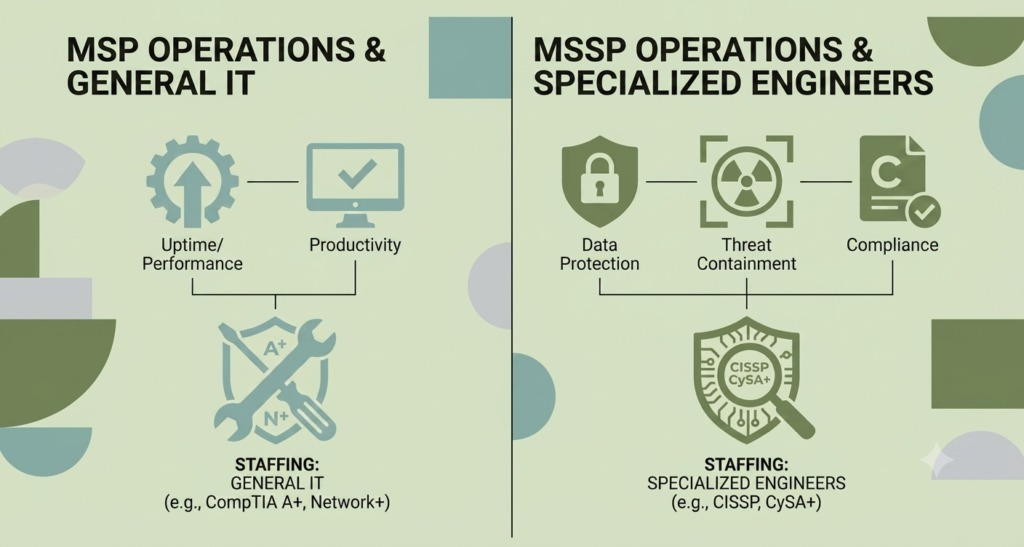
An MSP acts as the hands of a business’s IT environment — fixing slow systems, printers, and email migrations through a Network Operations Center (NOC) focused on one question: is the system online and working?
An MSSP operates differently. They act as the eyes — monitoring for malicious activity, containing threats, managing compliance, and running a 24/7/365 Security Operations Center (SOC) focused on a different question: is the system compromised, and is data being exfiltrated?
The Advanced Tools That Define MSSP-Grade Defense
Where a typical MSP deploys standard antivirus and backup software, an MSSP runs a fundamentally different stack: behavioral Endpoint Detection and Response (EDR) that catches novel attacks signature-based tools miss; Security Information and Event Management (SIEM) platforms that correlate events in real time; live threat intelligence feeds tracking emerging attack methods; and external attack surface monitoring that shows the business what an attacker sees from outside.
MSSP staff typically hold advanced certifications — CISSP, CISA, GIAC, CySA+ — well beyond the general IT credentials common at MSPs. For a business under NYDFS Part 500 or the SHIELD Act, that gap is the difference between being audit-ready and being caught flat-footed.
7 Best Cybersecurity Firms in NYC for Small Businesses
Every business has different compliance obligations, different budgets, and different levels of internal technical capability. The seven NYC cybersecurity firms below have been selected based on their local presence, verified service capabilities, and their fit for specific small business needs.
1. Fortress MSSP — Best for Regulated Finance and Legal
Fortress MSSP targets mid-market organizations in high-liability sectors — hedge funds, broker-dealers, registered investment advisors, healthcare networks, and law firms. Their operations are built around four pillars: managed network infrastructure backed by a 99.97% uptime SLA, integrated 24/7 NOC and SOC operations, manual penetration testing aligned with PTES and OWASP standards, and virtual CISO advisory services for compliance governance and board-level reporting.
Every engagement gets a senior engineer directly — no tiered escalation queues — plus deep local familiarity with NYDFS 500, the SHIELD Act, and NY State Bar requirements, and a physical metro-area presence for on-site work.
Best fit: Businesses that need continuous uptime guarantees alongside rigorous compliance management..
2. Power Consulting Group — Best for NYC SMBs Needing Layered Coverage
Power Consulting Group has built its reputation on layered, multi-tier security defenses and business continuity planning for SMBs across the NYC metropolitan area. Their client base runs from 10 to 250 users and spans non-profits, marketing agencies, real estate firms, boutique legal practices, and medical support offices.
Their Security-as-a-Service approach combines centralized antivirus, endpoint isolation, and automated patching with 24/7 SOC monitoring, plus Virtual CIO services for businesses that want executive-level guidance without a full-time hire. Operating from Manhattan, they guarantee a 4-hour on-site response SLA across NYC, with calls routed directly to a live technician.
3. Anatomy IT — Best for Healthcare Practices
Anatomy IT is one of the largest healthcare-exclusive managed IT and cybersecurity compliance firms in the country. Headquartered in White Plains with a strong NYC presence, they serve independent medical practices, surgical clinics, physical therapy networks, and health-tech startups with 50 to 500 employees.
Their HIPAA Security Risk Analysis maps electronic protected health information (ePHI) across all systems and produces documented evidence ready for federal audits. They protect clinical devices, manage encrypted backup/disaster recovery, and harden remote access with MFA and VPN. Critically, Anatomy IT signs formal Business Associate Agreements — legally binding themselves to ePHI safeguards — and helps clients align with MIPS requirements to protect Medicare reimbursement.
4. Kraft & Kennedy, Inc. — Best for Law Firms
Kraft & Kennedy, Inc. is an elite legal technology consulting and managed security firm headquartered in Manhattan, with over 35 years of experience serving the legal sector. Their target profile covers boutique-to-mid-sized law firms and corporate legal departments with 10 to 250 users.
Their service centers on four areas: document management (iManage, NetDocuments integration), a 24/7 SOC monitoring 20,000+ production devices, legal tech strategy (Azure Virtual Desktop, AI governance policies), and secure communications built for legal workflows. The firm understands attorney-client privilege, document isolation, and confidentiality obligations that general IT firms simply don’t carry.
Best fit: Boutique and mid-sized NYC law firms that require ironclad document management security, legal-specific SOC monitoring, and a technology partner fluent in legal operations.
5. CyberSecOp — Best for Compliance-Driven Businesses
CyberSecOp positions itself as a compliance-first cybersecurity firm, making it a natural fit for NYC businesses managing multiple overlapping regulatory frameworks — NYDFS Part 500, the SHIELD Act, HIPAA, PCI DSS, and SOC 2. Their services are built around helping organizations not just achieve compliance, but maintain and demonstrate it continuously.
Their offering spans managed detection and response, virtual CISO services, incident response, and risk assessments — giving businesses with overlapping regulatory obligations one structured program instead of separate ones per framework.
Best fit: Among NYC cybersecurity firms, CyberSecOp stands out for businesses in finance, healthcare, legal, or technology sectors that face multi-framework compliance obligations and need an organized, audit-ready compliance posture.
6. WCA Technologies — Best for Mid-Market SMBs
WCA Technologies serves the NYC mid-market SMB segment with a combined managed IT and security offering. They focus on businesses that have grown past the point where basic IT support is sufficient but have not yet reached the size where a dedicated internal security team makes financial sense.
Their services cover endpoint security, network monitoring, cloud security, and business continuity — translated into terms owners can act on without a technical background, in a model built to scale.
Best fit: Growing NYC SMBs that need a security-aware managed IT partner capable of scaling alongside business expansion.
7. TechEd Shield — Best for Non-Technical Business Owners
Most NYC cybersecurity firms are built for businesses that already have some technical infrastructure in place. TechEd Shield takes a different approach — one designed specifically for small business owners who run their businesses themselves, manage their own accounts and customer data, and do not have an IT team to lean on.
The core philosophy: most small businesses can dramatically cut their risk by fixing a handful of high-impact issues, without enterprise-grade complexity. TechEd Shield breaks cybersecurity into a clear, step-by-step system focused on what actually matters — securing email and banking accounts, replacing weak passwords, setting up phishing protections, and identifying exposed credentials — plus a beginner-friendly guide, tool recommendations like password managers and VPNs, and a roadmap from quick wins to full protection. The result: an owner who understands exactly what’s in place and why.
Best fit: Solo operators, freelancers, and small business owners in NYC who handle their own digital operations, manage customer data without IT support, and need a clear, plain-English system for getting protected without hiring a full security team.
| Firm | Best For | Client Size | Pricing Snapshot |
|---|---|---|---|
| Fortress MSSP | Regulated finance and legal | 50-2,000 employees | Managed network from $3,000/mo; vCISO from $3,500/mo; full-service bundle from $8,500/mo; IR retainer from $8,000/yr |
| Power Consulting Group | SMBs needing layered coverage | 10-250 users | $75-$300/user/mo (tiered), or $2,000-$7,500+/mo per site |
| Anatomy IT | Healthcare practices | 50-500 employees | $150-$300/user/mo (tiered); $5,000-$25,000 onboarding; 7% annual cap |
| Kraft & Kennedy, Inc. | Law firms | 10-250 users | Not publicly specified |
| CyberSecOp | Compliance-driven businesses | Not specified | Not publicly specified |
| WCA Technologies | Mid-market SMBs | 25-200 employees | Not publicly specified |
| TechEd Shield | Non-technical business owners | Solo operators / no IT team | Not publicly specified |
How Local Firms Turn Complex Laws Into a Clear Plan
Local NYC cybersecurity firms translate dense regulatory language into a structured, plain-English compliance process:
Discovery: Auditors trace where sensitive data actually lives — QuickBooks databases, email archives, cloud folders — rather than asking a manager to identify “Nonpublic Information.”
Gap Assessment: Findings become a Risk and Control Matrix ranking missing safeguards by legal and operational risk, giving owners a clear roadmap.
Automated Evidence Gathering: Software platforms connect to Microsoft 365, Azure, and AWS to automatically verify MFA settings and compile audit-ready evidence packages — no manual screenshot-hunting required.
Continuous Enforcement: Once gaps are closed, tools monitor and log activity on an ongoing basis, so the business can produce current compliance evidence on demand rather than scrambling to reconstruct it after the fact.
Seven firms, seven specialties — it’s a lot to hold in your head at once. Instead of scrolling back up to compare, answer three quick questions below and we’ll point you to the firm that’s built for businesses like yours.
Your match isn’t the only option worth a look — plenty of NYC businesses end up talking to two or three firms before signing anything. But it’s a solid starting point, and a lot faster than re-reading seven profiles to find the one that fits. Not sure yet whether you need a full MSSP or just a few quick fixes? Take the Free Cybersecurity Health Check first to see where your biggest gaps actually are.
The Right NYC Firm Protects You Before a Regulator Asks
The two laws governing NYC small business cybersecurity don’t wait for a breach to start applying — the SHIELD Act requires a written Data Security Program before an incident occurs, and NYDFS Part 500 requires continuous risk assessments and documented controls at all times. The question isn’t whether a small business will eventually face scrutiny — it’s whether the right protections are in place when that moment arrives. Whichever of these NYC cybersecurity firms fits your situation, the goal is the same: being audit-ready before a regulator or a breach forces the issue.
The seven firms covered here each serve a distinct segment of the NYC small business market. Regulated financial and legal firms have Fortress MSSP. Healthcare practices have Anatomy IT. Law firms have Kraft & Kennedy, Inc. Compliance-driven businesses have CyberSecOp. Growing mid-market SMBs have WCA Technologies. Businesses needing layered coverage have Power Consulting Group. And non-technical business owners who need a clear, honest starting point have TechEd Shield.
A note on pricing: Prices correct at time of writing. Always check current pricing before purchasing.