

Key Takeaways
- Small clinics are high-value ransomware targets specifically because they handle sensitive patient data without dedicated IT staff – and attackers know it.
- A five-tool security stack (MDR, enterprise firewall with VLANs, phishing-resistant MFA, encrypted email, and immutable backups) forms the non-negotiable foundation for HIPAA compliance.
- Public Law 116-321 gives clinics a real legal advantage: 12 months of documented compliance can reduce civil penalties and shorten corrective action plans after an incident.
- The free ASTP/ONC Security Risk Assessment Tool lets practice managers run a structured, audit-ready starting-point risk analysis without any technical background – but only if common documentation mistakes are avoided.
- TechEd Shield breaks down exactly what small healthcare practices need to put in place, in plain language, so compliance feels achievable rather than overwhelming.
HIPAA cybersecurity for small clinics doesn’t get simpler just because there’s no dedicated IT department. Running an independent medical practice, dental clinic, physical therapy group, or outpatient surgical facility means juggling patient care, billing, scheduling, and compliance – and that last part is where serious risk lives. Federal enforcement doesn’t slow down for practices still figuring things out. This guide walks through what actually needs to be in place, in the order it matters most.
Small Clinics Are Targeted Precisely Because They Lack IT Staff
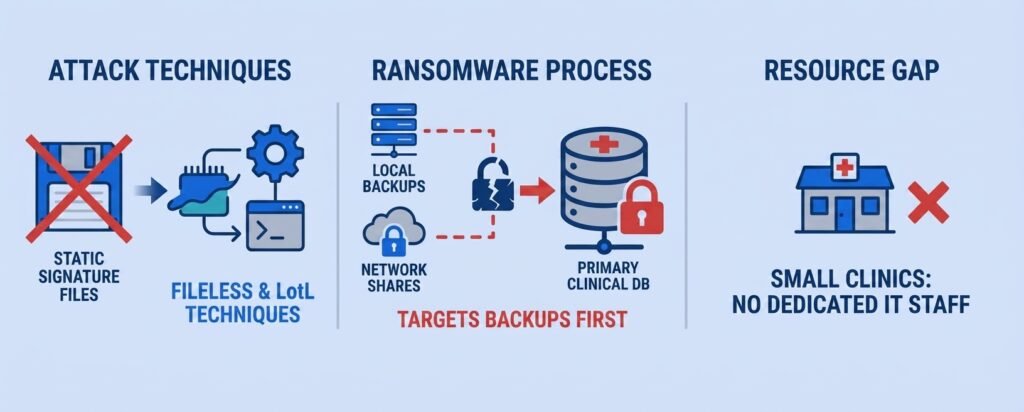
HIPAA cybersecurity for small clinics matters because cybercriminal groups don’t pick targets at random. Small healthcare clinics consistently appear at the top of their lists because the math is simple: high-value patient data, minimal defenses, and no one watching the network at 2 AM — a pattern HHS’s Health Sector Cybersecurity Coordination Center (HC3) has repeatedly flagged in its threat briefs on small and mid-sized practices. Ransomware operators use this gap to deploy double-extortion attacks – encrypting records while threatening to publish them unless a ransom is paid.
At the same time, the HHS Office for Civil Rights (OCR) has intensified enforcement of the HIPAA Security Rule. Under 45 CFR § 160.404 (with amounts adjusted annually per 45 CFR Part 102), civil monetary penalties now reach annual caps exceeding $2.19 million per violation category. Texas practices face an additional layer of state-level penalties on top of this — see our cyber security firms for Texas medical practices & clinics guide for the HB 300 and SB 2610 specifics. Cyber insurers are watching this same MFA/documentation gap closely — see 5 cyber insurance gaps medical practices miss in 2026 for how a mismatch between attested and actual controls can void a claim entirely. This is exactly why HIPAA cybersecurity for small clinics can’t be an afterthought: a single unencrypted laptop, a missing risk assessment, or a vendor without a signed Business Associate Agreement can trigger an investigation that costs far more than the security tools that would have prevented it.
The good news: most of the risk can be eliminated by getting a short list of fundamentals right. Resources like TechEd Shield exist specifically to help non-technical practice owners work through this landscape without needing to hire a full-time CISO.
The 5-Tool Stack Every Clinic Needs First
Building HIPAA cybersecurity for small clinics starts with five categories of tools that work automatically, since no one on staff has a technical background. Every independent clinic should have all five in place before addressing anything else.
Not sure where your clinic actually stands? Before you read another word, run your practice through the five-tool checklist below. It takes less than two minutes, and the score you land on will tell you exactly which section of this guide to focus on first.
HIPAA Security Stack Self-Assessment
Check every box that’s true for your clinic today, then see where you stand.
Whatever score you landed on, the good news is the same: every gap on this list has a straightforward fix, and none of them require hiring a full-time IT person. Use the sections below to close the gaps in order, starting with whichever tool category scored lowest — and remember that the 12-month documentation clock only starts once a practice is actually in place, so the sooner a gap closes, the sooner it counts toward Public Law 116-321 protection.
Managed EDR/MDR: Your 24/7 SOC Substitute
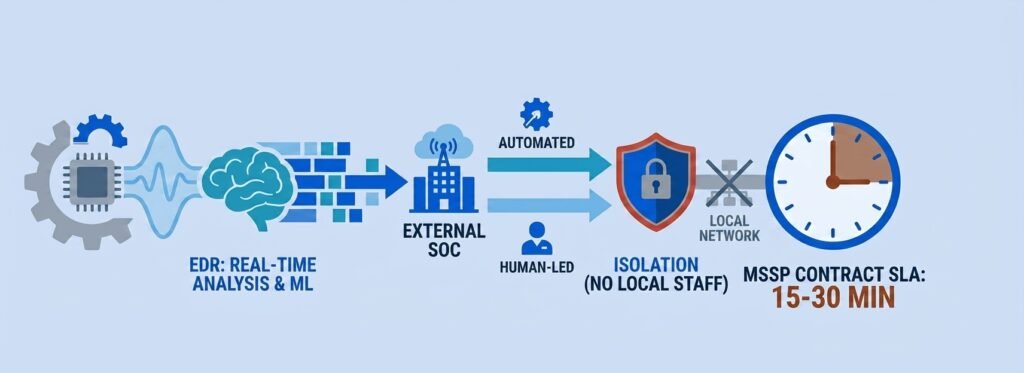
A core piece of HIPAA cybersecurity for small clinics is moving past traditional antivirus, which compares files against a list of known threats. Modern healthcare attacks don't use known threats - they use fileless techniques and native operating system tools that legacy software simply doesn't catch. Managed Detection and Response (MDR) pairs behavioral AI on every endpoint with a live, external Security Operations Center (SOC) staffed around the clock.
When an unauthorized process starts encrypting local directories - even at 3 AM on a Sunday - the SOC isolates that device from the network in seconds, halts the process, and rolls back affected files. No clinic staff action required. Solutions like SentinelOne Complete, CrowdStrike Falcon Complete, and Huntress are built for exactly this scenario. The key procurement question to ask any MDR vendor: "Does your SOC have contractual authority to isolate an infected machine without waiting for our confirmation?" If the answer is no, keep looking.
Enterprise Firewalls and VLAN Segmentation
Network protection is a non-negotiable part of HIPAA cybersecurity for small clinics. The router an internet provider installs is not a firewall - not in any meaningful security sense. Clinics need an enterprise-grade Next-Generation Firewall (NGFW) such as a Fortinet FortiGate, SonicWall TZ Series, or Cisco Meraki MX at the network perimeter. These appliances perform deep packet inspection, block malicious domains automatically, and enforce network segmentation using VLANs.
The network should be divided into at least three isolated zones: one for staff computers and cloud EHR access, one for network-connected medical devices (digital X-ray, lab analyzers, IoMT hardware), and one for patient Wi-Fi. Dental practices need a comparable four-zone structure — see our HIPAA-compliant WiFi for dental offices: secure setup guide. For the specific VLAN structure and hardware options that implement this, see our HIPAA-compliant WiFi for medical offices without an IT team. A compromised device on the patient Wi-Fi should have zero routing access to the EHR system. For the underlying router-level settings that make this enforceable, see our small business WiFi security checklist: 8 fixes that matter. VLAN segmentation is what makes that separation enforceable.
Phishing-Resistant MFA and Encrypted Email
Identity protection is one of the most overlooked layers of HIPAA cybersecurity for small clinics. Stolen credentials remain the single most common entry point into healthcare networks. Standard SMS-based two-factor authentication is no longer sufficient - SIM-swapping and adversary-in-the-middle phishing kits defeat it routinely. Clinics need phishing-resistant MFA enforced through a centralized Identity Provider like Duo Security, Microsoft Entra ID, or Okta Workforce, using either number-matching authenticator apps or FIDO2/WebAuthn hardware keys.
MFA must cover every access point: cloud EHR portals, email, billing clearinghouses, VPNs, and remote desktop sessions - no exceptions. For the right sequence to roll this out without disrupting clinical staff, see SSO vs MFA for small business: which to roll out first in 2026. Pair this with a direct-delivery encrypted email solution like Paubox or Virtru, which automatically applies TLS 1.2/1.3 encryption without requiring patients to create a separate login to read their own health information. Premium tiers of these platforms also offer data-loss-prevention scanning that flags ePHI in outbound messages.
Immutable Backups and the 3-2-1-1-0 Rule
Backup strategy is where HIPAA cybersecurity for small clinics often falls apart under pressure. Ransomware operators target backup files first. Consumer cloud sync tools and standard external drives fail here because they can be encrypted or deleted once an attacker has domain credentials. The answer is an immutable backup architecture following the 3-2-1-1-0 framework:
- 3 copies of clinical data
- 2 different storage media types
- 1 offsite copy
- 1 copy in an offline or WORM (Write Once, Read Many) immutable repository that no administrator account can delete or overwrite
- 0 errors - verified through automated daily restoration testing
Solutions like Veeam with Object Lock, Datto SIRIS, and Wasabi Immutable Cloud meet this standard. The zero-errors requirement is non-negotiable: a backup that has never been tested is not a backup.
MSP vs. MSSP: Choosing the Right Outside Partner
Choosing the right outside partner is central to HIPAA cybersecurity for small clinics. Without in-house IT staff, the clinic's outside technology partner becomes the de facto security team. The choice of partner matters enormously - and the most common mistake is hiring the wrong type of provider.
What a Generalist IT Provider Will Miss
A standard Managed Service Provider (MSP) focuses on uptime, help-desk tickets, and printer configurations. That's valuable, but it's not security. An MSSP - or a healthcare-specialized MSP with embedded MSSP capabilities - provides continuous threat monitoring, active incident response, vulnerability management, and proactive compliance documentation. The most viable path for a small clinic is either a healthcare-focused MSP whose standard service bundle includes managed EDR and 24/7 SOC monitoring, or a generalist MSP with a formal upstream MSSP partnership.
| Criteria | Standard MSP | MSSP / Healthcare-Specialized MSP |
|---|---|---|
| Primary focus | Uptime, help-desk tickets, printer configuration | Continuous threat monitoring and compliance |
| Threat detection | Basic antivirus | Managed EDR/MDR |
| Monitoring coverage | Business hours, alert-driven | 24/7, active incident response |
| Documentation | Logs provided only when asked | Proactive compliance documentation |
| Vulnerability management | Not typically included | Included |
Red Flags to Reject Before Signing Anything
- Hesitation to sign a BAA: Any vendor that delays or tries to narrow a Business Associate Agreement before accessing clinic systems should be disqualified immediately.
- Shared admin credentials: Using one shared "admin" password across multiple client sites undermines individual access tracking and accountability, violating the intent of HIPAA access control standards under 45 CFR 164.312(a)(2)(i).
- No SOC 2 Type II or ISO 27001: Without third-party validation of their own internal controls, a vendor can become a supply-chain liability.
- Vague incident response SLAs: Contracts without financially backed response time commitments for critical threats (many MSSP contracts specify guaranteed response within 15-30 minutes) leave the clinic exposed during off-hours attacks.
What the HHS 405(d) HICP Framework Recommends for Small Clinics
The HHS 405(d) Health Industry Cybersecurity Practices (HICP) framework is the federal blueprint for small healthcare organizations. It identifies five primary threat categories targeting clinics - social engineering, ransomware, loss or theft of equipment or data, insider threats, and attacks against network-connected medical devices - and responds with ten foundational practices. For how a comparable compliance framework translates into cost outside healthcare, see how much a small business security audit costs in 2026.
The 10 Foundational Practices You Must Document
HICP Technical Volume 1 maps directly onto the tools described above. The ten practices cover email protection, endpoint security, identity and access management, data protection, asset inventory, network management, vulnerability scanning, incident response planning, medical device security, and cybersecurity governance (including annual staff training and written policies). Every practice carries a documentation requirement - the 12-month audit trail is what transforms a tool purchase into a legal defense.
Public Law 116-321: How 12 Months of Compliance Reduces Your Penalties
EPublic Law 116-321 offers a direct financial incentive for investing in HIPAA cybersecurity for small clinics. Enacted in January 2021, it amends Section 13412 of the HITECH Act to provide meaningful regulatory relief for clinics that can demonstrate they were doing the right things before an incident occurred. Under this law, the HHS Secretary is required to consider a clinic's implementation of Recognized Cybersecurity Practices (RCP) - specifically the HICP framework or NIST Cybersecurity Framework - when determining penalty amounts, structuring corrective action plans, and deciding whether to continue an audit.
The threshold is specific: practices must have been actively implemented and consistently functioning across the entire organization for the 12 months prior to the security event. Buying a software license the week after a breach does not qualify. Maintaining 12 months of documented operational logs does. Documentation is not an administrative afterthought - it is the legal mechanism that limits financial exposure.
Running a HIPAA Security Risk Assessment Without an IT Team
Risk assessment is a mandatory piece of HIPAA cybersecurity for small clinics under 45 CFR 164.308(a)(1)(ii)(A) - and failure to perform one is the single most cited violation in OCR enforcement actions.
Using the Free ASTP/ONC SRA Tool Step by Step
The ASTP/ONC Security Risk Assessment Tool is a free Windows desktop application developed by the HHS Office for Civil Rights (OCR) and the Assistant Secretary for Technology Policy (ASTP), in collaboration with ONC. It translates complex regulatory language into plain-language questions that a practice manager can answer without technical expertise. The tool walks users through asset and vendor/BAA tracking, a series of Security Rule-aligned multiple-choice questions, and a threat-and-vulnerability assessment. Version 3.4+ adds a Remediation Report to track corrective actions, and results can be exported as a dated report (PDF or Excel workbook) for your compliance file. The final output is a dated, exportable PDF that serves as an audit-ready compliance artifact. All HIPAA risk assessments must be retained for a minimum of six years under 45 CFR 164.316(b)(2)(i).
SRA Mistakes That Lead Directly to OCR Penalties
- Treating the SRA as a one-time event: The assessment must be updated annually and after any significant operational change - a new EHR system, a satellite location, or new imaging equipment.
- Skipping medical devices: Digital X-ray units, ultrasound systems, and VoIP phones that carry voice ePHI must be included. Assessments that only cover administrative computers routinely fail OCR review.
- Identifying risks without fixing them: An SRA report that documents unencrypted laptops or missing MFA, with no corresponding corrective action plan and remediation tracking log, is treated as evidence of willful neglect - the highest penalty tier.
Documented Compliance Is the Only Compliance That Counts
Documentation ties every piece of HIPAA cybersecurity for small clinics together. Every tool purchased, every policy written, and every vendor contract signed is only as valuable as the documentation proving it was consistently in use. This applies directly to your password manager vendor too — see our HIPAA password managers for small practices with no IT team guide for which platforms actually offer a BAA. OCR investigators and cyber insurers don't take a clinic's word for it - they review logs, configuration exports, training completion records, and signed policy acknowledgments. A clinic that has done everything right but kept no records is indistinguishable from one that did nothing.
Build the documentation habit alongside the procurement process: save firewall configuration backups, export MFA enrollment logs monthly, archive every backup restoration test result, and file signed BAAs before any vendor touches the network. Compliance that can be proven is compliance that protects the practice - legally, financially, and operationally. Take the free Cybersecurity Health Check to see where your clinic's documentation gaps actually sit before OCR finds them first.