

Key Takeaways
- Storing data in an EU cloud region does not guarantee GDPR safety if your password manager vendor is headquartered in the US – the CLOUD Act can still reach that data.
- Under GDPR, your business is the Data Controller. The legal responsibility for choosing a compliant processor sits with you, not your vendor.
- Zero-knowledge encryption protects your vault contents from court-ordered disclosure, but it does not protect operational metadata – email addresses, IP logs, and access timestamps remain exposed.
- Natively European password managers offer the strongest data sovereignty because they fall entirely outside US surveillance laws like FISA 702 and the CLOUD Act.
- Article 32 requires you to document your security measures – keep reading to understand exactly what that means for a small business using a cloud password manager.
GDPR password managers for small business decisions sound simple at first – find one with good reviews, maybe an EU server option, done. But GDPR compliance goes deeper than where data physically sits. The legal framework your vendor operates under matters just as much as the location of their data center. Here is what small business owners and freelancers actually need to know.
EU Hosting Alone Does Not Guarantee GDPR Safety
This is the most common misconception around GDPR password managers for small business. A vendor can advertise “EU data residency” and genuinely store your data in Frankfurt or Dublin – and that data can still be legally compelled by US authorities. The location of the server and the jurisdiction of the company are two completely different things. If a vendor is incorporated in the United States, US law follows them everywhere, including to their European data centers. EU hosting reduces latency and satisfies some data localization preferences, but it does not sever a US company’s obligations under US law. That distinction is the foundation of everything else in this article.
You Are a Data Controller – Your Vendor Is Not
Before comparing GDPR password managers for small business, it helps to understand how GDPR actually assigns responsibility. The law creates two distinct roles, and which one your business occupies changes everything about your compliance obligations.
How Article 4 Defines Controller and Processor Roles
Under GDPR Article 4(7), the Data Controller is the party that determines the purposes and means of processing personal data – that is your business. The password manager vendor is the Data Processor under Article 4(8), acting only on your instructions. The burden of choosing a compliant processor falls on you. If your vendor’s data handling practices create a GDPR violation, regulators will look to you first.
Why Your DPA With the Vendor Is Non-Negotiable
GDPR Article 28 requires a signed Data Processing Addendum (DPA) between your business and any processor you use. This is a legal requirement, not a formality. The DPA should specify what data is processed, for what purpose, under what security conditions, and how sub-processors are managed. Without it, you have no documented basis for the processing relationship – a compliance gap on your side of the ledger.
The CLOUD Act Problem US Vendors Cannot Escape
The CLOUD Act is one of the biggest hidden risks in choosing GDPR password managers for small business. Enacted in 2018, it allows US law enforcement to compel US-headquartered companies to hand over data they control – regardless of where that data is physically stored. This is not theoretical. TechEd Shield addresses this exact gap in their free password security resource, where understanding what your tools actually protect – and what they do not – is the starting point for making smarter business security decisions.
Stored in Frankfurt, Still Reachable by US Courts
When a US company receives a valid CLOUD Act order, compliance is not optional. The company cannot refuse on the grounds that data is physically located in the EU. The Schrems II ruling by the Court of Justice of the EU (CJEU) invalidated the old EU-US Privacy Shield specifically because US surveillance law – including Section 702 of the Foreign Intelligence Surveillance Act (FISA) – was found to undermine the protections EU law guarantees. That legal conflict has not been resolved by subsequent frameworks.
FISA 702 and the Metadata You May Be Overlooking
FISA Section 702 authorizes the collection of communications data from non-US persons for foreign intelligence purposes. Where this affects small businesses is not in vault contents – it is in operational metadata: who logged in, from which IP address, at what time, using which device. This data is processed in plaintext by vendors and sits entirely outside the protection of zero-knowledge encryption. Even if a court order cannot extract your passwords, it can extract your employee roster, access logs, and account activity.
Two Types of Protection: Cryptographic vs. Jurisdictional
Understanding this distinction is the single most important technical concept when evaluating GDPR password managers for small business. These two types of protection are not interchangeable, and confusing them is the source of most false confidence in the market.
Zero-Knowledge Encryption: What It Actually Shields
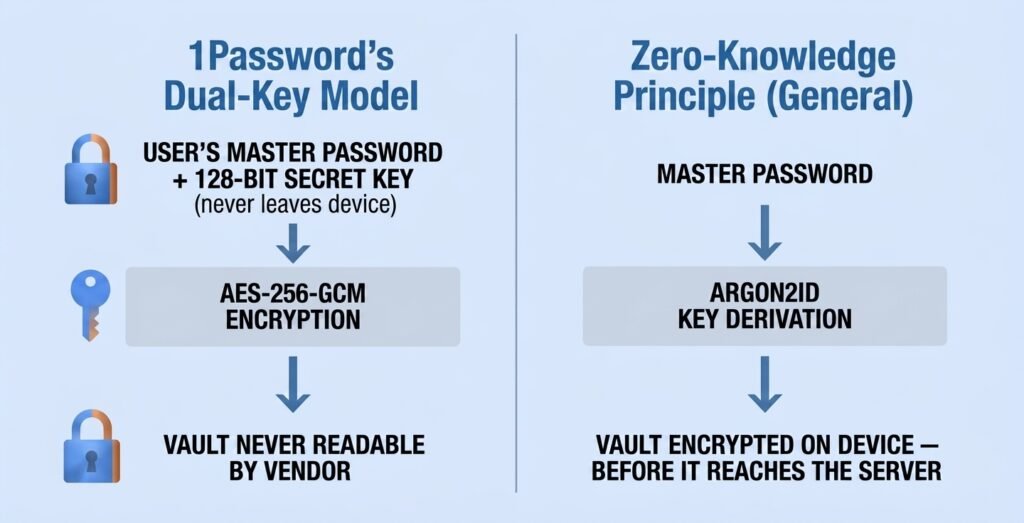
Zero-knowledge encryption means the vendor never holds your encryption keys. Your vault is encrypted on your device before it reaches their servers, using a key derived from your master password that is never transmitted. Even if a US court serves a valid legal order on the vendor, they mathematically cannot decrypt and produce your passwords, secure notes, or stored credentials. That is genuine cryptographic protection – and it is valuable.
Service Data: The Unencrypted Gap That Remains
Zero-knowledge only covers vault payloads. Every password manager also processes what is typically called Service Data – billing details, email addresses, user account records, sign-in IP addresses, device identifiers, and access timestamps. This data is processed in plaintext by the vendor’s systems and is fully accessible to them. It is also fully subject to CLOUD Act and FISA 702 compulsion. Your passwords may be cryptographically untouchable, but your business’s organizational metadata is not.
Where your vendor is incorporated matters as much as where your data sits. Check your own setup below.
What’s Your Vendor’s Jurisdiction Exposure?
Two questions about your current or prospective vendor.
This is a starting point, not a legal opinion — confirm specifics directly against your vendor’s current DPA before making a final compliance decision.
US-Headquartered Vendors With EU Regions: A Closer Look
Several of the most popular GDPR password managers for small business offer EU data residency options. Here is what that actually means in practice.
| Vendor | Corporate Incorporation | EU Hosting Location | CLOUD Act Exposure |
|---|---|---|---|
| 1Password (AgileBits Inc.) | Toronto, Canada (no separate US entity) | Ireland / Frankfurt (AWS) | Reduced structural exposure; review US sub-processors |
| Dashlane | Dual: Dashlane SAS (France) + Dashlane USA, Inc. (Delaware) | Ireland (AWS) | US entity carries structural exposure for Service Data |
| Bitwarden Inc. | United States | EU regions on Microsoft Azure | Full CLOUD Act exposure as US-incorporated entity |
1Password and Dashlane: EU Data Residency, US Jurisdiction
1Password (operated by AgileBits Inc., a company incorporated and headquartered in Toronto, Canada, with no separate US corporate entity) offers a dedicated EU hosting environment via the 1Password.eu endpoint, storing data on AWS infrastructure in Ireland and Frankfurt. The platform uses a dual-key zero-knowledge model – AES-256-GCM encryption paired with a 128-bit Secret Key that never leaves the user’s device. Both 1Password and Dashlane also appear in our broader breakdown of the best password managers for small businesses in 2026, evaluated outside the jurisdiction question covered here. Data transfers are supported by Standard Contractual Clauses alongside Canada’s formal EU adequacy status. Because AgileBits Inc. is Canadian-incorporated rather than US-incorporated, it does not carry the same structural CLOUD Act exposure as a US-headquartered vendor – though any US-based sub-processors in its infrastructure stack should still be reviewed as part of your vendor due diligence. Dashlane, by contrast, operates through a genuine dual corporate structure with entities in both France (Dashlane SAS) and the US (Dashlane USA, Inc., a Delaware corporation), with vault data stored on AWS infrastructure in Ireland. Dashlane’s US entity does carry structural CLOUD Act exposure for Service Data, regardless of where vault data is physically hosted. Note: The precise transfer mechanisms and corporate structures for both vendors should be verified directly against each vendor’s current DPA documentation before making compliance decisions.
Bitwarden: EU Hosting on Azure, Still Subject to US Law
Bitwarden Inc. is a US-incorporated company offering an EU cloud option hosted on Microsoft Azure within EU regions. The platform is open-source, zero-knowledge, and supports full self-hosting – a meaningful differentiator. For its managed cloud plans, Bitwarden publishes a Data Processing Agreement and holds compliance attestations including SOC 2 Type 2 and SOC 3. Note: Whether Bitwarden’s managed plans simultaneously rely on 2021 EU Standard Contractual Clauses and active EU-US Data Privacy Framework certification should be confirmed directly with Bitwarden, as these mechanisms interact in ways that affect your compliance documentation. Similarly, verify Bitwarden’s current sub-processor list directly with the vendor before relying on it for compliance purposes. Regardless of transfer mechanism, DPF certification does not alter FISA 702 or CLOUD Act applicability to Service Data.
DPF Certification vs. SCCs: What Changes for You
The EU-US Data Privacy Framework (DPF) allows certified US entities to receive EU personal data without requiring Standard Contractual Clauses. The European Commission’s DPF adequacy decision does not neutralize US surveillance law. Vendors relying on SCCs require you to conduct a formal Transfer Impact Assessment (TIA) under Article 46. DPF-certified vendors reduce that paperwork burden but do not reduce the underlying legal risk. Neither mechanism changes what FISA 702 can compel.
Natively European Providers Offer Stronger Sovereignty
Among GDPR password managers for small business, the cleanest solution to the CLOUD Act problem is a vendor with no US corporate presence at all.
No US Parent, No CLOUD Act Exposure
Providers like Passbolt (Luxembourg), Proton Pass (Switzerland), Psono (Germany), and Uniqkey (Denmark) are incorporated entirely within EU or EEA-adjacent jurisdictions.
| Provider | Country of Incorporation | CLOUD Act / FISA 702 Exposure |
|---|---|---|
| Passbolt | Luxembourg | None — no US nexus |
| Proton Pass | Switzerland | None — no US nexus; formal EU adequacy decision applies |
| Psono | Germany | None — no US nexus |
| Uniqkey | Denmark | None — no US nexus |
They have no US parent company, no US holding entity, and no mandatory US sub-processor dependencies. FISA 702 and the CLOUD Act have no legal mechanism to compel data disclosure from entities with no US nexus. This jurisdictional protection covers both encrypted vault payloads and unencrypted Service Data – the gap that zero-knowledge encryption alone cannot close. Swiss-based providers like Proton Pass also benefit from Switzerland’s formal EU adequacy decision, allowing data flows without SCCs.
Self-Hosting: Full Control, Serious Trade-Offs
Self-hosting is one alternative path among GDPR password managers for small business. An open-source option like Bitwarden or Passbolt on EU-owned private infrastructure (for example, Hetzner in Germany or Scaleway in France) provides absolute data sovereignty. There are no third-party cloud sub-processors in the data path, and both vault contents and operational logs stay entirely within EU jurisdiction. Self-hosting does, however, demand internal IT expertise to manage containers, TLS certificate renewals, server hardening, and ongoing patching. For resource-constrained small teams, a misconfigured or unpatched self-hosted server creates a higher practical security risk than a well-managed SaaS vendor. See our cloud vs. self-hosted password manager guide for the full three-year cost comparison behind that trade-off. If internal expertise is limited, a natively European managed SaaS provider is typically the safer and more realistic option.
Article 32 TOMs: What Your Business Must Document
Regardless of which GDPR password managers for small business you choose, Article 32 requires you to implement and document Technical and Organizational Measures (TOMs) appropriate to the risk. Using a secure password manager is not enough – the documentation has to exist.
Access Control, Audit Logs, and Vendor Oversight
When documenting your use of GDPR password managers for small business, your records should cover:
- MFA enforcement – TOTP or FIDO2/WebAuthn hardware keys (such as YubiKeys) on all password manager accounts, no exceptions.
- Role-Based Access Control (RBAC) – least-privilege vault assignments documented per team or department. Finance credentials restricted to finance personnel, for example.
- Audit logging – administrative event logs enabled, covering login attempts, failed MFA, vault item changes, and permission updates, with defined retention schedules. CPA firms face a near-identical documentation burden under the FTC Safeguards Rule — see our password managers for CPA firms: FTC Safeguards & MFA compliance guide for that regulatory parallel.
- Vendor governance – a signed DPA, a documented TIA or DPF mapping, and an up-to-date sub-processor inventory with a process for handling vendor change notifications.
- Automated offboarding – SCIM provisioning connected to your identity provider so that revoking an employee’s account in your directory instantly removes their password manager access.
Recovery Procedures and Breach Notification Under Articles 32, 33, and 34
Article 32 also requires a documented incident response and recovery plan. This means a written procedure for secure emergency access or master key recovery, a tested backup and disaster recovery protocol, and a clear 72-hour breach notification procedure linked to your password manager’s logging capabilities. Under Articles 33 and 34, you are required to notify your supervisory authority within 72 hours of becoming aware of a personal data breach – and in some cases notify affected individuals directly. Your password manager’s event logs are a key input to that process, which is why audit logging is a compliance requirement, not a premium feature.
Zero-Knowledge Encryption Is Essential, But Jurisdiction Still Matters
Zero-knowledge encryption is non-negotiable – any of the GDPR password managers for small business worth considering should implement it. Treating it as the only compliance consideration, though, leaves a meaningful gap. Operational metadata, billing records, user registries, and access logs are all processed in plaintext by every cloud password manager. Ecommerce sellers face a parallel exposure with non-payment customer data — see 9 ecommerce security risks PCI compliance leaves unprotected for how that gap plays out under CCPA and GDPR. For EU small businesses where GDPR compliance is a genuine legal requirement, the jurisdiction of your vendor is the deciding factor that zero-knowledge encryption alone cannot resolve. Choosing a natively European provider closes both gaps. Choosing a US vendor with EU hosting closes one.
TechEd Shield helps small business owners evaluate GDPR password managers for small business and take clear, actionable steps to protect their business data – without needing a technical background to do it. Take the free Cybersecurity Health Check as a starting point for understanding what your current tools actually protect – and what they do not.