

Key Takeaways
- Law firms are high-value targets because they hold sensitive client data – and a breach carries both ethical and legal consequences, not just reputational ones.
- These technical and operational controls, including Zero Trust access and continuous monitoring, are increasingly recognized as essential measures to meet the “reasonable efforts” standard for ethical compliance under ABA Model Rule 1.6.
- Human error drives the majority of successful cyberattacks, making ongoing training more important than any single piece of technology.
- Encrypted communications and vendor due diligence, if not adequately implemented, can create significant vulnerabilities that cybercriminals exploit in legal environments.
- Read on to understand exactly how each control maps to specific ethical and legal obligations – and what happens when firms skip them.
Ways law firms can prevent client data breaches start with understanding what’s at stake: a law firm’s file system is one of the most valuable targets a cybercriminal can find. Corporate trade secrets, financial records, M&A term sheets, personal client data – all concentrated in one place, and the firm is often less defended than the companies it represents. The stakes go beyond financial loss. A breach can trigger state regulatory action, bar complaints, civil litigation, and permanent damage to client trust. The good news: most of it is preventable.
Law Firms Are High-Value Targets – And the Stakes Are Different
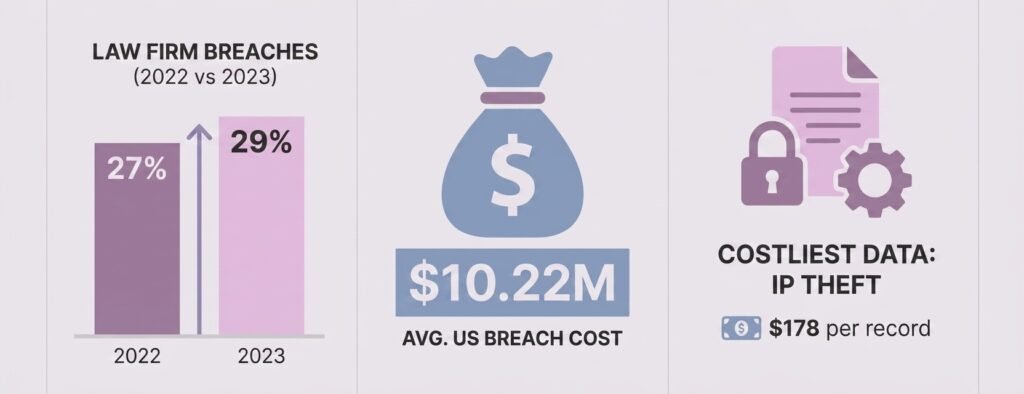
Understanding the ways law firms can prevent client data breaches starts with the stakes: unlike a retailer or a healthcare provider, a law firm stores confidential information under a legal duty of confidentiality that predates digital technology by centuries. When that data is exposed, the fallout extends well beyond a breach notification letter. The American Bar Association, state bar associations, and state attorneys general all have a say in what happens next. The numbers back up the urgency: according to the ABA’s Cybersecurity TechReport, 29% of law firms reported a security breach in 2023, up from 27% the year before. When a breach does occur, the financial exposure is severe – IBM’s 2025 Cost of a Data Breach Report puts the average US breach cost at $10.22 million, with intellectual property theft the costliest category of compromised data at $178 per record. Firms operating in New York, California, or Texas face layered obligations under state cybersecurity statutes on top of their professional ethics rules. That combination of ethical, civil, and regulatory exposure is what makes law firm data security categorically different – and why cybersecurity resources like TechEd Shield specifically focus on translating complex security requirements into actionable steps for smaller organizations without dedicated IT teams.
Adopt Zero Trust: No User Gets Automatic Access
One of the most effective ways law firms can prevent client data breaches is adopting Zero Trust. The traditional castle-and-moat model – where anyone inside the network is trusted – breaks down when attorneys are accessing files from home, coffee shops, and mobile devices. Zero Trust Architecture (ZTA) flips the default: no user, device, or application gets access automatically, regardless of where it connects from. Every session is verified before access is granted.
Phishing-Resistant MFA and Role-Based Access Controls
Two controls do most of the heavy lifting inside a Zero Trust model. Multi-factor authentication (MFA) should be deployed across every firm system – document management, email, VPNs, client portals, and billing platforms. Legacy SMS-based MFA is vulnerable to SIM-swapping attacks and should be replaced with hardware security keys (FIDO2/WebAuthn) or managed authenticator apps. Even properly configured MFA has a documented bypass method firms should know about — see 9 cyber risks law firms miss even when fully compliant. Alongside MFA, Role-Based Access Control (RBAC) limits who can see what. A paralegal on a real estate matter has no need to access active M&A files. Partial MFA coverage carries the same practical risk as none at all from an insurer’s perspective — see our MFA gaps: is your law firm’s cyber claim at risk? guide. Restricting access to only what is needed for active representation sharply limits the blast radius of any single compromised account.
How Small Firms Deploy ZTA Without Disrupting Casework
The most common objection from small and midsize firms is friction – that strict access controls will slow down time-sensitive work. A phased approach resolves this:
- Single Sign-On (SSO) via a centralized identity provider (Microsoft Entra ID or Okta) connected to practice management tools like Clio or LawPay means attorneys authenticate once per session, not dozens of times. For the right sequence to roll this out — MFA first, SSO layered on top — see SSO vs MFA for small business: which to roll out first in 2026.
- Context-aware conditional access keeps authentication invisible for recognized devices and locations, and only triggers a step-up MFA prompt when a login comes from a new geography or unmanaged device.
- Three-tier RBAC (general practice, high-sensitivity matters, financial/management) keeps permissions manageable without building a complex matrix for every file.
- Break-glass override accounts – secured, audited, and held by designated firm leadership – ensure that a lockout never blocks a court filing deadline.
Encrypt Everything – At Rest and In Transit
Encryption is one of the most reliable ways law firms can prevent client data breaches – it’s the closest thing to a universal safety net in data security. If a laptop is stolen or a file transfer is intercepted, encryption renders the data unreadable to anyone without the cryptographic key. A complete law firm encryption strategy covers two states:
- Data at rest: Full-disk encryption (AES-256) across all endpoints – laptops, desktops, tablets, smartphones, and removable media. Database-level encryption protects structured client files stored in servers or cloud platforms.
- Data in transit: All external web traffic and portal access should enforce TLS 1.3. Standard unencrypted email (SMTP) should not be used for sensitive client communications.
Key Management: Where Most Firms Get It Wrong
Encryption is only as strong as its key management. The most common failure is storing encryption keys alongside the encrypted data – which is like locking a safe and taping the combination to the door. Best practice requires a Hardware Security Module (HSM) or centralized enterprise key vault that is physically and logically separate from the data it protects, with strict lifecycle rotation and auditable access controls.
Encrypted Portals Over Standard Email for Client Files
ABA Formal Ethics Opinion 477R made clear that unencrypted email may be insufficient for transmitting sensitive client data. Firms should establish a clear encryption policy that routes all client file transfers through end-to-end encrypted client portals or secure file transfer protocols (SFTP) and actively discourages saving confidential documents locally. This is increasingly an ethical baseline, not just a best practice.
Your Vendors Are Your Weakest Link
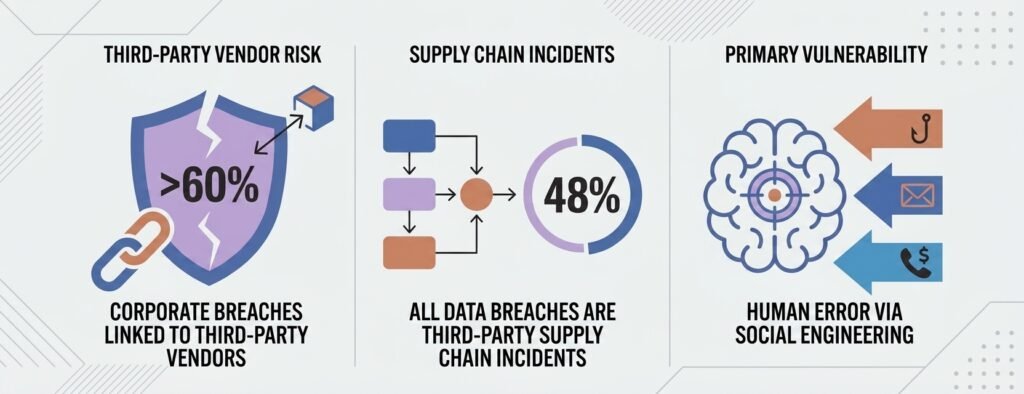
Vendor management is one of the more overlooked ways law firms can prevent client data breaches. Cloud storage, e-discovery platforms, litigation support tools, outsourced IT – every third-party connection is a potential entry point. Vendor Risk Management (VRM) brings that exposure under systematic control. The scale of the problem is well documented: Verizon’s Data Breach Investigations Report found that 60% of breaches involve a third party, and more recent industry data puts third-party and supply chain incidents at 48% of all breaches.
Security Due Diligence Before Signing Any Contract
Before onboarding any SaaS tool or cloud application that will touch client data, firms should require and review:
- SOC 2 Type II reports (focusing on security, confidentiality, and availability)
- ISO/IEC 27001 certifications
- Third-party penetration test summaries
Relying solely on a vendor’s standard terms of service – without independent security review – constitutes a failure of technological competence under ABA Model Rule 1.1, Comment [8]. CPA firms face a nearly identical vendor-vetting requirement under the FTC Safeguards Rule — see our password managers for CPA firms: FTC Safeguards & MFA compliance guide for how that’s structured.
Enforceable Data Processing Addendums and Audit Rights
Security due diligence should be locked into the contract itself. Data Processing Addendums (DPAs) should bind vendors to specific safeguards, restrictions on sub-processors, firm data ownership provisions, and explicit audit rights. Firms should also seek to include breach notification timelines, with 24-72 hours being a common regulatory expectation and best practice. The NY SHIELD Act specifically requires covered entities to select service providers capable of maintaining appropriate safeguards and to require those safeguards by contract – making enforceable DPAs a statutory obligation, not just a negotiating preference.
Monitor Continuously – Not Just After a Breach
Continuous monitoring is among the more technical ways law firms can prevent client data breaches. Sophisticated attacks often sit undetected inside a network for weeks or months before deploying ransomware or exfiltrating data. Firms that rely on traditional antivirus software alone have no way of seeing that activity until the damage is done.
Why Modern Threat Detection Has Moved Beyond Traditional Antivirus
Endpoint Detection and Response (EDR) tools continuously record device activity, analyze behavior using machine learning, and can automatically isolate a compromised endpoint from the network in real time. Alongside EDR, a Security Information and Event Management (SIEM) system aggregates logs from across the firm – authentication events, file accesses, firewall activity, cloud administration changes – into a single auditable record. For effective incident investigation and regulatory compliance, SIEM logs are commonly recommended to be retained for 12-24 months. Without them, a firm cannot definitively prove which files an intruder accessed, and regulators and courts will often presume all accessible data was compromised.
Build an Incident Response Plan Before You Need One
Building an incident response plan is one of the most overlooked ways law firms can prevent client data breaches from becoming catastrophic. Even well-defended firms get breached – the difference often comes down to whether the firm had a written, tested plan before the phone rang.
The Four NIST-Aligned Phases Every Law Firm IRP Needs
An effective Incident Response Plan (IRP) aligns with the NIST Incident Response Lifecycle, which outlines four phases: Preparation (asset inventories and threat models); Detection and Analysis (EDR/SIEM monitoring and anomaly alerting); Containment, Eradication, and Recovery (activating a pre-established breach response team to isolate systems, mitigate harm, and restore from immutable backups); and Post-Incident Activity (fulfilling notification obligations and conducting after-action reviews). The plan should define objective materiality thresholds – what constitutes a reportable breach versus a contained IT event – and include pre-drafted notification templates mapped to applicable state laws.
How Early Breach Counsel Retention Can Help Protect Privilege
One of the most overlooked elements of incident readiness is retaining specialized external breach counsel before an incident occurs. When a breach happens, counsel immediately retains the Digital Forensics and Incident Response (DFIR) firm under a tripartite engagement structure. This keeps forensic findings, root-cause analyses, and vulnerability assessments shielded under attorney-client privilege and work-product doctrine – preventing plaintiffs from using internal technical reviews against the firm in discovery. States including Ohio and Connecticut have enacted statutes that reward firms maintaining a written cybersecurity program aligned with NIST CSF: Ohio’s law provides a full affirmative defense against qualifying tort claims, while Connecticut’s law bars punitive damages in qualifying claims. Both frameworks reference NIST CSF, which includes incident response planning as a core function.
Human Error Is Behind Most Breaches – Train Accordingly
Training staff is one of the highest-impact ways law firms can prevent client data breaches, since human error contributes to over 80% of successful cyberattacks. Spear-phishing, pretexting, and executive wire-fraud spoofing bypass even well-configured technical controls by exploiting human trust. No technical stack eliminates that exposure – training does.
Phishing Simulations Over Annual Checkbox Training
Annual compliance training is not enough. Effective human risk management requires continuous security awareness training combined with periodic, unannounced phishing simulations that test staff against current real-world attack tactics. Employees who click on simulated phishing emails receive targeted remedial training immediately – reinforcing the lesson in context. This approach treats human risk as an ongoing operational variable, not a once-a-year box to check.
What ABA Rule 1.6 and the NY SHIELD Act Actually Require
The ethical rules themselves point to specific ways law firms can prevent client data breaches. ABA Model Rule 1.6(c) requires lawyers to make reasonable efforts to prevent unauthorized access to client information. ABA Formal Opinion 477R expanded this to require specific measures – encryption, access controls, and ongoing security training – based on a risk assessment of the information’s sensitivity. ABA Formal Opinion 483 further established an active duty to monitor for unauthorized access and to promptly notify clients when a breach compromises material confidences.
On the state level, the New York SHIELD Act expanded the definition of a security breach to include unauthorized access to private information – not just acquisition. That distinction matters: a threat actor who views a client file without downloading it can still trigger mandatory notification obligations under New York law. The SHIELD Act also imposes civil penalties for violating breach notification requirements, such as $20 per instance, not to exceed $250,000, and explicitly requires that service providers be selected and contractually bound to maintain appropriate safeguards.
Seven controls. One question: is your firm actually meeting the “reasonable efforts” standard ABA Rule 1.6 demands, or just assuming it is? Check off what’s already in place at your firm and see where you stand.
Law Firm Cybersecurity Readiness Self-Assessment
Check every control your firm currently has in place, then see your readiness tier.
Skipping even one of these ways law firms can prevent client data breaches is enough to leave a firm exposed – and, as the controls above show, enough to complicate an ethics inquiry or a breach notification filing.
These Seven Controls Are Now the Baseline for Ethical Compliance
These seven ways law firms can prevent client data breaches – Zero Trust access, end-to-end encryption, vendor due diligence, continuous monitoring, a tested incident response plan, ongoing human training, and a working understanding of ABA and state obligations – are the operational floor that regulators, bar associations, and courts increasingly measure firms against when something goes wrong. Implementing all seven demonstrates the reasonable efforts standard that Rule 1.6 demands, and creates a concrete evidentiary record that defends against negligence claims, regulatory audits, and civil litigation when an incident does occur.
For law firms looking to build on these ways law firms can prevent client data breaches, TechEd Shield offers practical cybersecurity education and protection resources designed specifically for small and midsiz e businesses – no IT team required. Take the free Cybersecurity Health Check to see where your firm’s controls actually stand.