

Key Takeaways
- The average cost of a cyber incident for small and medium businesses globally is $264,000 USD – a roughly 30% jump from the previous year – according to the 2025 NetDiligence Cyber Claims Study. Canadian SMEs specifically have fared worse: NetDiligence data compiled by RSM Canada puts the five-year average total incident cost for Canadian SMEs at US$874,000.
- The Canadian Centre for Cyber Security’s 13 Baseline Controls are built around the 80/20 rule: fix the right things first and you’ll eliminate the vast majority of your risk.
- Tools like Microsoft 365 Business Premium and CIRA Canadian Shield simplify cybersecurity management and reduce the need for extensive technical expertise.
- PIPEDA legally requires Canadian businesses to log every security breach for 24 months – and report serious ones to federal regulators.
- Not sure where your business stands right now? The controls and tools covered below give you a clear starting point – no IT team needed.
Cyber security for small business with no IT team doesn’t have to mean running unprotected. The steps that eliminate most of the real risk are simpler than the cybersecurity industry wants you to believe – and they’re backed by the Canadian government. Here’s exactly what to do, and why it matters.
Cyber Incidents Are Costing Canadian Small Businesses $264,000 on Average – and Attackers Know It
The stakes behind cyber security for small business with no IT team start with the numbers: the average cost of a cyber incident for small and medium businesses globally now sits at $264,000 USD – a roughly 30% jump from the previous year, according to the 2025 NetDiligence Cyber Claims Study. Canadian SMEs specifically have it worse: a five-year average total incident cost of US$874,000, per NetDiligence data compiled by RSM Canada. That number alone should reframe how small business owners think about cybersecurity spending.
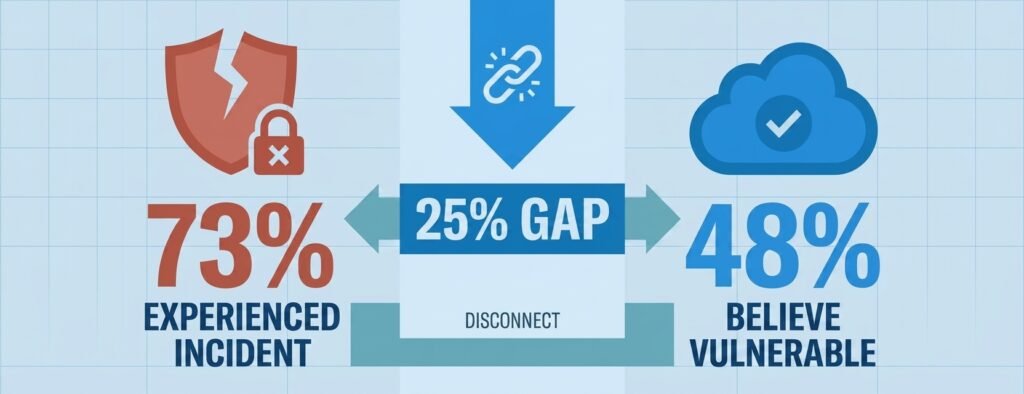
Attackers aren’t just going after large corporations. Small businesses are targeted precisely because they’re less protected. Statistics Canada data shows that approximately 16% of Canadian businesses were impacted by a cybersecurity incident in 2023 – yet many small business owners still believe they’re too small to be a target. That disconnect shows up clearly in industry survey data: research from the Business Development Bank of Canada found that 73% of small businesses have experienced a cybersecurity incident, yet a 2025 Insurance Bureau of Canada survey found only 48% of SME respondents believe their business is vulnerable to a cyberattack – a 25-point gap between what’s already happened and what owners believe could happen to them. That belief is one of the most expensive mistakes a business owner can make.
Resources like TechEd Shield exist specifically to help non-technical business owners understand what protection actually looks like in practice – translating government frameworks and industry tools into clear, doable steps. The good news: the fixes that matter most aren’t complicated.
The Real Risks Hitting Canadian Small Businesses
Ransomware: Locked Out, Losing Revenue by the Day
Ransomware is one of the biggest threats behind the push for cyber security for small business with no IT team – it’s the single largest driver of cyber losses globally, accounting for 69% of total incident costs with an average price tag of $631,000 USD per incident, according to the 2025 NetDiligence Cyber Claims Study. Canadian ransomware claims specifically have run even higher, averaging $1.3M USD per incident over the same five-year period. What makes ransomware especially damaging for small businesses is the recovery gap: no IT team means no one on-site to isolate systems, assess damage, or restore from backups. That’s why having automated, tested backups set up before an incident is the difference between a bad week and a business-ending event.
Business Email Compromise Starts With One Click
Business Email Compromise (BEC) is the second-costliest threat globally, averaging $98,000 USD per incident over the five-year period, per the 2025 NetDiligence Cyber Claims Study. The mechanics are straightforward – and that’s what makes it so effective. A staff member receives a convincing email: a fake invoice, a spoofed supplier, an urgent wire request. BEC doesn’t require sophisticated hacking. It exploits trust. Without security awareness training in place, every inbox in a business is a potential entry point.
Canada’s Government-Backed Starting Point
The CCCS 13 Baseline Controls (The 80/20 Rule for Security)
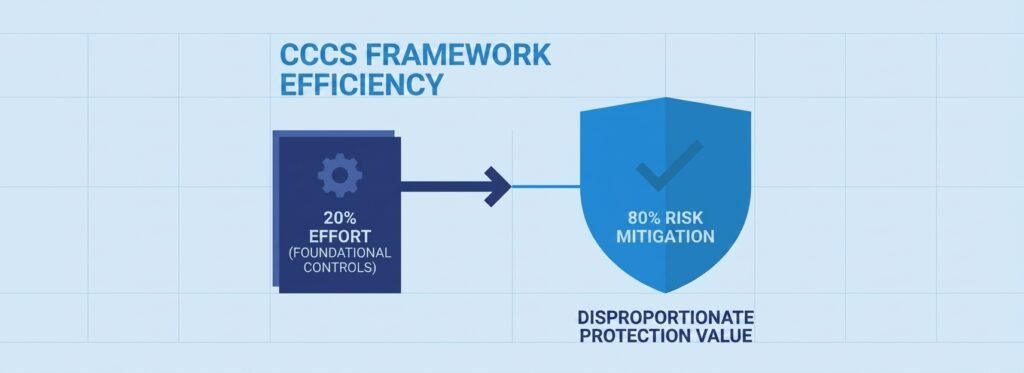
The government’s answer to cyber security for small business with no IT team is the CCCS Baseline Cyber Security Controls for Small and Medium Organizations (ITSM.10.089) – the Government of Canada’s official minimum security standard. These 13 controls are deliberately built around the 80/20 rule: implement them and you achieve approximately 80% of your total risk reduction with only 20% of the effort required by full enterprise security programs.
That’s a meaningful distinction for a business without an IT department. The 13 controls cover multi-factor authentication, automated patching, data backups, DNS filtering, and staff training. They aren’t theoretical – they’re specific, testable, and achievable without a technical background.
CyberSecure Canada Certification: What It Is and Who It’s For
CyberSecure Canada is the federal government’s certification program for businesses with 1 to 499 employees. Administered by the Standards Council of Canada (SCC) since March 2023, it evaluates organizations against the 13 CCCS Baseline Controls plus 5 foundational organizational controls. Successful certification earns a federally recognized mark valid for two years – useful for demonstrating security hygiene to clients, business partners, and cyber insurance underwriters alike. Certification also positions businesses for federal procurement opportunities under the Canadian Program for Cyber Security Certification (CPCSC).
The Four Controls to Implement First
Prioritizing cyber security for small business with no IT team means not trying to implement all 13 controls at once. The right approach is to neutralize the most common attack methods first, then build outward. These four deliver the highest immediate impact:
- Multi-Factor Authentication (MFA) on everything – email, cloud portals, and remote access. Missing MFA is the number one reason cyber insurance applications get rejected. It’s also free to enable in most platforms. See does cyber insurance require a pen test or vulnerability scan for the full picture of what insurers now verify before writing a policy.
- Automated OS and application patching – enable automatic updates on all devices. Most successful attacks target known vulnerabilities that already have patches available. Windows Update for Business and macOS Automatic Updates handle this at zero cost.
- Endpoint Detection and Response (EDR) – deploy cloud-managed anti-malware software across all computers. Legacy antivirus isn’t sufficient; modern EDR watches for suspicious behaviour in real time, not just known virus signatures. For specific platform picks, see our roundup of the best cybersecurity tools for small businesses with no IT team.
- Automated, isolated data backups – configure daily backups stored separately from your main systems, ideally with immutable, air-gapped cloud storage. Test a restore quarterly. This single control is the difference between recovering from ransomware and starting over.
Where Do You Actually Stand? Find Out in 30 Seconds
Before you read another word about baseline controls, check which of the four highest-impact protections your business already has running. This isn’t a compliance audit — it’s a 30-second gut check that tells you exactly where to start.
Whatever your score, the fix isn’t complicated — it’s sequencing. Enable MFA first, automate patching second, layer in EDR third, and lock down tested backups fourth. Each one closes a door attackers are actively trying. None of them require hiring an IT department to implement.
Tools That Do the Heavy Lifting for You
Microsoft 365 Business Premium: One Suite, Multiple Protections
Consolidated tools make cyber security for small business with no IT team far more achievable. Rather than piecing together separate tools from different vendors, Microsoft 365 Business Premium consolidates the most critical security functions into a single subscription. If you’re migrating to the cloud more broadly, see our 12-step cloud security checklist for small business migration for the full sequence. It includes Entra ID Plan 1 for enforcing MFA and Conditional Access policies, Microsoft Defender for Business for enterprise-grade EDR and anti-malware on all endpoints, and Microsoft Intune for managing device encryption and mobile device security. For a small business without IT staff, the value is in the consolidation: one dashboard, one vendor, one monthly bill – and the core of the CCCS baseline covered automatically.
CIRA DNS Firewall and Canadian Shield: Free Perimeter Defence
A significant share of malware uses DNS – the system that translates web addresses into IP addresses – to connect back to attackers or redirect users to phishing pages. Blocking threats at the DNS layer stops attacks before they reach devices.
The Canadian Internet Registration Authority (CIRA), the non-profit managing Canada’s .ca domain space, offers two purpose-built options. CIRA Canadian Shield is completely free: update your router’s DNS settings to CIRA’s Protected servers and every device on the network benefits from malware and phishing filtering – setup takes under 15 minutes. CIRA DNS Firewall is the business-grade version, designed for organizations that need off-network protection extending to remote laptops and mobile devices.
No IT Team? Outsource It Instead
Outsourcing is one legitimate path to cyber security for small business with no IT team. A Canadian Managed Service Provider (MSP) or Managed Security Service Provider (MSSP) is the most practical option. Under a per-user, per-month model, a good MSP covers patch management, identity administration, endpoint security, and audit evidence collection – everything needed to maintain the CCCS 13 Baseline Controls without hiring internal staff.
When choosing a provider, look for CISSP-led or SOC 2-compliant Canadian firms that explicitly build their service stack around the CCCS baseline and can assist with CyberSecure Canada certification documentation. That last point matters: the evidence collected during routine MSP management is the same evidence required for formal certification audits.
What PIPEDA Requires If You’re Breached
Regulatory compliance is part of cyber security for small business with no IT team too. The Personal Information Protection and Electronic Documents Act (PIPEDA) applies to Canadian businesses that collect, use, store, or disclose personal information in commercial activities – though businesses in provinces with substantially similar privacy legislation, such as Quebec, British Columbia, and Alberta, may be subject to provincial laws for provincially regulated activities, while PIPEDA continues to apply to federal works and interprovincial or international transactions. These obligations kick in the moment a breach occurs.
The Real Risk of Significant Harm (RROSH) Test
Under PIPEDA, if a breach creates a Real Risk of Significant Harm (RROSH) to any individual, the business must report to the Office of the Privacy Commissioner of Canada (OPC) as soon as feasible and directly notify all affected individuals. RROSH is assessed based on two factors: the sensitivity of the compromised data (financial records, health information, Social Insurance Numbers, or basic contact data combined with passwords), and the probability of misuse based on how the breach occurred and who accessed the data. Quebec businesses face additional obligations under Law 25, with penalties reaching up to $25,000,000 or 4% of worldwide annual turnover for non-compliance.
Mandatory 24-Month Breach Records
Even if a breach does not meet the RROSH threshold, PIPEDA requires that a record of every breach be retained for a minimum of 24 months from the date it was confirmed. The OPC can inspect these records at any time. Every business needs a basic breach log – document the date, what was involved, what steps were taken, and the rationale for whether RROSH was triggered.
The Basics Done Right Will Protect Your Business – Start This Week
When it comes to cyber security for small business with no IT team, the single biggest mistake owners make is waiting until something goes wrong. The attacks targeting small businesses aren’t sophisticated – they target unlocked doors: accounts without MFA, devices without patching, staff without training, and backups that were never tested.
The CCCS 13 Baseline Controls exist precisely because the Canadian government recognizes that small businesses don’t need an IT department to be protected – they need the right things done first, the right tools running automatically, and a plan for when something goes wrong. Enable MFA today. Set patching to automatic. Point your router’s DNS to CIRA Canadian Shield. Schedule a backup restore test for next week. These aren’t complicated steps – they’re just steps most businesses haven’t taken yet.
For a plain-language guide to cyber security for small business with no IT team, TechEd Shield offers step-by-step cybersecurity education and tools built specifically for Canadian small business owners who are handling everything themselves, including our Zero-Trust security guide for small businesses with no IT team, which builds on the same MFA-first approach using Microsoft 365 Business Premium. Take the free cyber insurance readiness check to see how your business measures up against these baseline controls, and which gaps insurers would flag.