


Key Takeaways
- The upfront purchase price of on-premise IT infrastructure, including security components, is typically just 20-40% of what you’ll actually spend over its lifetime.
- A single cybersecurity hire can cost a small business over $250,000 per year once salary, benefits, tools, and training are fully accounted for.
- One hour of unplanned downtime can cost a small business anywhere from $8,000 to $25,000 – and that’s before recovery expenses.
- Cloud and managed security models can significantly reduce five-year total security costs compared to running everything in-house, with some analyses showing savings of 45% or more.
- Later, there’s a breakdown of exactly which hidden costs hit hardest – and a real-world numbers comparison that shows how wide the gap actually is.
If you’ve never compared on-premise vs cloud security cost side by side, you’re probably assuming the on-premise route is the smart, one-time financial call. Buy the hardware, set it up, stay protected — simple enough. But the actual cost of running your own security infrastructure quietly compounds year after year, and by the time most businesses realize it, they’ve already spent far more than they ever planned to.
Your Initial Purchase Price Is Just the Tip of the Iceberg
When security vendors quote a price for firewalls, servers, or security appliances, that number reflects hardware sitting in a box – nothing more. What it doesn’t include is the cost of everything required to actually run it: the physical space it occupies, the power it draws, the cooling it needs, the software licenses that expire annually, and the IT labor required to keep it alive.
Industry TCO research generally puts the upfront purchase price at roughly 20-40% of an asset’s true lifetime cost. The remaining 60-80% accumulates through operational expenses, staffing, maintenance, compliance work, and downtime risk. For small businesses operating without a dedicated IT team, those hidden layers are especially dangerous because they’re rarely budgeted for in advance.
If you’re weighing this build-vs-buy decision without any in-house IT support, our guide to choosing a cyber security company for UK SMEs without an IT team walks through exactly what a provider must deliver – and what the hidden costs look like before you sign anything.
What You’re Actually Paying For (And Don’t Realize)
Hardware, Licensing, and Setup Fees
The visible costs of on-premise security go well beyond the appliance itself. A proper setup requires rack mounts, uninterruptible power supplies (UPS), network cabling, and in many cases dedicated server room space with cooling and fire suppression. On top of that, the software running those appliances – operating systems, threat intelligence feeds, database engines – carries its own licensing fees. Vendors often charge annual maintenance and support contracts, which can be a significant recurring expense, often estimated at around 15% to 20% of the original hardware and software cost annually, though specific percentages vary by vendor and contract terms. Those contracts are non-negotiable if you want access to critical security patches.
Then there’s installation. Deploying a firewall or a security management system isn’t plug-and-play. Most SMBs don’t have the in-house expertise to configure these systems correctly, which means hiring outside specialists – often at a cost that equals or exceeds the hardware itself.
The Refresh Cycle That Never Ends
Like other IT hardware, security appliances typically require replacement every three to five years as they reach end-of-life status, necessitating a full capital expenditure reset: new hardware, new licenses, new integration work. For a growing business, that cycle repeats without exception. There’s no escaping it. The cost is baked into the model.
Hiring for Security Costs Far More Than a Salary
Loaded Costs for a Senior Security Engineer Can Exceed $250K Annually
The number that shows up on a job posting is the base salary. The real number – what it actually costs to employ that person – is much higher. Employer payroll taxes, health insurance, paid leave, management time, and ongoing certification training add roughly 25-35% on top of base pay. Factor in the tooling that person needs to do their job (endpoint detection software, backup platforms, vulnerability scanners, ticketing systems), and a single senior cybersecurity specialist can represent a substantial annual expense — often $130,000 to $180,000+ in base salary alone, which can reasonably exceed $200,000 once payroll taxes, benefits, and tooling are factored in.
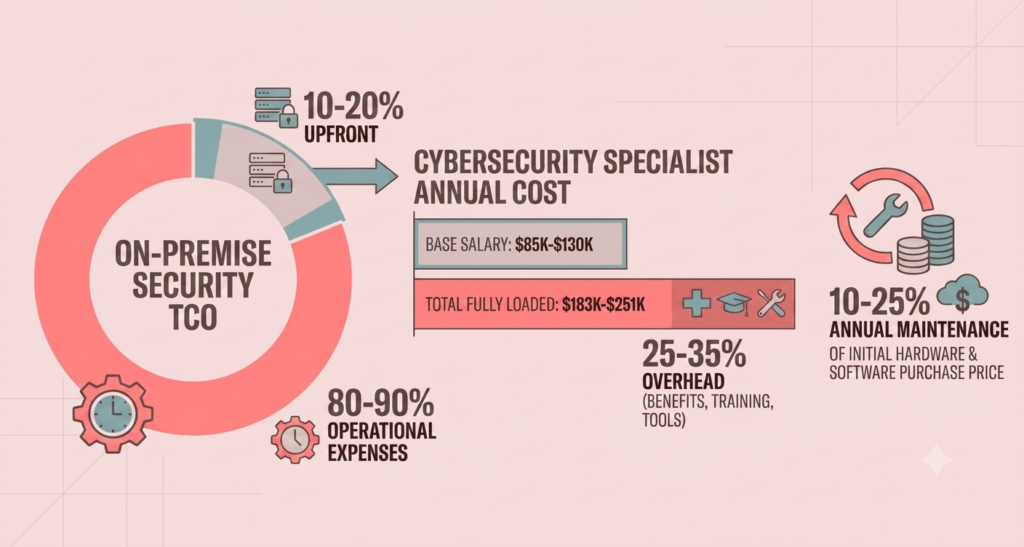
For most small businesses, that’s the entire IT budget – and it buys just one person, covering one shift, which is exactly why many owners start by weighing whether to hire a cybersecurity consultant instead of building an in-house team from scratch.
Why 24/7 Coverage Requires Five People, Not One
A standard work week is 40 hours. A full calendar week is 168 hours. Achieving continuous 24/7 security monitoring typically requires a minimum of four to five full-time staff to cover shifts, holidays, and training, ensuring constant vigilance against threats. Consequently, the true annual cost of providing around-the-clock in-house security can easily exceed $500,000 – a figure that’s simply not realistic for most SMBs. What typically happens instead is that a generalist IT person gets assigned security tasks on top of their regular workload, which creates gaps, delays, and real exposure.
One Outage Can Cost a Small Business Tens of Thousands Per Hour
On-premise systems create a single point of failure. When the hardware goes down – due to a failed component, a botched update, or a power issue – business stops. There’s no automatic failover. Recovery is manual, slow, and expensive.
Industry estimates put unplanned downtime costs for small businesses at $8,000 to $25,000 per hour, factoring in lost revenue, idle staff wages, and recovery overhead. A widely cited 2014 Gartner estimate put average IT downtime costs at $5,600 per minute; more recent industry surveys suggest costs for many organizations now run considerably higher, illustrating just how fast the losses compound. For a 20-person business generating $5 million annually, a single three-hour outage can wipe out tens of thousands of dollars in combined productivity and direct revenue loss – before any repair or emergency consulting fees are counted.
Cyberattacks compound the risk further. Small businesses face cyberattacks frequently, with some industry trackers estimating incidents occurring as often as every 7 seconds. Breach-cost research commonly puts SMB breach costs between $120,000 and $1.24 million, with some studies of businesses under 500 employees reporting notably higher averages. Under the on-premise model, every dollar of that fallout lands entirely on the business – forensic investigation, legal fees, ransom demands, hardware replacement, and customer notification all come out of the same pocket.
Compliance Becomes Your Problem Alone
Businesses that handle health data, payment card information, or government contracts are subject to regulations like HIPAA, PCI DSS, and CMMC. Under an on-premise model, proving compliance means auditing every layer of the environment yourself: physical access controls, hardware configurations, network segmentation, data encryption, and log integrity – all documented and defensible on demand.
That work takes hundreds of hours annually, and getting it wrong is costly. According to HHS penalty tiers, which are adjusted annually for inflation, the most severe HIPAA violation category can reach over $2.13 million per year for repeated violations. Non-compliance with PCI DSS (currently version 4.0.1) can result in losing the ability to process card payments entirely. These aren’t theoretical risks – they’re outcomes that hit small businesses that simply didn’t have the staffing to keep up with the administrative burden of managing compliance in-house.
Cloud and Managed Security Change the Math
The Five-Year Cost Gap Is Significant
A real-world comparison illustrates the gap clearly — and it’s laid out in the table below.
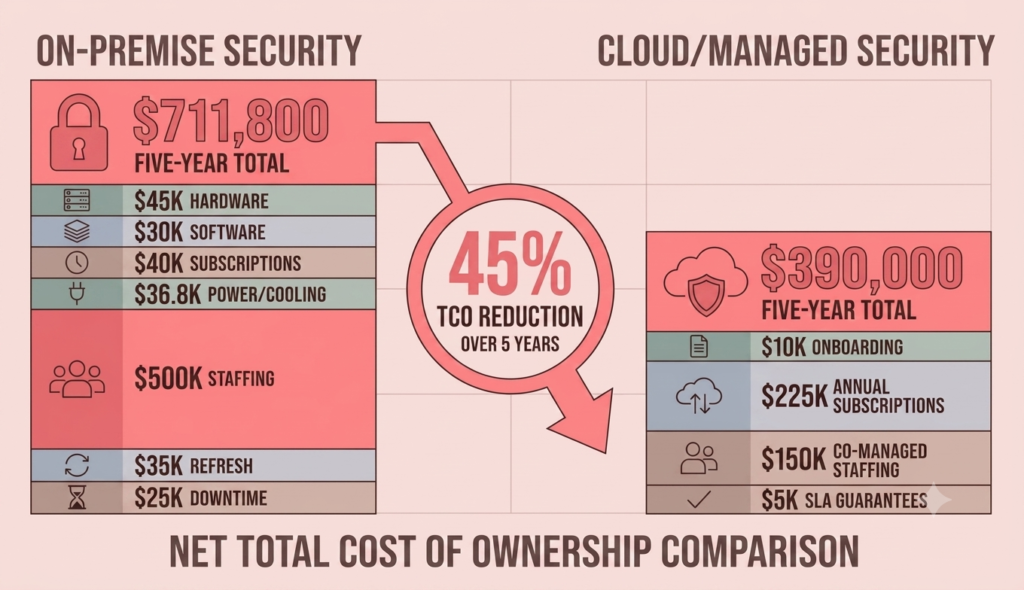
Managed IT services for SMBs typically run between $100 and $400 per user per month – a predictable, flat operating expense that includes monitoring, support, cybersecurity, and data backup. Compare that to the unpredictable capital spikes of on-premise ownership, and the full managed security vs. in-house IT cost breakdown makes the financial case clear.
| Cost Factor | On-Premise Security | Cloud / Managed Security |
|---|---|---|
| Upfront cost vs. true lifetime cost | Purchase price is typically only 20-40% of true 5-year cost | Flat, predictable monthly fee ($100-$400/user/month) |
| Staffing for full coverage | $200K+/year for one hire; $500K+/year for true 24/7 coverage (4-5 staff) | Team of specialists included in subscription |
| Downtime risk | No automatic failover; $8,000-$25,000/hour estimated cost | Automated failover; 99.5-99.99% uptime SLAs |
| Compliance liability | Business audits and documents every layer itself; HIPAA penalties can exceed $2.13M/year | Shared responsibility; provider secures infrastructure layer |
| Hardware refresh cycle | Full capex reset every 3-5 years | No refresh cycle for the business to fund |
| Estimated 5-year TCO impact | Baseline (higher) | Commonly 45%+ lower |
What the Shared Responsibility Model Offloads
One of the most underappreciated advantages of the shift toward cloud-based security is structural: the cloud provider takes ownership of securing the underlying hardware, data centers, host operating systems, and network infrastructure. The business remains responsible for user access and data classification – but the catastrophic financial exposure that comes with physical infrastructure failure shifts to the provider. Cloud providers also operate under strict uptime SLAs (typically 99.5-99.99%), with automated failover and real-time global threat updates pushed in the background – no maintenance windows, no manual patching, no downtime risk from a delayed update.
You’ve just read where the hidden costs come from. Now put your own headcount into the math. This quick estimator uses the industry benchmarks from this article — managed security pricing and typical on-premise savings — to show you a rough five-year comparison for a business your size.
5-Year Security Cost Estimator
Enter your employee count to compare estimated on-premise vs. cloud/managed security costs over five years.
This is a directional estimate, not a quote — your actual numbers will depend on your industry, compliance requirements, and existing infrastructure. But the gap it shows is the same gap TCO analysts keep finding across the SMB market: the "cheaper" option upfront is rarely cheaper over five years. If these numbers are in the ballpark of your own business, it's worth getting a free cybersecurity health check before your next hardware refresh cycle forces the decision for you.
Stop Paying the Hidden Tax - Switch to a Model That Scales
The core problem with on-premise security for small businesses is that it was designed for organizations with dedicated IT departments, capital reserves, and compliance teams. When an SMB tries to run the same model without those resources, the hidden costs don't disappear. They just go unbudgeted until they hit.
Cloud and managed security models flip that equation. Instead of absorbing unpredictable capital spikes, businesses pay a flat monthly fee. Instead of tasking one generalist with security responsibilities they were never hired for, they get access to a full team of specialists. Instead of bearing 100% of compliance and breach liability, they share the operational burden with a provider built to handle it.
For small businesses, freelancers, and independent operators who are already stretched thin, that shift makes strong financial sense - and it's the only model that realistically scales alongside a growing business without quietly draining it.