


Key Takeaways
- Accounting firms typically pay between $58 and $80 per month for cyber insurance, though actual premiums shift significantly based on firm size, record volume, and security controls in place.
- Under federal law, CPA firms and tax preparers are classified as financial institutions – which means stricter regulatory obligations and higher underwriting scrutiny from insurers.
- A basic cyber rider on your professional liability policy is not the same as standalone cyber coverage – the gaps can be costly when a real incident hits.
- The security controls your firm has (or lacks) don’t just reduce your risk – they directly determine whether a carrier will pay your claim at all.
- TechEd Shield covers the intersection of cybersecurity and small business risk in plain language, making it easier for firms to understand what protection they actually need.
Cyber insurance cost for accounting firms is no longer a side question – it’s central to running a compliant practice. Between the sensitive financial data you handle daily and the federal regulations that govern how you protect it, the real question isn’t whether to get coverage – it’s understanding what it costs, what it actually covers, and what can quietly void your policy when you need it most.
Accounting Firms Pay $58-$80/Month – Here’s What Shapes That Range
The cyber insurance cost for accounting firms starts with a broad industry baseline: finance and accounting businesses pay an average of $58 per month for cyber liability insurance. For CPAs, accountants, and auditors specifically, that figure climbs to around $80 per month, or roughly $964 per year. Those are averages – and the actual premium your firm lands on can fall well below or significantly above that range depending on a handful of underwriting factors.
The commercial cyber insurance market uses actuarial models that tie your premium to three primary metrics: gross annual revenue, employee count, and the volume of sensitive client records your firm stores or processes. Revenue signals overall transaction volume and target attractiveness. Record volume determines your statutory baseline for post-breach notification costs, which scale under state privacy laws.
Why Accounting Firms Are a Prized Target
One reason the cyber insurance cost for accounting firms runs higher than other industries: accounting firms hold some of the most valuable personal and financial data in existence – Social Security numbers, bank account credentials, Employer Identification Numbers, W-2s, and multi-year tax histories. That concentration makes them a primary target for ransomware, business email compromise, and credential-harvesting phishing attacks.
Classified as Financial Institutions Under Federal Law
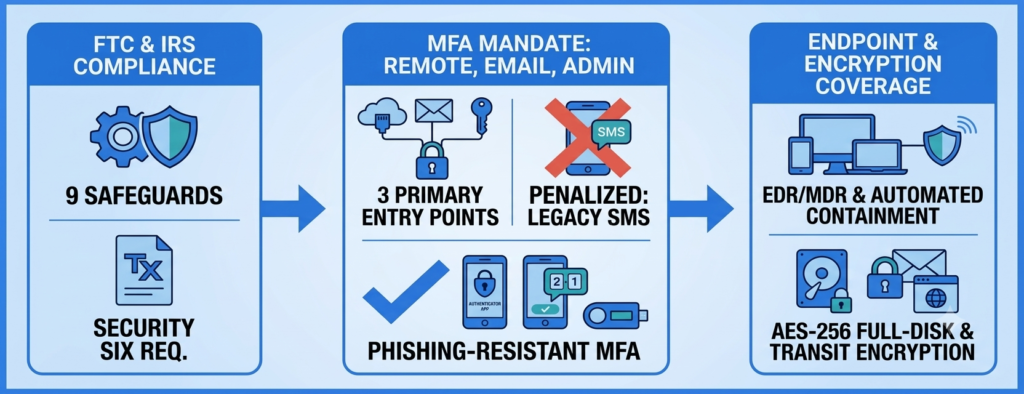
Under the Gramm-Leach-Bliley Act (GLBA) and the FTC Safeguards Rule (16 CFR Part 314), all paid tax professionals, bookkeepers, and accounting firms are legally classified as financial institutions. For the specific technical controls this classification requires, see our password managers for CPA firms: FTC Safeguards & MFA compliance guide. That classification carries real consequences: FTC civil penalties can reach $53,088 per violation, per day. IRS Publication 4557 further requires every paid preparer to maintain a Written Information Security Plan (WISP), with non-compliance risking PTIN or EFIN suspension – and GLBA civil penalties for willful Safeguards Rule violations that can reach $100,000 per violation.
Insurers know this regulatory exposure well – and it’s built directly into their pricing models. Law firms face a nearly identical dynamic — see 9 cyber risks law firms miss even when fully compliant for how passing a compliance audit still leaves real gaps open. Medical practices run into the same disconnect from the insurance side — see 5 cyber insurance gaps medical practices miss in 2026.
TechEd Shield provides small business owners and financial professionals with straightforward guidance on navigating compliance and security requirements without needing an IT department.
What One Breach Actually Costs
The global average cost of a data breach reached $4.88 million in 2024. For U.S. financial organizations specifically, that average rises to $6.08 million per incident. Even for smaller practices, a cyberattack typically costs between $120,000 and $1.24 million – and 60% of small businesses close within six months of a significant attack.
To put notification costs alone into perspective: if your firm holds 10,000 unique client records, you’re looking at a potential notification liability of $1.5 million before forensic, legal, and business interruption costs are factored in. That figure is based on an industry-standard per-record cost of roughly $150 when digital forensics, legal counsel, and crisis management are included.
What Drives Your Premium Up or Down
Revenue, Employee Count, and Record Volume
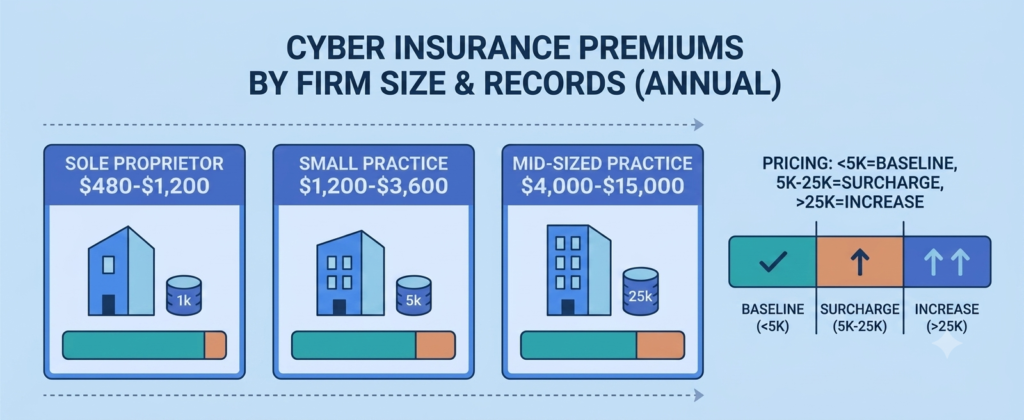
These three variables form the actuarial foundation that determines your cyber insurance cost for accounting firms of any size. Firms maintaining under 5,000 total client records receive standard baseline pricing. As record volume grows, underwriters apply surcharges that reflect the higher likelihood of class-action litigation and regulatory monitoring costs following a breach.
Geographic Location and Regulatory Climate
Geography is another factor that swings the cyber insurance cost for accounting firms – where your firm operates matters more than most owners realize. For accountants, monthly premiums range from as low as $79 in states like Alaska to as high as $116 in Washington, D.C., where regulatory density and litigation risk are both elevated. State-level privacy laws add further compliance obligations, including breach notification timelines that amplify potential liability.
Security Controls That Directly Affect Your Rate
This is where firms have the most direct control over the cyber insurance cost for accounting firms of their own size and profile. Carriers don’t just ask about your security – they increasingly verify it with network scanning tools. Firms with robust, documented controls are rewarded with favorable pricing. Firms without them are either quoted at a significant surcharge or pushed into the non-admitted surplus lines market at much higher rates.
Premium Benchmarks by Firm Size
Sole Proprietors to Large Practices
Here’s how the commercial market prices cyber coverage across four firm classifications:
| Firm Size | Employees | Revenue | Records | Annual Premium | Deductible | Limits |
|---|---|---|---|---|---|---|
| Sole Proprietor | Under 2 | Under $150K | Under 1,000 | $480-$1,200 ($40-$100/mo) | $1,000-$2,500 | Under $1M |
| Small Practice | 2-19 | $150K-$1M | 1,000-5,000 | $1,200-$3,600 ($100-$300/mo) | $2,500-$5,000 | $1M |
| Mid-Sized Practice | 20-99 | $1M-$10M | 5,000-25,000 | $3,000-$7,200 ($250-$600/mo) | $5,000-$25,000 | $1M-$3M |
| Large Practice | 100-499 | $10M-$50M | 25,000+ | $7,200-$30,000 ($600-$2,500/mo) | SIR up to $100,000 | $3M-$5M+ |
Where does your firm fall? Answer three quick questions and see which pricing tier applies to you.
These ranges reflect the commercial market baseline — your actual quote will move up or down from here based on the security controls covered next. That’s the part of your premium you can still influence.
Standalone Policy vs. E&O Cyber Rider: A Critical Difference
When firms look for ways to lower the cyber insurance cost for accounting firms, many assume that adding a cyber rider to their existing Errors and Omissions (E&O) policy checks the coverage box. That assumption is one of the most expensive mistakes a firm can make.
Coverage Gaps That Catch Firms Off Guard
Standard E&O cyber riders only activate when a breach stems directly from a professional error – like accidentally emailing a tax return to the wrong client. If the breach happens through an unpatched vulnerability, an open RDP port, or a brute-force attack unrelated to client deliverables, those riders routinely deny the claim. Standalone cyber policies use network security failure triggers that cover any unauthorized access, regardless of how it occurred. Real estate closings run into a similar sublimit trap — see our breakdown of the real estate cyber insurance gap between $100K policies and $250K losses.
Other critical gaps in standard E&O riders include:
| Coverage Feature | E&O Cyber Rider | Standalone Cyber Policy |
|---|---|---|
| Trigger for coverage | Only breaches from a professional error (e.g., misdirected email) | Any unauthorized network access, regardless of cause |
| Ransomware extortion coverage | Capped at $10,000-$25,000 | Up to full policy limits |
| Dependent business interruption | Not covered (e.g., third-party tax software outage) | Covered |
| Funds transfer fraud / BEC | Generally excluded entirely | Covered |
When a Rider Falls Short
Accounting firms that rely solely on E&O riders often discover coverage gaps mid-crisis, when it’s too late to do anything about them. A breach that compromises Social Security numbers and sensitive client data can scale quickly – and the policy structure in place at that moment determines how much of the financial fallout the firm absorbs on its own.
The Security Controls Carriers Now Require
MFA, EDR, and Immutable Backups
These controls directly shape the cyber insurance cost for accounting firms heading into 2026 renewals, and underwriters require verifiable proof of three core areas:
- Universal MFA: Required on all VPNs, remote desktop sessions, cloud email (Microsoft 365, Google Workspace), and all privileged accounts. Legacy SMS-based MFA is increasingly rejected – carriers now want authenticator apps, push-based MFA with number matching, or FIDO2 hardware tokens.
- Endpoint Detection and Response (EDR): Traditional antivirus is no longer accepted. EDR or Managed Detection and Response (MDR) must be deployed across all workstations, servers, and mobile endpoints, with 24/7 behavioral monitoring and automated threat isolation. Carriers increasingly verify these controls directly rather than taking your word for it — see does cyber insurance require a pen test or vulnerability scan.
- Immutable backups: The 3-2-1 strategy is the baseline – three copies of data, on two media types, with one off-site in an air-gapped or cloud-immutable vault. Ransomware actively targets online backups, so write-once configurations are required to avoid policy declinations. E-commerce sellers face this same requirement — see cyber insurance for online sellers: is $1,500 a year worth it?
WISP and FTC Safeguards Rule Alignment
Carriers align their compliance questionnaires directly to the FTC Safeguards Rule and IRS Publication 4557. To qualify for standard-market pricing, firms are increasingly expected to demonstrate: a formally appointed security lead, a documented and non-templated WISP, annual risk assessments, robust encryption for data at rest and in transit, strong network security including next-generation firewalls and intrusion detection systems, written vendor oversight agreements, and employee phishing simulation records. A templated WISP that doesn’t reflect your firm’s actual data flows and network assets won’t satisfy underwriters – or the IRS.
Deductibles, Waiting Periods, and Out-of-Pocket Exposure
Deductibles are another line item baked into the cyber insurance cost for accounting firms – when an incident occurs, your firm absorbs costs before coverage kicks in. For sole proprietors and small practices at $1M limits, monetary deductibles typically run $1,000-$5,000. Mid-sized practices often carry $5,000-$25,000 deductibles. Larger firms may use self-insured retentions (SIRs) of $25,000-$100,000.
Business interruption coverage doesn’t use dollar deductibles – it uses waiting periods, typically 8-12 hours. Two structures exist: a time-based model where you absorb losses during the waiting window, and a qualifying-period model where the policy pays retroactively to hour zero if the outage exceeds the threshold. Severe ransomware incidents average 24 days of downtime, so the structure and length of your waiting period matters significantly. Firms with strong security postures can sometimes negotiate waiting periods down to 4-6 hours.
Strong Controls Lower Your Premium – Weak Ones Can Void Your Claim
The cyber insurance market has entered a prove-it era, and it’s reshaping what determines the cyber insurance cost for accounting firms each renewal cycle. Carriers don’t take your word for security controls – they scan networks and audit documentation before issuing or renewing policies. Firms that can demonstrate verified MFA, active EDR, immutable backups, and a functional WISP earn preferred pricing and broader coverage. Firms that can’t are either declined or pushed into surplus lines at elevated rates.
A significant portion of all cyber claims involve policy exclusions or control failures that result in non-payment or partial payment. Claiming MFA is deployed on all applications while only using it on email is considered a material misrepresentation – and a common reason claims are denied outright after a breach. Ransomware was involved in 88% of small and mid-sized business breaches in 2025, with the average total cost of a ransomware incident – including downtime, legal, remediation, and business interruption – reaching $5.08 million. Having a policy that excludes or severely sub-limits ransomware because your backup architecture didn’t meet underwriting standards is an entirely preventable outcome.
For accounting firms ready to close those gaps, TechEd Shield helps small business owners and professional service firms put the practical, step-by-step security systems in place that both insurers and regulators now require. Take the free Cybersecurity Health Check to see how your firm’s controls stack up before your next renewal.
A note on pricing: Prices correct at time of writing. Always check current pricing before purchasing.