


Key Takeaways
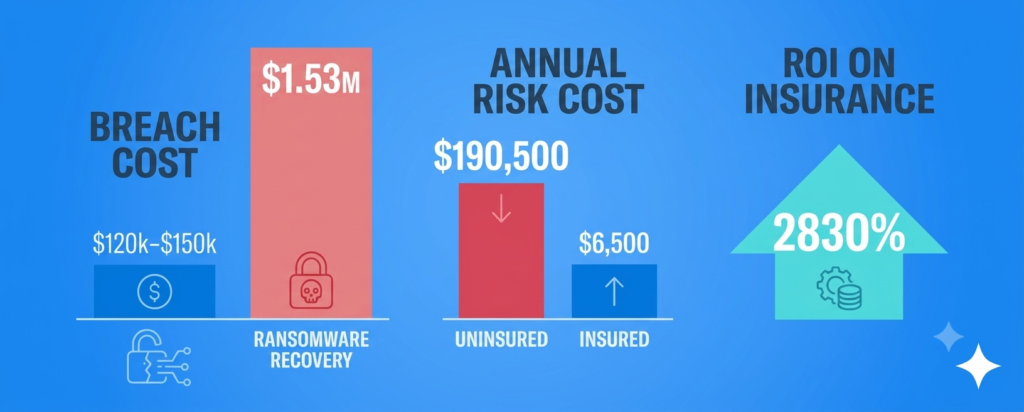
- A single cyber breach costs a small online seller an average of $120,000 to $190,000 out-of-pocket – more than 80 years’ worth of a $1,500 annual premium.
- A standalone $1,500 cyber policy covers far more than a basic General Liability add-on, including ransomware recovery, business interruption, and PCI fines – but only if you maintain the security controls you declared at sign-up.
- Your e-commerce platform (Shopify vs. WooCommerce, for example) directly affects your risk level, your premium, and whether your claim gets approved.
- Insurers reward specific security habits – like app-based multi-factor authentication and tested backups – with premium discounts of 10-25%, which can bring a robust policy well under $1,500.
- Keep reading to see the side-by-side numbers on what a breach actually costs insured vs. uninsured sellers.
Cyber insurance for online sellers often gets dismissed as an unnecessary expense – paying $1,500 a year for something you hope to never use is a tough sell when margins are tight. But the better question is whether absorbing a $190,000 loss is survivable. For most small online sellers, it isn’t.
A Single Breach Costs More Than 80 Years of Premiums
This is exactly the gap cyber insurance for online sellers is built to close: the average data breach for a business with fewer than 500 employees cost $3.31 million in 2025. Even at the small-seller end of the spectrum, a realistic e-skimming or ransomware event lands between $120,000 and $190,000 in direct out-of-pocket costs once forensic audits, legal fees, regulatory notifications, credit monitoring, PCI fines, and lost revenue while the store is offline are all factored in.
The market rate for a standalone cyber policy with a $1 million aggregate limit sits at roughly $129 per month – about $1,552 annually. Regulated industries pay considerably more for the same limits — see how much cyber insurance costs for accounting firms for comparison. A merchant generating under $1 million in annual revenue can often land that coverage closer to the $1,500 mark. That means a single avoided breach pays for more than 80 years of premiums. The math doesn’t require a spreadsheet.
TechEd Shield helps small business owners cut through the noise on exactly this kind of decision – breaking down what coverage actually does (and doesn’t) protect, in plain language, without assuming any technical background.
What a $1,500 Policy Actually Covers
Not all cyber insurance for online sellers is the same. Understanding the difference between a bolt-on endorsement and a real standalone policy is one of the most important decisions a small seller can make.
Standalone Policy vs. GL Add-On
Standard General Liability (GL) policies are built for physical risks – a customer slipping in a warehouse, product damage in transit – not digital ones. See the comparison table below for exactly what gets excluded. Basic cyber endorsements added to a GL or Business Owner Policy (BOP) tend to offer limited protection and often leave out critical threats like ransomware, cyber extortion, and business email compromise entirely.
| Coverage | GL / BOP Cyber Add-On | Standalone Policy (~$1,500 tier) |
|---|---|---|
| Digital/data losses | Excluded | $1,000,000 aggregate limit |
| Ransomware / extortion | Often excluded | Covered up to $250,000 sub-limit |
| Business email compromise | Often excluded | Covered (with endorsement) |
| Business interruption | Not covered | Covered, subject to sub-limits/waiting periods |
| PCI DSS fines | Not covered | Covered under dedicated PCI sub-limits |
| Incident response support | Not included | 24/7 pre-approved incident response panel |
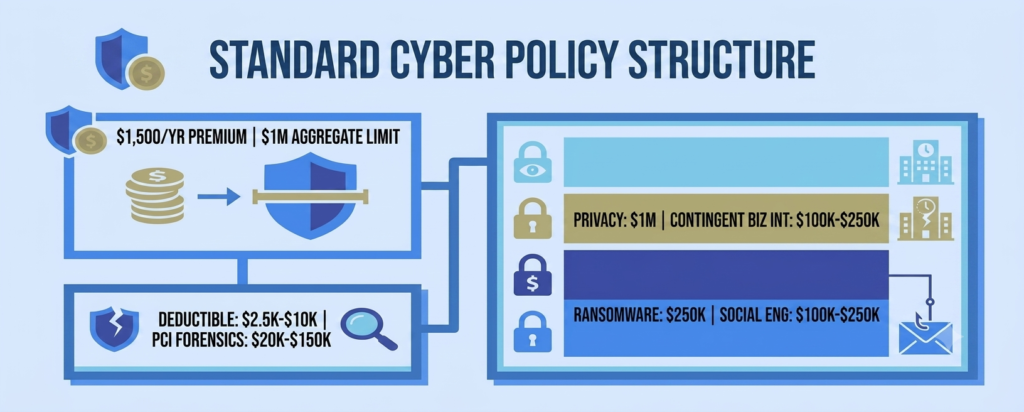
A standalone policy from a specialized carrier – such as AIG, Chubb, or Beazley – is structured completely differently. At the $1,500 premium tier, a merchant typically gets:
- $1,000,000 aggregate limit with a $2,500-$10,000 deductible
- Business interruption coverage, subject to sub-limits and waiting periods
- Privacy liability for class-action lawsuits and customer claims
- Cyber extortion/ransomware up to a $250,000 sub-limit
- PCI DSS fines and card-brand assessments covered under dedicated PCI sub-limits
- Security breach response – forensic investigators, legal breach coaches, and regulatory notifications
First-Party vs. Third-Party Protections
First-party coverage funds the seller’s own emergency response: forensic investigation, data restoration, and lost income while the store is offline. Third-party coverage defends against external claims – lawsuits from customers whose data was exposed, or regulatory actions by a state attorney general. A well-structured standalone policy delivers both, and critically, it includes 24/7 access to a pre-approved incident response panel. When a breach hits at 2 a.m. on a Sunday, having a breach coach already assigned is worth more than most sellers realize.
The Threats Driving Claims for Online Sellers
The case for cyber insurance for online sellers is backed by the numbers: 46% of confirmed breaches affect businesses with fewer than 1,000 employees, yet only 17% of US small businesses carry standalone coverage. Three specific threats are responsible for the majority of e-commerce claims.
Ransomware: The Costliest Disruption
Ransomware is the single biggest driver behind claims on cyber insurance for online sellers, appearing in 88% of confirmed small business breaches in recent data. For an online seller, an infection doesn’t just lock a file cabinet – it disables the checkout engine, inventory system, shipping APIs, and customer portals simultaneously. Recovery costs average $1.53 million excluding the ransom payment, though for smaller sellers a realistic scenario lands closer to $120,000-$1.24 million depending on downtime length and data complexity. Verizon’s 2025 DBIR puts real bankruptcy risk after a cyberattack at around 19% for small businesses – and separately, 40% of owners say a $100,000 attack would end their business.
E-Skimming: The Silent Checkout Attack
E-skimming attacks – made infamous by organized groups like Magecart – inject malicious JavaScript directly into checkout pages, capturing card numbers, CVV codes, and billing addresses in real time as customers type them. This is one of several gaps a compliant store can still fall through — see 9 ecommerce security risks PCI compliance leaves unprotected. Because the legitimate transaction completes normally, these attacks routinely run for months before detection. The resulting liabilities drive class-action lawsuits and state attorney general investigations. Merchants of the same size as most independent online stores have faced settlements ranging from $200,000 to $500,000 or more – not enterprise-level companies.
PCI Non-Compliance: Fines That Escalate Fast After a Breach
After a suspected breach, card brands require a certified PCI Forensic Investigator (PFI) audit. Monthly non-compliance fines start at $5,000-$10,000 for the first three months, scaling to $100,000 per month if remediation stalls beyond six months. Card replacement penalties add $3-$10 per exposed card on top of that, and total PCI-related costs for a small merchant commonly reach $45,000 or more.
Your Platform Changes Your Risk Level
Hosted SaaS vs. Self-Hosted Risk Profiles
Your platform choice directly shapes the cost of cyber insurance for online sellers – where a store is built matters enormously, both for actual risk and for what an insurer will charge.
Fully hosted platforms like Shopify, BigCommerce, and Amazon manage infrastructure security, SSL certificates, and PCI compliance on the seller’s behalf. Merchants on these platforms qualify for PCI SAQ A – the simplest validation level, with no vulnerability scans required. Underwriters treat this as a low-risk profile, which means faster approvals and easier access to the $1,500 premium tier.
Self-hosted platforms like WooCommerce and Magento shift full technical liability to the merchant. These storefronts require compliance with more demanding PCI SAQ levels (SAQ A-EP or SAQ D), mandatory quarterly scans by an Approved Scanning Vendor, and annual penetration testing.
| Factor | Hosted SaaS (Shopify, BigCommerce, Amazon) | Self-Hosted (WooCommerce, Magento) |
|---|---|---|
| PCI validation level | SAQ A (simplest) | SAQ A-EP or SAQ D (demanding) |
| Vulnerability scans | Not required | Mandatory quarterly scans by an Approved Scanning Vendor |
| Penetration testing | Not required | Required annually |
| Underwriter documentation | Minimal | Network diagrams, firewall configs, verified MFA logs |
| Underwriting outcome | Low-risk profile, faster approval, easier access to $1,500 tier | Surcharges of 25-50% or denial if documentation is missing |
Underwriters will ask for network diagrams, firewall configurations, and verified MFA logs before binding a policy. Failing to produce them results in premium surcharges of 25-50%, restrictive sub-limits, or outright denial.
The Policy Gaps That Can Void Your Claim
Only about one in four closed cyber claims results in a full payout, which is why understanding the fine print of cyber insurance for online sellers matters just as much as buying the policy.
The Controls You Must Actually Maintain
Cyber policies are written around the controls declared during the application – and those declarations become binding conditions of coverage. If a merchant attests to enforcing multi-factor authentication (MFA) on all admin accounts and a ransomware claim reveals MFA was disabled on even a single account, the insurer can deny the entire claim. Claims from known, publicly disclosed vulnerabilities left unpatched are routinely excluded as preventable negligence. Timing matters too: policies operate on a claims-made basis with a retroactive date, so a skimming script injected before that date – but discovered months later – produces a denied claim regardless of when the store owner noticed the problem.
Sub-Limits That Cap What You Collect
A $1 million aggregate limit sounds solid, but the fine print of cyber insurance for online sellers matters just as much – specific incident payouts are controlled by sub-limits embedded in the policy schedule. Ransomware is commonly capped at $250,000. Social engineering and business email compromise may be restricted to lower sub-limits – and only if a dedicated endorsement was added. Business interruption caused by a third-party host going down is excluded unless Contingent Business Interruption (CBI) coverage was negotiated separately. These gaps don’t make a policy worthless; they make it essential to read the schedule carefully before buying.
The Real Numbers: Insured vs. Uninsured
Here’s where cyber insurance for online sellers actually earns its cost: a moderate e-skimming breach involving 5,000 exposed customer records, with and without a $1,500 standalone policy (assuming a $5,000 deductible):
| Cost Category | Uninsured | Insured |
|---|---|---|
| Digital forensics (PFI audit) | $35,000 | Covered |
| Legal counsel (breach coach) | $25,000 | Covered |
| Regulatory notifications | $10,000 | Covered |
| Credit monitoring (1 year) | $12,500 | Covered |
| PCI fines and assessments | $45,000 | Covered under PCI sub-limits |
| Platform restoration | $8,000 | Covered |
| Business interruption | $40,000 | Covered after waiting period |
| Regulatory fines (CCPA/state law) | $15,000 | Covered where legally insurable |
| Total cash outflow | ~$190,500 | ~$6,500 (premium + deductible) |
That’s a difference of $184,000 on a single, mid-sized incident – and Verizon’s 2025 DBIR puts real bankruptcy risk after a cyberattack at around 19% for small businesses that experience one.
Here’s the same breach, run twice — once with a $1,500 policy in place, once without. Toggle between them.
Insured vs. Uninsured: One Breach, Two Outcomes
A moderate e-skimming breach, 5,000 exposed records, $5,000 deductible.
$184,000 is the gap on a single, moderate incident. That’s not a worst-case scenario — it’s a realistic one for a store handling a few thousand customer records.
How to Lower Your Premium Below $1,500
Controls Insurers Reward Most
Lowering the cost of cyber insurance for online sellers isn’t about buzzwords – insurers discount on proof that specific controls are actually running. See our roundup of the best cybersecurity tools for small businesses with no IT team for specific products that satisfy MFA, EDR, and backup requirements. The following habits move premiums meaningfully:
- App-based MFA on all admin accounts: SMS-based MFA is increasingly rejected by carriers in favor of app-based or biometric MFA across all remote and administrative logins. Strong MFA earns premium credits of 10-15%, while its absence triggers surcharges of 25-50% or outright denial.
- Tested, offline backups (3-2-1 rule): Three copies, two media types, one stored completely offline or in an immutable cloud repository ransomware can’t reach. Documented restoration tests – not just automated success emails – are what underwriters want to see.
- Endpoint Detection and Response (EDR) with active monitoring: Carriers reward merchants using managed detection services with 24/7 coverage, recognizing the significant reduction in time between infection and containment. Some carriers offer meaningful premium credits for verified EDR deployments.
- Patch management with documented SLAs: Security updates applied within 14-30 days of public disclosure. Running end-of-life software is a leading cause of both breaches and claim denials.
- Data Loss Prevention (DLP) tools: Automated controls that stop sensitive customer data from leaving the network reduce the probability of a costly claim and can unlock premium discounts at renewal.
Stacking these controls consistently brings a robust $1 million standalone policy well within the $1,500 target – and keeps it there at renewal.
At $1,500, the Math Strongly Favors Coverage
The math behind cyber insurance for online sellers is straightforward: an online seller running without dedicated IT support faces a meaningful annual probability of a destructive breach. Against average unmitigated losses of $120,000 or more, transferring that risk for $1,500 per year produces a strong expected return in avoided loss exposure. The coverage has real limitations – sub-limits matter, declared controls must be maintained, and retroactive dates require careful attention when switching carriers. But the financial case for a standalone policy versus absorbing even one modest breach out-of-pocket is overwhelming for any seller generating meaningful revenue online.
For small business owners who want a clear, step-by-step system for both securing their store and understanding what protection they actually need, TechEd Shield offers straightforward cybersecurity education and tools built specifically for non-technical business owners. Take the free Cybersecurity Health Check to see your store’s exposure before you buy or renew a policy.