


Key Takeaways
- Shopify secures its platform infrastructure – but merchants are fully responsible for access controls, third-party scripts, backups, and financial settings.
- Over 40% of cyber insurance claims are denied, most often because a security control that was promised on the application was not actually in place when the breach happened.
- Partial MFA, connected backups, and unmonitored third-party scripts are among the most common reasons insurers reject Shopify merchant claims.
- A voluntary parting exclusion can wipe out coverage for stolen revenue – even if a hacker caused it – if the payout was technically authorized by your own system.
- Getting the basics right before your next renewal is the most direct way to protect your coverage – the five gaps below show exactly where merchants fall short.
Most Shopify merchants assume that because Shopify is a secure, reputable platform, their cyber insurance will cover them if something goes wrong. That assumption is expensive. The real question is not whether Shopify is secure – it is. The question is whether a specific store configuration meets the requirements the insurer agreed to cover. Those are two very different things, and the gap between them is where a Shopify cyber insurance claim denied situation begins.
40% of Cyber Claims Are Denied – And Shopify Merchants Are Especially Exposed
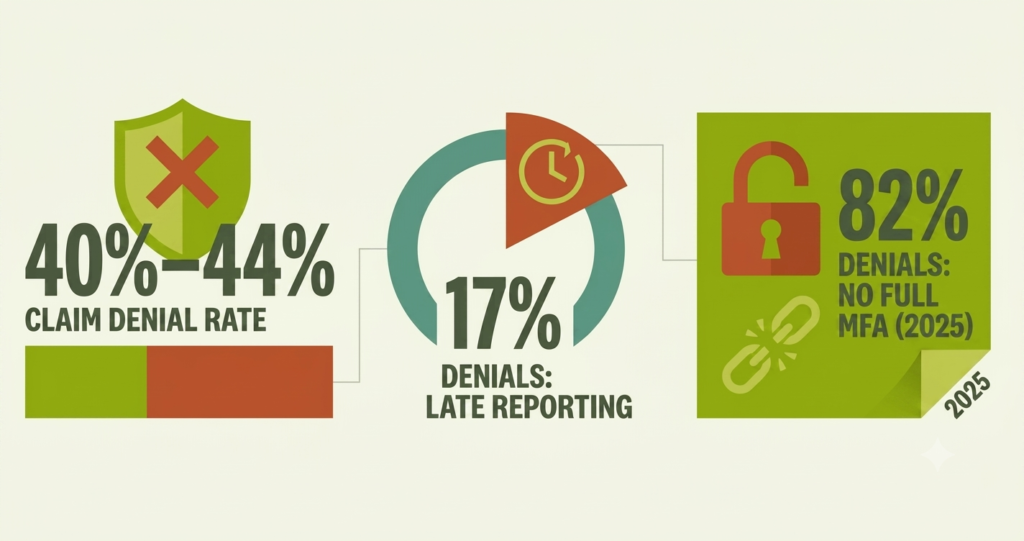
Various industry estimates put cyber insurance claim denial rates above 40%. The majority trace back to one of three problems: a security control that was promised on the application was not actually in place, the policy did not cover the type of incident that occurred, or the merchant made procedural mistakes after the breach. Insurance carriers have shifted from passive payers into active auditors – they investigate what security looked like before the incident, not just what happened during it.
Shopify merchants sit in a uniquely exposed position because the platform’s built-in security – Level 1 PCI DSS compliance, SOC 2 Type II certification, and platform-level disaster recovery – creates a false sense of complete coverage. A free cybersecurity health check helps small business owners understand exactly where platform protection ends and merchant responsibility begins, which is the critical line that determines whether a claim gets paid. Understanding the five most common gaps is the first step to closing them.
Shopify Secures the Platform. You’re Responsible for Everything Else.
What Shopify Actually Covers
Shopify maintains the infrastructure that runs every store on its network. That includes the servers, the global hosting environment, the native checkout’s PCI-compliant payment flow, and the platform’s own disaster recovery systems. If Shopify’s infrastructure is attacked or goes down, that is Shopify’s problem to fix.
Where Your Liability Begins
Everything that touches a specific store falls on the merchant. That means who has admin access and whether MFA is enforced on every account, which third-party apps and scripts are running in the storefront, where store data is backed up and whether those backups are isolated, and whether payment routing settings have proper verification controls. Insurers evaluate all of these when a claim is filed – and if any fall short of what was stated on the policy application, coverage can be denied entirely.
Gap 1: Partial MFA Can Void Your Entire Policy
One Exempt Account Is All It Takes
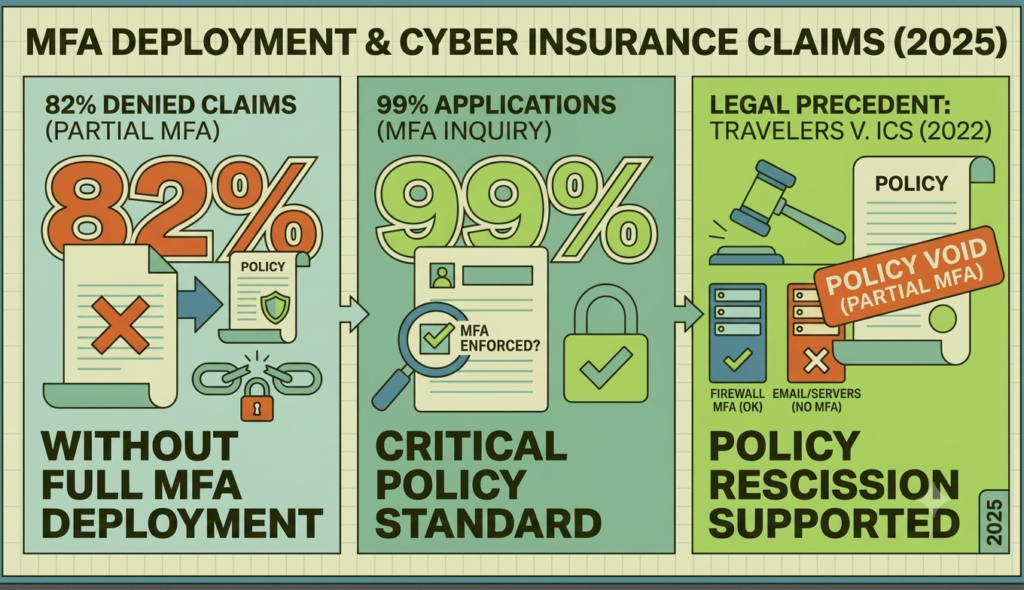
Multi-factor authentication is no longer a recommendation – it is a contract warranty. Virtually every cyber insurance application now asks specifically whether MFA is enforced across all administrative portals, email accounts, remote access points, and financial systems. If a merchant answers yes but a forensic audit after a breach reveals even a single exempted account, the insurer has grounds to rescind the entire policy for material misrepresentation – not just reduce the payout, but void the policy from inception.
The most common way this happens: a merchant grants temporary access to a developer, marketing agency, or legacy service account and exempts them from MFA just for now. That exemption becomes permanent through inaction. Industry commentary widely cites MFA gaps as the single most common factor behind denied cyber claims, though a precise, consistently-sourced percentage is hard to pin down across the secondary literature.
Notable Cases Where Partial MFA Led to Claim Denial
In Travelers Property Casualty Company of America v. International Control Services Inc. (2022), a ransomware attack led Travelers to audit the policyholder’s MFA deployment. MFA had only been applied to the firewall – email accounts and target servers were left on single-factor authentication, despite the application stating otherwise. Travelers and ICS jointly stipulated to a court order voiding the policy from inception, effectively ending ICS’s bid to have its insurer cover the loss. The business absorbed all forensic, recovery, and litigation costs out of pocket.
In February 2024, the City of Hamilton suffered a ransomware attack that disrupted municipal services for weeks. The city’s insurer denied the claim, identifying the absence of fully implemented MFA in specific departments as the root failure that allowed the attacker to gain access. The attackers demanded approximately $18.5 million in ransom, which the city refused to pay. The city’s insurer denied its $5 million cyber insurance claim over the MFA gap, leaving taxpayers to cover the bulk of the roughly $18.3 million total recovery cost.
Gap 2: Third-Party Scripts – A Common Way Customer Data Gets Stolen That Insurers Scrutinize
A typical Shopify storefront loads dozens of third-party scripts directly into the customer’s browser – marketing pixels, live chat tools, review widgets, and conversion trackers. Each one is a potential entry point. Magecart-style attacks work by compromising an upstream script provider and injecting card-skimming code that runs silently in customers’ browsers during checkout, capturing payment details in real time before they ever reach Shopify’s secure servers.
Recent analysis of leading e-commerce sites found that 64% of third-party applications access sensitive customer data fields without any clear business justification – up from 51% in 2024. Marketing and digital teams are responsible for 43% of this third-party script exposure, a figure confirmed by research published in early 2026, compared to 19% managed by IT departments based on the same analysis.
Navigating PCI DSS v4.0 Requirements for Third-Party Scripts
PCI DSS v4.0 Requirements 6.4.3 and 11.6.1, which became mandatory on March 31, 2025, directly address this risk — though as our breakdown of 9 ecommerce security risks PCI DSS certification misses shows, script monitoring only ever covers payment pages, leaving the rest of a Shopify storefront unwatched. Requirement 6.4.3 mandates that merchants maintain an authorized inventory of every script running on payment pages, with documented justification for each.
Requirement 11.6.1 requires a real-time detection and alerting mechanism to catch unauthorized script changes or additions. If a merchant suffers an e-skimming breach and these controls were not in place, standard policy exclusions for failure to maintain compliance standards can block the claim entirely – even if the attack originated from a compromised third-party vendor’s server.
The Leeds United cyberattack illustrates how quickly this plays out. Attackers compromised a third-party script embedded in the club’s online store – likely a chat widget, analytics tool, or ad module – executing malicious code in customer browsers for several days before detection. The breach exposed payment card details for a limited number of customers, illustrating how quickly a single unmonitored script can compromise a store.
Gap 3: Your Revenue Got Redirected. The Insurer Calls It Voluntary.
How the Voluntary Parting Exclusion Works
One of the most damaging attack types targeting Shopify merchants does not involve stealing data – it involves silently changing where daily revenue goes. An attacker gains access to the admin dashboard through phishing or credential stuffing, navigates to the financial settings, and reroutes the payout destination to an account they control. By the time the merchant notices, days or weeks of settlements have vanished.
When the merchant files under the Computer Fraud section of their policy, the claim is frequently denied under the voluntary parting exclusion. The insurer’s argument: the merchant’s own system authorized and executed the bank account change. Because the platform simply followed its instructions, the loss is classified as voluntary rather than a direct computer attack. Many policies also cap social engineering and fraudulently induced transfer coverage at sublimits that can start as low as $10,000, with ranges varying widely by policy and market segment.
The Midlothian Enterprises Case: A Denied Claim Illustrating Voluntary Parting
In Midlothian Enterprises, Inc. v. Owners Insurance Company (2020), a fraudulent wire transfer induced by impersonation was ruled excluded under the voluntary parting clause. The court’s reasoning: the employee voluntarily executed the transfer, even though they were deceived into doing so — the same voluntary parting exclusion that guts most commercial crime coverage for wire fraud, not just payout redirection. The loss was not covered because the authorization came from inside the organization. The same logic applies directly to Shopify payout redirection attacks.
Gap 4: A Platform Outage May Not Trigger Your Policy at All
The Waiting Period Problem
Standard cyber business interruption insurance only responds when a merchant’s own systems are taken offline by a direct attack. If Shopify, a payment processor, or a connected logistics provider goes down – even for hours during a peak sales period – a standard policy likely will not pay. Covering that exposure requires a specific Contingent Business Interruption (CBI) or Dependent Business Interruption endorsement — see our full e-commerce cyber insurance breakdown for 2026 for how the waiting period, vendor naming, and sub-limit traps actually work — and even then, broad systemic-event exclusions, which have drawn renewed attention since the July 2024 CrowdStrike outage caused over $5 billion in direct Fortune 500 losses, may still block recovery.
Even with the right endorsement in place, most policies include a waiting period deductible of 6 to 24 hours of continuous downtime before any loss begins to accrue. A payment gateway that goes offline for five hours on Black Friday – costing thousands in lost sales – produces zero insurance recovery if the policy has a 12-hour waiting period.
Gap 5: Your Backups Don’t Count If They’re Connected to the Breach
Shopify’s terms of service are explicit: data protection and backup retention are the store owner’s responsibility. Shopify maintains platform-level disaster recovery for its own infrastructure but does not restore individual merchant accounts after a breach, corrupted database, or malicious app deletion.
Insurers require backups that are isolated from the live environment – stored in a separate cloud vault that a compromised admin account cannot reach. If backups live in the same administrative ecosystem as the store, an attacker who gains access can delete both the live data and the backups simultaneously. The backup warranty is then void, and so is the ransomware recovery coverage tied to it.
A documented case study from CFC illustrates the financial stakes. A retailer hit by ransomware found its backups had not been stored externally and were encrypted along with the rest of its network. Even after the business used a decryption key to restore most files, one database was corrupted beyond repair, and manually rebuilding it required $20,858 in overtime and contract labor, while the two-week recovery period produced a $106,420 revenue shortfall. At a 20% gross profit rate, the business interruption loss came to $21,284 – for a combined recovery cost of $42,142. Had that merchant been unable to demonstrate a reasonable backup methodology to their insurer, the entire claim could have been denied under standard negligence exclusions.
Before you renew your policy, run your store through the same five checkpoints an insurer’s forensic team will check after a breach. Answer honestly — this takes under a minute, and it will tell you exactly where your coverage is most likely to fall apart when you need it most.
Your score isn’t a grade — it’s a preview of what a forensic auditor will find if you’re ever breached. Every unchecked box above maps directly to one of the five gaps in this article, and each one is fixable before your next renewal without hiring an IT team.
What to Fix Before Your Next Renewal
MFA and Access Controls
Enable phishing-resistant MFA – such as FIDO2 security keys – on every account without exception: the primary owner account, all staff and collaborator profiles, connected business email, payment processor portals, and any synced platforms. Apply role-based access controls so no staff member can modify bank routing details or payment settings unless that is specifically their role. Audit for exemptions quarterly and document the results.
Script Monitoring and Financial Verification
Maintain a documented inventory of every script running on payment pages, covering who owns it, why it is there, and what data it can access. Set up real-time alerts for any unauthorized script changes. For financial settings, require out-of-band verification – a phone call or in-person confirmation through a separate channel – before any payout routing change is authorized. Dual-approval for bank account modifications adds another layer that insurers view favorably.
Isolated Backups and Incident Response
Use an automated SaaS backup tool – such as Rewind or BackupLABS – to capture daily incremental backups of products, customer lists, order records, and theme files. Store those backups in an isolated, write-protected (WORM) cloud vault that is completely separate from the active Shopify admin environment. Run a documented restore test at least quarterly and keep the results on file – that documentation is what an insurer will ask for when a claim is filed.
Your Policy Won’t Pay If Your Controls Don’t Match What You Signed
Cyber insurance is a contract that pays out when specific conditions are met – not a safety net that catches every loss. Carriers audit post-breach. They check whether the security controls described on the application were actually in place. Partial MFA, unmonitored scripts, connected backups, and unsecured payout settings are not minor oversights – they are the exact grounds on which claims get denied, policies get rescinded, and businesses absorb six-figure losses on their own.
None of these gaps require an IT team to fix. They require clear, prioritized steps taken before the next renewal and documented evidence that those steps were completed. Closing these five gaps is the most direct way to ensure a paid policy actually pays when it matters most.