


Key Takeaways
- Most medical practices believe their cyber insurance policy covers them – but specific gaps in MFA compliance, vendor outages, and patient harm claims can leave them completely unprotected when a breach actually happens.
- Insurers in 2026 no longer take your word for it: they use real-time scanning tools to verify your security controls before and during the policy period.
- The Change Healthcare attack exposed a devastating blind spot – many practices had no coverage for third-party vendor outages, losing significant revenue from unpaid claims.
- Pixel tracking tools and AI clinical scribes are generating lawsuits that standard cyber policies routinely deny, creating uninsured legal exposure most practices don’t see coming.
- TechEd Shield helps medical practices and small businesses understand exactly what they need to have in place – before a claim gets denied.
Your Policy Could Be Void Before a Breach Happens
Cyber insurance gaps medical practices don’t see coming are costing them everything – because most owners assume their policy works like malpractice coverage: pay the premium, something goes wrong, the insurer pays. The cyber insurance market in 2026 has fundamentally changed. Carriers facing catastrophic losses from ransomware, supply chain attacks, and privacy class-action lawsuits have tightened their policies to an extraordinary degree. Law firms face a nearly identical disconnect between passing compliance and being actually covered — see 9 cyber risks law firms miss even when fully compliant. What looks like coverage on paper can be dismantled in a claims investigation within days.
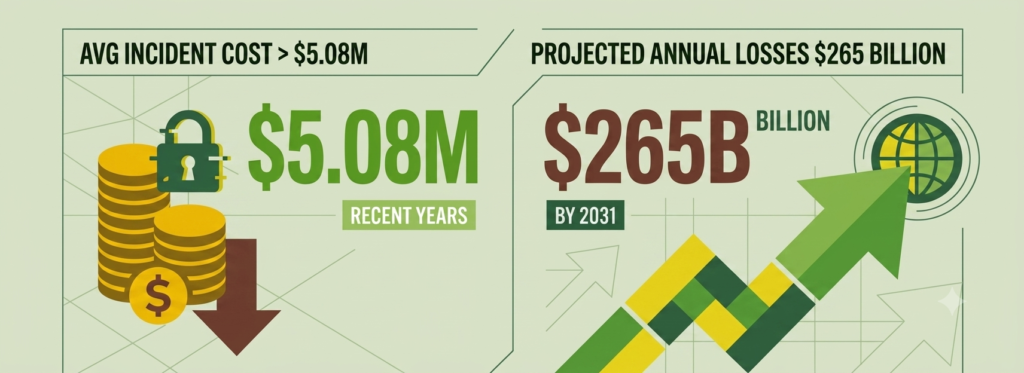
Healthcare is a prime target. In just the first half of 2026, the industry absorbed 410 ransomware attacks – an average of 2.3 per day, up 14% from the prior period. Texas clinics face compounding exposure from state law on top of this — see our cyber security firms for Texas medical practices & clinics guide. The average cost of a single ransomware incident now exceeds $5.08 million — and globally, across all industries, Cybersecurity Ventures projects ransomware damage costs will exceed $265 billion annually by 2031, driven in part by an expanding attack surface of connected medical devices and healthcare IoT systems. Yet many of the practices hit hardest discover their policy won’t pay – not because the attack didn’t happen, but because of gaps they never knew existed. Resources like TechEd Shield exist to help non-technical business owners understand these gaps before they become financial catastrophes.
The five gaps below are the most common – and the most expensive – that medical practices miss heading into 2026. (If you’re still pricing a policy, see what small clinics actually pay for coverage that holds up before you shop further.)
MFA Bypasses That Erase Your Coverage
Multi-factor authentication (MFA) sits at the center of one of the most common cyber insurance gaps medical practices face today. Multi-factor authentication is now a hard requirement on nearly every cyber insurance application – the problem isn’t that practices don’t know this, it’s that the MFA they have in place often doesn’t match what they checked “yes” to on their application.
Clinical Workarounds vs. Policy Requirements
In real clinical environments, MFA creates friction. Physicians moving between exam rooms, nurses sharing workstation terminals, and technicians on dictation devices often push back against multi-step logins as a barrier to patient care. IT teams respond by creating exceptions – disabling MFA on shared terminals, legacy diagnostic hardware, or specific user groups. These workarounds feel like reasonable operational decisions. To an insurer, they’re a material misrepresentation.
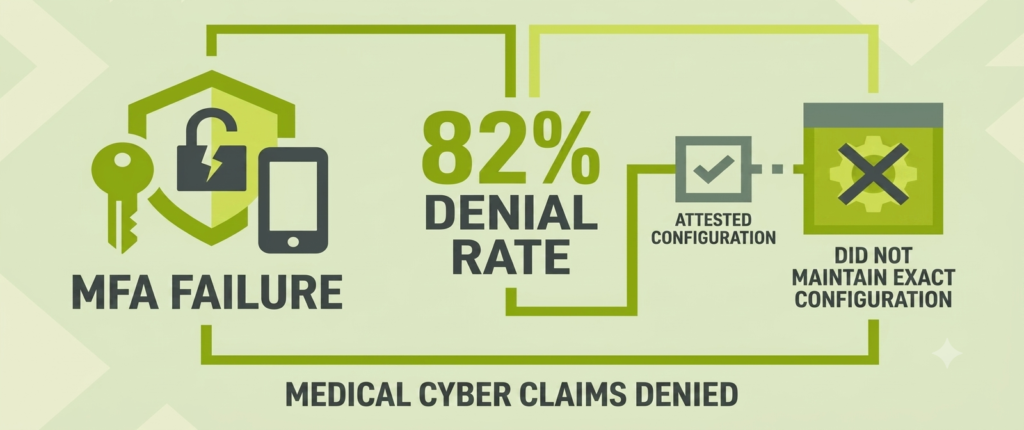
This single issue drives one of the most common cyber insurance gaps medical practices run into: approximately 82% of denied cyber claims involve organizations that failed to maintain the exact MFA configurations they attested to at renewal. Insurers aren’t guessing – in 2026, underwriters use “outside-in” scanning tools that actively monitor a practice’s external attack surface during the policy period, identifying exposed RDP ports, missing email authentication (SPF, DKIM, DMARC), and unpatched legacy systems in real time.
How Insurers Prove You Were Never Covered
The legal mechanism here is called policy rescission ab initio – the insurer voids the policy from its start date, as if it never existed. Online sellers run into a related trap through sub-limits rather than rescission — see cyber insurance for online sellers: is $1,500 a year worth it? In one documented federal case involving a ransomware attack, forensic investigation revealed MFA was only active on an external firewall, not on internal servers – despite the policyholder’s CEO attesting otherwise. The result: all forensic, notification, and ransom costs paid out of pocket.
Insurers don’t need to prove the MFA gap caused the breach. Under a warranty or condition precedent clause, non-compliance with attested security controls – even a single bypassed terminal – can be sufficient grounds to forfeit the claim entirely. The fix requires both a technical audit of actual MFA deployment and a review of policy language to convert hard warranties into representations, which carry a higher evidentiary burden for the insurer to deny. For the full five-tool stack HIPAA itself expects a clinic to have in place, see our HIPAA cybersecurity for small clinics: no-IT-staff buyer’s guide.
The Vendor Outage Your Policy Won’t Pay For
Vendor outages expose another one of the cyber insurance gaps medical practices routinely overlook. Medical practices run on third-party systems – cloud EHRs, billing clearinghouses, e-prescribing tools. When those systems go down, revenue stops immediately. Most practices assume their cyber policy covers that loss. Most are wrong.
“Security Failure” vs. “System Failure”: The Hidden Trigger
This distinction is behind one of the costliest cyber insurance gaps medical practices overlook: standard Dependent Business Interruption (DBI) coverage only activates on a “Security Failure” – a malicious cyberattack at the vendor’s site. A “System Failure” – a software defect, bad update, misconfiguration, or cloud outage – triggers the same operational and financial damage for the practice, but the policy won’t respond.
| Trigger Type | Definition | Real-World Example | Standard DBI Response |
|---|---|---|---|
| Security Failure | A malicious cyberattack at the vendor’s site | Change Healthcare ransomware attack (Feb 2024) | Covered |
| System Failure | A software defect, bad update, misconfiguration, or cloud outage — no attack involved | CrowdStrike update incident (July 2024), which crashed 8.5 million Windows devices | Denied, unless a System Failure endorsement was negotiated |
This is the exact gap exposed by the July 2024 CrowdStrike update incident, which crashed 8.5 million Windows devices globally through a flawed configuration file. Practices whose cloud infrastructure went down found their DBI claims denied because no attack occurred.
Change Healthcare: Widespread Industry Fallout
The February 2024 ransomware attack on Change Healthcare – a UnitedHealth Group subsidiary processing claims for one in three U.S. patient records – demonstrated what happens when a single clearinghouse becomes a systemic single point of failure. UnitedHealth Group reported cyberattack-related impacts of approximately $2.457 billion by September 2024, with over $2 billion directed to aid affected providers. A survey of affected practices found that 36% had claims payments suspended, 32% couldn’t submit claims at all, and 80% lost revenue from unpaid claims – with 55% resorting to personal funds to cover operating expenses.
Practices that lacked a System Failure DBI endorsement and an expanded “Service Provider” definition in their policy had no path to recovery through insurance. Negotiating these endorsements at renewal – not after a loss – is the only window to close this gap.
When Cyber and Malpractice Insurance Both Say No
Overlapping Exclusions That Leave Patient Harm Claims Uncovered
Pixel tracking and AI scribes have created new cyber insurance gaps medical practices haven’t caught up to. Many practices have embedded Meta Pixels, Google Tag Manager, or similar tracking codes into their patient-facing websites and portals for marketing analytics. Healthcare organizations have increasingly flagged concern that cyberattacks could result in patient fatalities, and that loss of access to patient records creates immediate malpractice liability.
When that lawsuit arrives, here’s what happens: three separate policies deny the same claim, each citing a different exclusion. The practice is trapped in a coordinated denial from every carrier simultaneously.
| Policy | Exclusion Invoked | Result |
|---|---|---|
| Cyber Liability | Absolute Bodily Injury exclusion | Denied |
| Medical Professional Liability (MPL) | Cyber and Data-Related Liability exclusion (bars bodily injury from network/database failures) | Denied |
| Commercial General Liability (CGL) | Electronic data and cyber exclusions | Denied |
The solution requires two negotiated endorsements: a “Consequential Bodily Injury” write-back into the cyber policy, forcing it to respond to physical injury claims caused by a security failure or device compromise, and a “Cyber Carve-Back” in the MPL policy, preserving malpractice coverage when clinical negligence occurs during an IT downtime event. Practices heavily reliant on telemedicine or remote monitoring should also consider a hybrid “eHealth” or “Tech Bodily Injury” policy that consolidates professional indemnity, tech E&O, and malpractice into one form.
Pixels and AI Scribes Are Creating Uninsured Lawsuits
Why “Intentional” Tools Trigger Policy Denials
Many practices have embedded Meta Pixels, Google Tag Manager, or similar tracking codes into their patient-facing websites and portals for marketing analytics. Others have deployed AI clinical scribes to record and transcribe patient consultations. Both are intentional, operational tools – and that’s exactly the problem.
Here’s another one of the cyber insurance gaps medical practices don’t anticipate: standard cyber policies require a triggering event involving an unauthorized breach or accidental data transmission. When a class-action lawsuit alleges that a tracking pixel or AI scribe intercepted and transmitted sensitive patient data to third-party tech companies without consent, insurers deny coverage under “Wrongful Data Collection,” “Eavesdropping,” and “Intentional Acts” exclusions. Because the tool was installed deliberately and functioned exactly as designed, there’s no “security incident” – and no coverage.
CIPA: $5,000 Per Violation, Coverage Frequently Disputed
Plaintiffs’ attorneys are using the California Invasion of Privacy Act (CIPA) – a 1967 wiretapping statute – to file these claims, arguing that tracking pixels function as digital “trap and trace” devices and that AI scribes constitute unlawful electronic eavesdropping. CIPA carries statutory damages of $5,000 per violation. The Video Privacy Protection Act adds statutory damages per violation as well; the Electronic Communications Privacy Act provides for $10,000 or $100 per day of violation, whichever is greater. These numbers multiply fast in a class-action context.
Advocate Aurora Health settled a pixel tracking class action for $12.25 million. Kaiser Permanente issued breach notifications to approximately 13.4 million patients after discovering tracking codes on its web properties had transmitted patient data to third parties. CIPA litigation surged significantly from 2023 to 2024, and plaintiffs are now extending the theory to generative AI tools and chatbots that repurpose user inputs. Any practice using these tools needs explicit privacy liability endorsements that cover wrongful data collection – not just breach response.
What Underwriters Actually Demand in 2026
The Audit-Ready Evidence Package
Underwriting demands are closing some cyber insurance gaps medical practices used to slip through, since cyber underwriting in 2026 functions as a technical audit, not a questionnaire. “Yes/No” attestations are no longer sufficient to secure unrestricted coverage limits. Underwriters now require verifiable proof of enforced controls – and practices that can’t produce it face higher premiums, sublimit restrictions, or outright declinations.
Closing the remaining cyber insurance gaps medical practices face starts with proof, not promises. The baseline evidence package that underwriters expect includes:
- Phishing-resistant MFA (FIDO2 keys, biometric authenticators, or RFID tap-and-go) enforced across Microsoft 365 or Google Workspace, VPN, RDP gateways, and all applications containing protected health information (PHI) – with no active exceptions for clinical workflows. Accounting firms face this same underwriting scrutiny under GLBA and the FTC Safeguards Rule — see how much cyber insurance costs for accounting firms.
- Behavioral EDR deployed on 100% of endpoints, including clinical servers and virtual machines. For practices without a dedicated security operations team, a Managed Detection and Response (MDR) provider delivering 24/7 active monitoring is required.
- 3-2-1-1-0 backup framework: three copies, two media types, one offsite, one immutable or air-gapped, zero restoration errors – with documented restore test results from the prior six months showing specific Recovery Time and Recovery Point Objectives.
- Centralized SIEM or MDR dashboard logs showing 12 months of active, timestamped event ingestion.
- Network architecture diagrams showing VLAN isolation of clinical networks and Internet of Medical Things (IoMT) devices from general business operations.
- Vendor SOC 2 Type II reports and active Business Associate Agreements (BAAs) for all Tier 1 SaaS, billing, and IT providers.
- Annual tabletop exercise documentation detailing the breach scenario simulated, incident response roles, response times, and improvements implemented.
Patch management timelines also matter: insurers increasingly expect critical vulnerabilities (CVSS score 7.0 or higher) to be remediated promptly after vendor release, with many policies specifying windows in the range of 14 to 30 days. Internet-facing assets and VPN gateways must be scanned continuously. These aren’t optional best practices – they’re the floor for maintaining coverage. They also overlap heavily with the 9 cyber risks a clean HIPAA audit still misses, since underwriting evidence and HIPAA safeguards are frequently confused for the same thing.
Your policy might already have a hole in it, and you won’t find out until a denial letter tells you. Check the gaps your practice has actually closed.
The 5-Gap Coverage Check
Check every gap your practice has already closed.
Every unchecked box above is a gap no premium payment was ever going to close on its own. That’s the difference between having a policy and having coverage.
Your Policy Has Gaps – Find Them Before a Claim Does
Understanding the cyber insurance gaps medical practices face matters more than ever, because cyber insurance is no longer a safety net that catches whatever falls through. In 2026, it’s a precisely written legal contract with specific conditions, triggers, and exclusions that frequently don’t align with how medical practices actually operate. The five gaps above – MFA compliance drift, vendor outage triggers, the cyber-malpractice coverage void, pixel and AI scribe liability, and underwriting evidence requirements – are where most claims fail. None of them require a sophisticated attack to activate. Most are discovered only after a denial letter arrives.
Closing the cyber insurance gaps medical practices face starts with one step: a structured review of existing policy language against actual operational controls – not what’s documented in an IT policy, but what’s running on the network today. Every gap found before a breach is a gap that can be closed – which is exactly why identifying the cyber insurance gaps medical practices face matters so much. Every gap found after is a bill with no one else to pay it.
For practical guidance on building the kind of documented security system that satisfies underwriters and actually protects your practice, TechEd Shield provides straightforward, step-by-step cybersecurity education and protection resources designed specifically for business owners who don’t have an IT team behind them. Take the free Cybersecurity Health Check to see which of these coverage gaps apply to your practice.